

spontaneous process on the potential energy surface, as can be seen from the reaction
coordinate shown in Fig. 21, which depicts the re-association of the MeB(C 6 F 5 ) 3
À
anion to the metallocenium cation. The exothermicity of the ion pairing is so high
(~20 kcal/mol) that the process is irreversible [146].
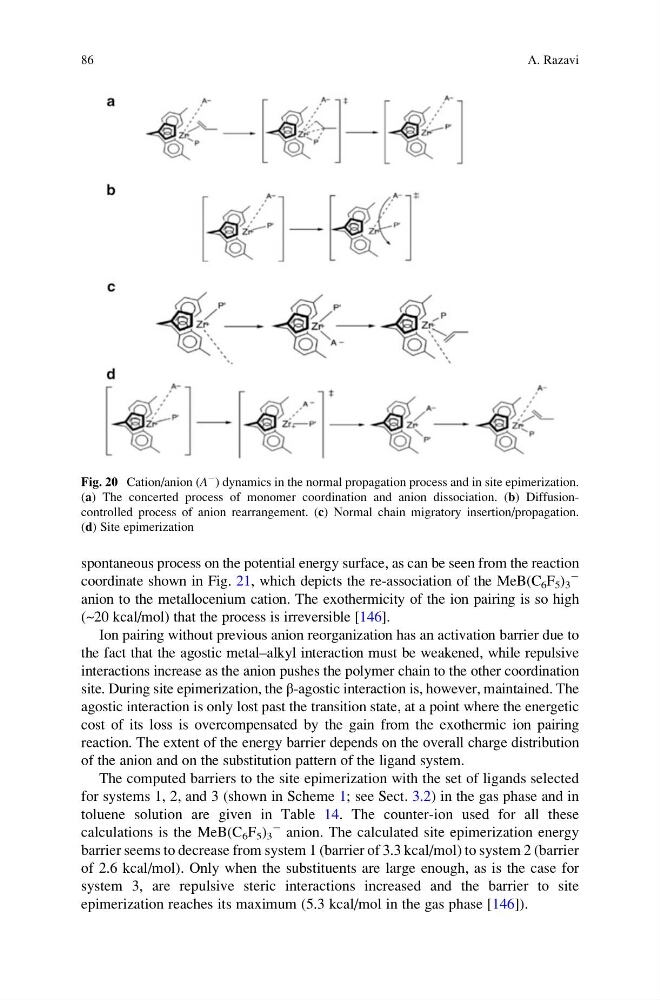
Ion pairing without previous anion reorganization has an activation barrier due to
the fact that the agostic metal–alkyl interaction must be weakened, while repulsive
interactions increase as the anion pushes the polymer chain to the other coordination
site. During site epimerization, the β-agostic interaction is, however, maintained. The
agostic interaction is only lost past the transition state, at a point where the energetic
cost of its loss is overcompensated by the gain from the exothermic ion pairing
reaction. The extent of the energy barrier depends on the overall charge distribution
of the anion and on the substitution pattern of the ligand system.
The computed barriers to the site epimerization with the set of ligands selected
for systems 1, 2, and 3 (shown in Scheme 1; see Sect. 3.2) in the gas phase and in
toluene solution are given in Table 14. The counter-ion used for all these
calculations is the MeB(C 6 F 5 ) 3
À anion. The calculated site epimerization energy
barrier seems to decrease from system 1 (barrier of 3.3 kcal/mol) to system 2 (barrier
of 2.6 kcal/mol). Only when the substituents are large enough, as is the case for
system 3, are repulsive steric interactions increased and the barrier to site
epimerization reaches its maximum (5.3 kcal/mol in the gas phase [146]).
Fig. 20 Cation/anion (A
À
) dynamics in the normal propagation process and in site epimerization.
(a) The concerted process of monomer coordination and anion dissociation. (b) Diffusioncontrolled process of anion rearrangement. (c) Normal chain migratory insertion/propagation.
(d) Site epimerization
86
A. Razavi
coordinate shown in Fig. 21, which depicts the re-association of the MeB(C 6 F 5 ) 3
À
anion to the metallocenium cation. The exothermicity of the ion pairing is so high
(~20 kcal/mol) that the process is irreversible [146].
Ion pairing without previous anion reorganization has an activation barrier due to
the fact that the agostic metal–alkyl interaction must be weakened, while repulsive
interactions increase as the anion pushes the polymer chain to the other coordination
site. During site epimerization, the β-agostic interaction is, however, maintained. The
agostic interaction is only lost past the transition state, at a point where the energetic
cost of its loss is overcompensated by the gain from the exothermic ion pairing
reaction. The extent of the energy barrier depends on the overall charge distribution
of the anion and on the substitution pattern of the ligand system.
The computed barriers to the site epimerization with the set of ligands selected
for systems 1, 2, and 3 (shown in Scheme 1; see Sect. 3.2) in the gas phase and in
toluene solution are given in Table 14. The counter-ion used for all these
calculations is the MeB(C 6 F 5 ) 3
À anion. The calculated site epimerization energy
barrier seems to decrease from system 1 (barrier of 3.3 kcal/mol) to system 2 (barrier
of 2.6 kcal/mol). Only when the substituents are large enough, as is the case for
system 3, are repulsive steric interactions increased and the barrier to site
epimerization reaches its maximum (5.3 kcal/mol in the gas phase [146]).
Fig. 20 Cation/anion (A
À
) dynamics in the normal propagation process and in site epimerization.
(a) The concerted process of monomer coordination and anion dissociation. (b) Diffusioncontrolled process of anion rearrangement. (c) Normal chain migratory insertion/propagation.
(d) Site epimerization
86
A. Razavi