

metallocenes catalyses particularly those comprising at least a fluorenyl and an
indenyl, and possibly those with substituted cyclopentadienyl ring system(s).
Whether or not any change in hapticity influences the polymerization behavior of
the catalysts depends on the individual case and particularities of the catalysts/
polymerization processes under discussion.
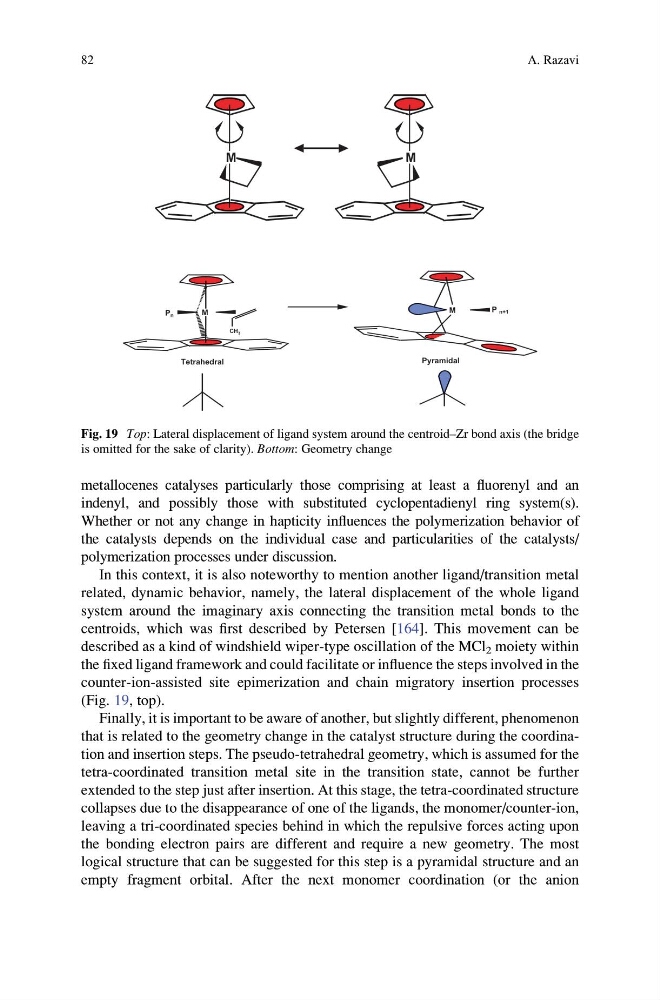
In this context, it is also noteworthy to mention another ligand/transition metal
related, dynamic behavior, namely, the lateral displacement of the whole ligand
system around the imaginary axis connecting the transition metal bonds to the
centroids, which was first described by Petersen [164]. This movement can be
described as a kind of windshield wiper-type oscillation of the MCl 2 moiety within
the fixed ligand framework and could facilitate or influence the steps involved in the
counter-ion-assisted site epimerization and chain migratory insertion processes
(Fig. 19, top).
Finally, it is important to be aware of another, but slightly different, phenomenon
that is related to the geometry change in the catalyst structure during the coordination and insertion steps. The pseudo-tetrahedral geometry, which is assumed for the
tetra-coordinated transition metal site in the transition state, cannot be further
extended to the step just after insertion. At this stage, the tetra-coordinated structure
collapses due to the disappearance of one of the ligands, the monomer/counter-ion,
leaving a tri-coordinated species behind in which the repulsive forces acting upon
the bonding electron pairs are different and require a new geometry. The most
logical structure that can be suggested for this step is a pyramidal structure and an
empty fragment orbital. After the next monomer coordination (or the anion
M
M
M
P n+1
Tetrahedral
Pyramidal
M
Pn
CH3
Fig. 19 Top: Lateral displacement of ligand system around the centroid–Zr bond axis (the bridge
is omitted for the sake of clarity). Bottom: Geometry change
82
A. Razavi
indenyl, and possibly those with substituted cyclopentadienyl ring system(s).
Whether or not any change in hapticity influences the polymerization behavior of
the catalysts depends on the individual case and particularities of the catalysts/
polymerization processes under discussion.
In this context, it is also noteworthy to mention another ligand/transition metal
related, dynamic behavior, namely, the lateral displacement of the whole ligand
system around the imaginary axis connecting the transition metal bonds to the
centroids, which was first described by Petersen [164]. This movement can be
described as a kind of windshield wiper-type oscillation of the MCl 2 moiety within
the fixed ligand framework and could facilitate or influence the steps involved in the
counter-ion-assisted site epimerization and chain migratory insertion processes
(Fig. 19, top).
Finally, it is important to be aware of another, but slightly different, phenomenon
that is related to the geometry change in the catalyst structure during the coordination and insertion steps. The pseudo-tetrahedral geometry, which is assumed for the
tetra-coordinated transition metal site in the transition state, cannot be further
extended to the step just after insertion. At this stage, the tetra-coordinated structure
collapses due to the disappearance of one of the ligands, the monomer/counter-ion,
leaving a tri-coordinated species behind in which the repulsive forces acting upon
the bonding electron pairs are different and require a new geometry. The most
logical structure that can be suggested for this step is a pyramidal structure and an
empty fragment orbital. After the next monomer coordination (or the anion
M
M
M
P n+1
Tetrahedral
Pyramidal
M
Pn
CH3
Fig. 19 Top: Lateral displacement of ligand system around the centroid–Zr bond axis (the bridge
is omitted for the sake of clarity). Bottom: Geometry change
82
A. Razavi