

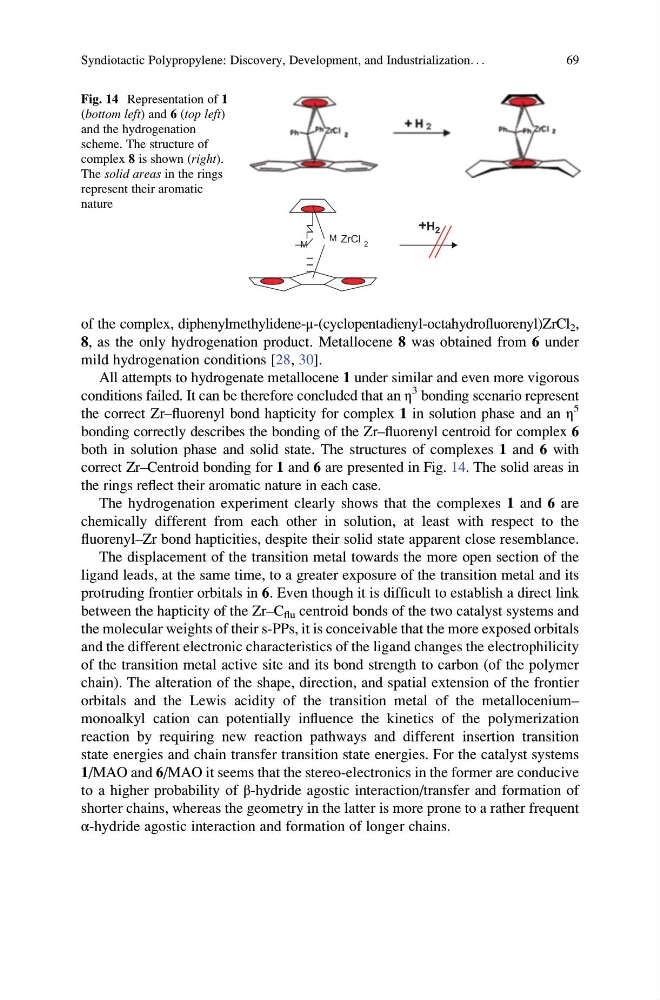
of the complex, diphenylmethylidene-μ-(cyclopentadienyl-octahydrofluorenyl)ZrCl 2 ,
8, as the only hydrogenation product. Metallocene 8 was obtained from 6 under
mild hydrogenation conditions [28, 30].
All attempts to hydrogenate metallocene 1 under similar and even more vigorous
conditions failed. It can be therefore concluded that an η
3 bonding scenario represent
the correct Zr–fluorenyl bond hapticity for complex 1 in solution phase and an η
5
bonding correctly describes the bonding of the Zr–fluorenyl centroid for complex 6
both in solution phase and solid state. The structures of complexes 1 and 6 with
correct Zr–Centroid bonding for 1 and 6 are presented in Fig. 14. The solid areas in
the rings reflect their aromatic nature in each case.
The hydrogenation experiment clearly shows that the complexes 1 and 6 are
chemically different from each other in solution, at least with respect to the
fluorenyl–Zr bond hapticities, despite their solid state apparent close resemblance.
The displacement of the transition metal towards the more open section of the
ligand leads, at the same time, to a greater exposure of the transition metal and its
protruding frontier orbitals in 6. Even though it is difficult to establish a direct link
between the hapticity of the Zr–C flu centroid bonds of the two catalyst systems and
the molecular weights of their s-PPs, it is conceivable that the more exposed orbitals
and the different electronic characteristics of the ligand changes the electrophilicity
of the transition metal active site and its bond strength to carbon (of the polymer
chain). The alteration of the shape, direction, and spatial extension of the frontier
orbitals and the Lewis acidity of the transition metal of the metallocenium–
monoalkyl cation can potentially influence the kinetics of the polymerization
reaction by requiring new reaction pathways and different insertion transition
state energies and chain transfer transition state energies. For the catalyst systems
1/MAO and 6/MAO it seems that the stereo-electronics in the former are conducive
to a higher probability of β-hydride agostic interaction/transfer and formation of
shorter chains, whereas the geometry in the latter is more prone to a rather frequent
α-hydride agostic interaction and formation of longer chains.
ZrCl 2
M
M
+ H 2
Fig. 14 Representation of 1
(bottom left) and 6 (top left)
and the hydrogenation
scheme. The structure of
complex 8 is shown (right).
The solid areas in the rings
represent their aromatic
nature
Syndiotactic Polypropylene: Discovery, Development, and Industrialization. . .
69
8, as the only hydrogenation product. Metallocene 8 was obtained from 6 under
mild hydrogenation conditions [28, 30].
All attempts to hydrogenate metallocene 1 under similar and even more vigorous
conditions failed. It can be therefore concluded that an η
3 bonding scenario represent
the correct Zr–fluorenyl bond hapticity for complex 1 in solution phase and an η
5
bonding correctly describes the bonding of the Zr–fluorenyl centroid for complex 6
both in solution phase and solid state. The structures of complexes 1 and 6 with
correct Zr–Centroid bonding for 1 and 6 are presented in Fig. 14. The solid areas in
the rings reflect their aromatic nature in each case.
The hydrogenation experiment clearly shows that the complexes 1 and 6 are
chemically different from each other in solution, at least with respect to the
fluorenyl–Zr bond hapticities, despite their solid state apparent close resemblance.
The displacement of the transition metal towards the more open section of the
ligand leads, at the same time, to a greater exposure of the transition metal and its
protruding frontier orbitals in 6. Even though it is difficult to establish a direct link
between the hapticity of the Zr–C flu centroid bonds of the two catalyst systems and
the molecular weights of their s-PPs, it is conceivable that the more exposed orbitals
and the different electronic characteristics of the ligand changes the electrophilicity
of the transition metal active site and its bond strength to carbon (of the polymer
chain). The alteration of the shape, direction, and spatial extension of the frontier
orbitals and the Lewis acidity of the transition metal of the metallocenium–
monoalkyl cation can potentially influence the kinetics of the polymerization
reaction by requiring new reaction pathways and different insertion transition
state energies and chain transfer transition state energies. For the catalyst systems
1/MAO and 6/MAO it seems that the stereo-electronics in the former are conducive
to a higher probability of β-hydride agostic interaction/transfer and formation of
shorter chains, whereas the geometry in the latter is more prone to a rather frequent
α-hydride agostic interaction and formation of longer chains.
ZrCl 2
M
M
+ H 2
Fig. 14 Representation of 1
(bottom left) and 6 (top left)
and the hydrogenation
scheme. The structure of
complex 8 is shown (right).
The solid areas in the rings
represent their aromatic
nature
Syndiotactic Polypropylene: Discovery, Development, and Industrialization. . .
69