

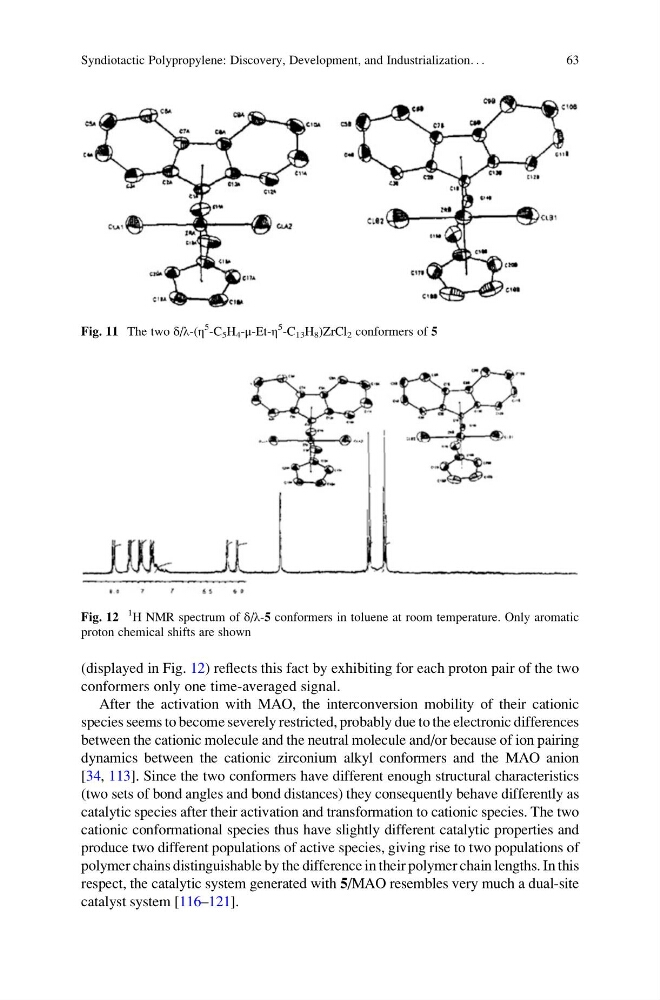
(displayed in Fig. 12) reflects this fact by exhibiting for each proton pair of the two
conformers only one time-averaged signal.
After the activation with MAO, the interconversion mobility of their cationic
species seems to become severely restricted, probably due to the electronic differences
between the cationic molecule and the neutral molecule and/or because of ion pairing
dynamics between the cationic zirconium alkyl conformers and the MAO anion
[34, 113]. Since the two conformers have different enough structural characteristics
(two sets of bond angles and bond distances) they consequently behave differently as
catalytic species after their activation and transformation to cationic species. The two
cationic conformational species thus have slightly different catalytic properties and
produce two different populations of active species, giving rise to two populations of
polymer chains distinguishable by the difference in their polymer chain lengths. In this
respect, the catalytic system generated with 5/MAO resembles very much a dual-site
catalyst system [116–121].
Fig. 11 The two δ/λ-(η
5
-C 5 H 4 -μ-Et-η
5
-C 13 H 8 )ZrCl 2 conformers of 5
Fig. 12
1
H NMR spectrum of δ/λ-5 conformers in toluene at room temperature. Only aromatic
proton chemical shifts are shown
Syndiotactic Polypropylene: Discovery, Development, and Industrialization. . .
63
conformers only one time-averaged signal.
After the activation with MAO, the interconversion mobility of their cationic
species seems to become severely restricted, probably due to the electronic differences
between the cationic molecule and the neutral molecule and/or because of ion pairing
dynamics between the cationic zirconium alkyl conformers and the MAO anion
[34, 113]. Since the two conformers have different enough structural characteristics
(two sets of bond angles and bond distances) they consequently behave differently as
catalytic species after their activation and transformation to cationic species. The two
cationic conformational species thus have slightly different catalytic properties and
produce two different populations of active species, giving rise to two populations of
polymer chains distinguishable by the difference in their polymer chain lengths. In this
respect, the catalytic system generated with 5/MAO resembles very much a dual-site
catalyst system [116–121].
Fig. 11 The two δ/λ-(η
5
-C 5 H 4 -μ-Et-η
5
-C 13 H 8 )ZrCl 2 conformers of 5
Fig. 12
1
H NMR spectrum of δ/λ-5 conformers in toluene at room temperature. Only aromatic
proton chemical shifts are shown
Syndiotactic Polypropylene: Discovery, Development, and Industrialization. . .
63