

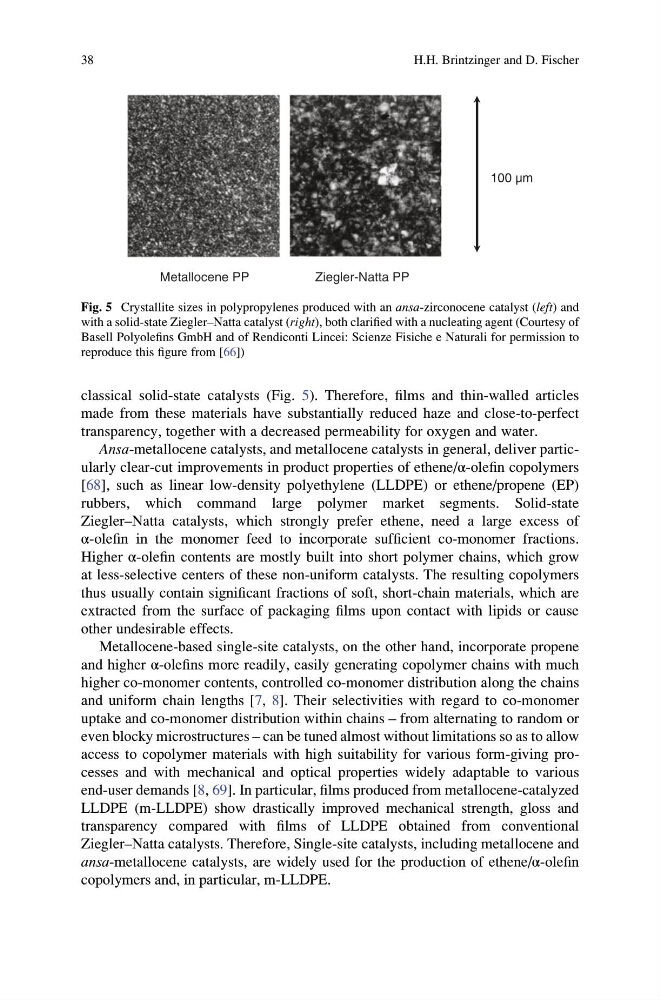
classical solid-state catalysts (Fig. 5). Therefore, films and thin-walled articles
made from these materials have substantially reduced haze and close-to-perfect
transparency, together with a decreased permeability for oxygen and water.
Ansa-metallocene catalysts, and metallocene catalysts in general, deliver particularly clear-cut improvements in product properties of ethene/α-olefin copolymers
[68], such as linear low-density polyethylene (LLDPE) or ethene/propene (EP)
rubbers, which command large polymer market segments. Solid-state
Ziegler–Natta catalysts, which strongly prefer ethene, need a large excess of
α-olefin in the monomer feed to incorporate sufficient co-monomer fractions.
Higher α-olefin contents are mostly built into short polymer chains, which grow
at less-selective centers of these non-uniform catalysts. The resulting copolymers
thus usually contain significant fractions of soft, short-chain materials, which are
extracted from the surface of packaging films upon contact with lipids or cause
other undesirable effects.
Metallocene-based single-site catalysts, on the other hand, incorporate propene
and higher α-olefins more readily, easily generating copolymer chains with much
higher co-monomer contents, controlled co-monomer distribution along the chains
and uniform chain lengths [7, 8]. Their selectivities with regard to co-monomer
uptake and co-monomer distribution within chains – from alternating to random or
even blocky microstructures – can be tuned almost without limitations so as to allow
access to copolymer materials with high suitability for various form-giving processes and with mechanical and optical properties widely adaptable to various
end-user demands [8, 69]. In particular, films produced from metallocene-catalyzed
LLDPE (m-LLDPE) show drastically improved mechanical strength, gloss and
transparency compared with films of LLDPE obtained from conventional
Ziegler–Natta catalysts. Therefore, Single-site catalysts, including metallocene and
ansa-metallocene catalysts, are widely used for the production of ethene/α-olefin
copolymers and, in particular, m-LLDPE.
100 µm
Metallocene PP
Ziegler-Natta PP
Fig. 5 Crystallite sizes in polypropylenes produced with an ansa-zirconocene catalyst (left) and
with a solid-state Ziegler–Natta catalyst (right), both clarified with a nucleating agent (Courtesy of
Basell Polyolefins GmbH and of Rendiconti Lincei: Scienze Fisiche e Naturali for permission to
reproduce this figure from [66])
38
H.H. Brintzinger and D. Fischer
made from these materials have substantially reduced haze and close-to-perfect
transparency, together with a decreased permeability for oxygen and water.
Ansa-metallocene catalysts, and metallocene catalysts in general, deliver particularly clear-cut improvements in product properties of ethene/α-olefin copolymers
[68], such as linear low-density polyethylene (LLDPE) or ethene/propene (EP)
rubbers, which command large polymer market segments. Solid-state
Ziegler–Natta catalysts, which strongly prefer ethene, need a large excess of
α-olefin in the monomer feed to incorporate sufficient co-monomer fractions.
Higher α-olefin contents are mostly built into short polymer chains, which grow
at less-selective centers of these non-uniform catalysts. The resulting copolymers
thus usually contain significant fractions of soft, short-chain materials, which are
extracted from the surface of packaging films upon contact with lipids or cause
other undesirable effects.
Metallocene-based single-site catalysts, on the other hand, incorporate propene
and higher α-olefins more readily, easily generating copolymer chains with much
higher co-monomer contents, controlled co-monomer distribution along the chains
and uniform chain lengths [7, 8]. Their selectivities with regard to co-monomer
uptake and co-monomer distribution within chains – from alternating to random or
even blocky microstructures – can be tuned almost without limitations so as to allow
access to copolymer materials with high suitability for various form-giving processes and with mechanical and optical properties widely adaptable to various
end-user demands [8, 69]. In particular, films produced from metallocene-catalyzed
LLDPE (m-LLDPE) show drastically improved mechanical strength, gloss and
transparency compared with films of LLDPE obtained from conventional
Ziegler–Natta catalysts. Therefore, Single-site catalysts, including metallocene and
ansa-metallocene catalysts, are widely used for the production of ethene/α-olefin
copolymers and, in particular, m-LLDPE.
100 µm
Metallocene PP
Ziegler-Natta PP
Fig. 5 Crystallite sizes in polypropylenes produced with an ansa-zirconocene catalyst (left) and
with a solid-state Ziegler–Natta catalyst (right), both clarified with a nucleating agent (Courtesy of
Basell Polyolefins GmbH and of Rendiconti Lincei: Scienze Fisiche e Naturali for permission to
reproduce this figure from [66])
38
H.H. Brintzinger and D. Fischer