

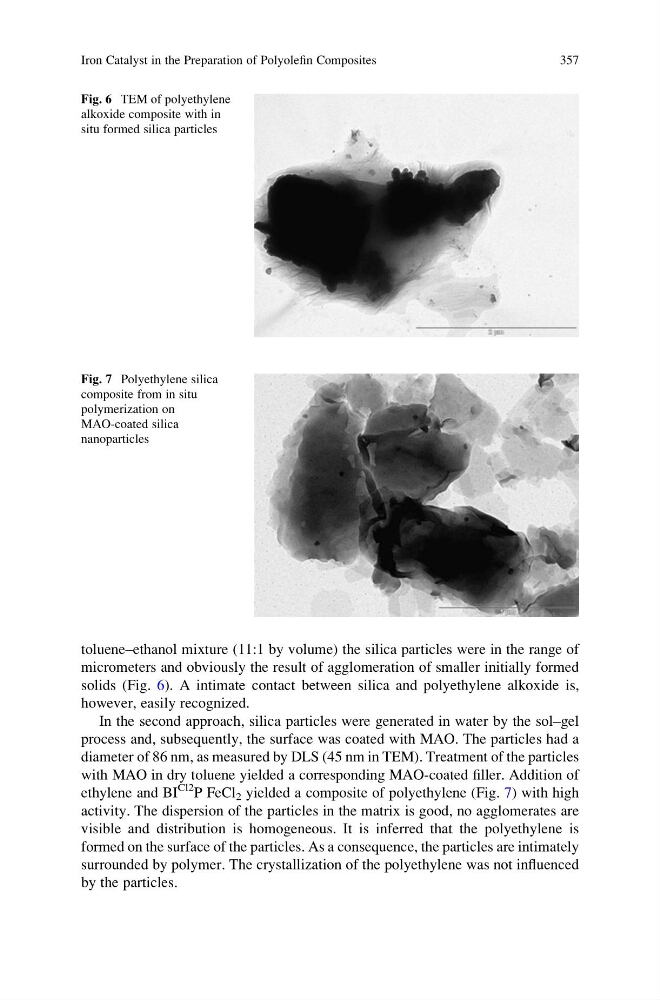
toluene–ethanol mixture (11:1 by volume) the silica particles were in the range of
micrometers and obviously the result of agglomeration of smaller initially formed
solids (Fig. 6). A intimate contact between silica and polyethylene alkoxide is,
however, easily recognized.
In the second approach, silica particles were generated in water by the sol–gel
process and, subsequently, the surface was coated with MAO. The particles had a
diameter of 86 nm, as measured by DLS (45 nm in TEM). Treatment of the particles
with MAO in dry toluene yielded a corresponding MAO-coated filler. Addition of
ethylene and BI
Cl2 P FeCl 2 yielded a composite of polyethylene (Fig. 7) with high
activity. The dispersion of the particles in the matrix is good, no agglomerates are
visible and distribution is homogeneous. It is inferred that the polyethylene is
formed on the surface of the particles. As a consequence, the particles are intimately
surrounded by polymer. The crystallization of the polyethylene was not influenced
by the particles.
Fig. 7 Polyethylene silica
composite from in situ
polymerization on
MAO-coated silica
nanoparticles
Fig. 6 TEM of polyethylene
alkoxide composite with in
situ formed silica particles
Iron Catalyst in the Preparation of Polyolefin Composites
357
micrometers and obviously the result of agglomeration of smaller initially formed
solids (Fig. 6). A intimate contact between silica and polyethylene alkoxide is,
however, easily recognized.
In the second approach, silica particles were generated in water by the sol–gel
process and, subsequently, the surface was coated with MAO. The particles had a
diameter of 86 nm, as measured by DLS (45 nm in TEM). Treatment of the particles
with MAO in dry toluene yielded a corresponding MAO-coated filler. Addition of
ethylene and BI
Cl2 P FeCl 2 yielded a composite of polyethylene (Fig. 7) with high
activity. The dispersion of the particles in the matrix is good, no agglomerates are
visible and distribution is homogeneous. It is inferred that the polyethylene is
formed on the surface of the particles. As a consequence, the particles are intimately
surrounded by polymer. The crystallization of the polyethylene was not influenced
by the particles.
Fig. 7 Polyethylene silica
composite from in situ
polymerization on
MAO-coated silica
nanoparticles
Fig. 6 TEM of polyethylene
alkoxide composite with in
situ formed silica particles
Iron Catalyst in the Preparation of Polyolefin Composites
357