

A further study reports on silica as a support for BI
iPr2
P iron catalysts in more
detail [68]. Consistently, no interactions could be found between the BIP FeCl 2 and
the silica support, which was conditioned at several temperatures. The polymerization of ethylene at the support was effectuated by the addition of MAO (Al/
Fe ¼ 500–1,500/1). The rates of polymerization showed the usual dependence on
reaction time, and the products were typically bimodal. In contrast to the Al 2 O 3
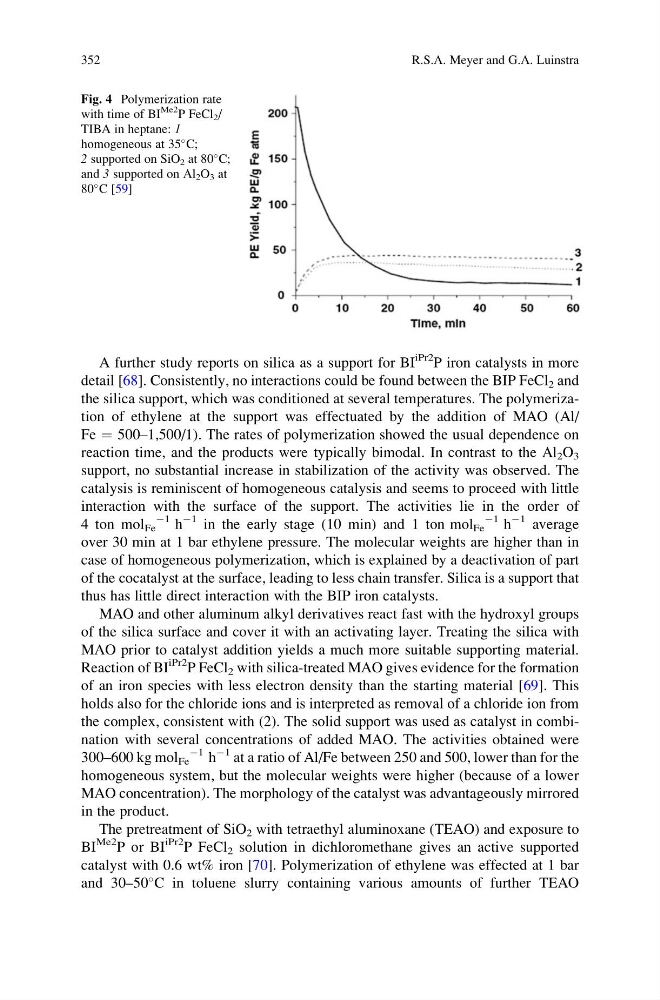
support, no substantial increase in stabilization of the activity was observed. The
catalysis is reminiscent of homogeneous catalysis and seems to proceed with little
interaction with the surface of the support. The activities lie in the order of
4 ton mol Fe
À1 h
À1 in the early stage (10 min) and 1 ton mol Fe
À1 h
À1 average
over 30 min at 1 bar ethylene pressure. The molecular weights are higher than in
case of homogeneous polymerization, which is explained by a deactivation of part
of the cocatalyst at the surface, leading to less chain transfer. Silica is a support that
thus has little direct interaction with the BIP iron catalysts.
MAO and other aluminum alkyl derivatives react fast with the hydroxyl groups
of the silica surface and cover it with an activating layer. Treating the silica with
MAO prior to catalyst addition yields a much more suitable supporting material.
Reaction of BI
iPr2 P FeCl 2 with silica-treated MAO gives evidence for the formation
of an iron species with less electron density than the starting material [69]. This
holds also for the chloride ions and is interpreted as removal of a chloride ion from
the complex, consistent with (2). The solid support was used as catalyst in combination with several concentrations of added MAO. The activities obtained were
300–600 kg mol Fe
À1 h
À1 at a ratio of Al/Fe between 250 and 500, lower than for the
homogeneous system, but the molecular weights were higher (because of a lower
MAO concentration). The morphology of the catalyst was advantageously mirrored
in the product.
The pretreatment of SiO 2 with tetraethyl aluminoxane (TEAO) and exposure to
BI
Me2 P or BI
iPr2 P FeCl 2 solution in dichloromethane gives an active supported
catalyst with 0.6 wt% iron [70]. Polymerization of ethylene was effected at 1 bar
and 30–50
C in toluene slurry containing various amounts of further TEAO
Fig. 4 Polymerization rate
with time of BI
Me2 P FeCl 2 /
TIBA in heptane: 1
homogeneous at 35
C;
2 supported on SiO 2 at 80
C;
and 3 supported on Al 2 O 3 at
80
C [59]
352
R.S.A. Meyer and G.A. Luinstra
iPr2
P iron catalysts in more
detail [68]. Consistently, no interactions could be found between the BIP FeCl 2 and
the silica support, which was conditioned at several temperatures. The polymerization of ethylene at the support was effectuated by the addition of MAO (Al/
Fe ¼ 500–1,500/1). The rates of polymerization showed the usual dependence on
reaction time, and the products were typically bimodal. In contrast to the Al 2 O 3
support, no substantial increase in stabilization of the activity was observed. The
catalysis is reminiscent of homogeneous catalysis and seems to proceed with little
interaction with the surface of the support. The activities lie in the order of
4 ton mol Fe
À1 h
À1 in the early stage (10 min) and 1 ton mol Fe
À1 h
À1 average
over 30 min at 1 bar ethylene pressure. The molecular weights are higher than in
case of homogeneous polymerization, which is explained by a deactivation of part
of the cocatalyst at the surface, leading to less chain transfer. Silica is a support that
thus has little direct interaction with the BIP iron catalysts.
MAO and other aluminum alkyl derivatives react fast with the hydroxyl groups
of the silica surface and cover it with an activating layer. Treating the silica with
MAO prior to catalyst addition yields a much more suitable supporting material.
Reaction of BI
iPr2 P FeCl 2 with silica-treated MAO gives evidence for the formation
of an iron species with less electron density than the starting material [69]. This
holds also for the chloride ions and is interpreted as removal of a chloride ion from
the complex, consistent with (2). The solid support was used as catalyst in combination with several concentrations of added MAO. The activities obtained were
300–600 kg mol Fe
À1 h
À1 at a ratio of Al/Fe between 250 and 500, lower than for the
homogeneous system, but the molecular weights were higher (because of a lower
MAO concentration). The morphology of the catalyst was advantageously mirrored
in the product.
The pretreatment of SiO 2 with tetraethyl aluminoxane (TEAO) and exposure to
BI
Me2 P or BI
iPr2 P FeCl 2 solution in dichloromethane gives an active supported
catalyst with 0.6 wt% iron [70]. Polymerization of ethylene was effected at 1 bar
and 30–50
C in toluene slurry containing various amounts of further TEAO
Fig. 4 Polymerization rate
with time of BI
Me2 P FeCl 2 /
TIBA in heptane: 1
homogeneous at 35
C;
2 supported on SiO 2 at 80
C;
and 3 supported on Al 2 O 3 at
80
C [59]
352
R.S.A. Meyer and G.A. Luinstra