

molecular weight products carry more olefinic endgroups than the low molecular
weight fraction. We have found that very large excess of MAO or TEA (Al/Fe from
5,000 to 150,000) leads to basically paraffinic compounds with a PDI of 2 [49].
The production of bimodally distributed PE has been considered an advantage.
Such products simultaneously have the excellent mechanical properties of high
molecular weight PEs and the good flow properties of low molecular weight PEs. In
industrial production of PE, such mixtures are produced using procedures such as
physical blending, two stage polyreactions in cascade reactors, or ethylene polymerization with mixtures of catalysts. These methods are more elaborate and have
higher costs than those using a single catalyst in a simple process. The options for
PE formation using a single iron catalyst is nicely illustrated by recent finding using
a catalyst with an asymmetric substituted bis(imino)pyridyl ligand, i.e., based
on 2,4-dibenzhydryl-6-methylbenzamine and dialkyl anilines [50] or comparable
complexes [51, 52]. BIP iron(III) complexes were also active and in addition
produce branched 1-olefins; the reactivity was strongly dependent on the substitution pattern on the ligand [53]. The ligand substituents on the anilinic ortho
positions are of importance for the ratio of the rates of β-hydrogen elimination
and chain transfer to aluminum [54–59]. The rate of transfer to aluminum alkyls is
also dependent on the type and concentration of aluminum compound as well as on
the reaction time [35, 47, 60]. The concentration of chain transfer agent is probably
also related to the conversion of the aluminum alkyl to aluminum polymeryl, the
reversibility of the transmetallation reaction, and the solubility of aluminum
polymeryls [47].
2.3 Kinetics of Polyolefin Formation
The polymerization reaction with homogeneous iron complexes usually has an
induction phase with increasing activity, followed by a decay (Fig. 3) [47, 61, 62].
0
0.005
0.01
0.015
0.02
0.025
10
12
14
16
18
20
intensity [a. u.]
elution time [min]
5 min
10 min
60 min
30 min
15 min
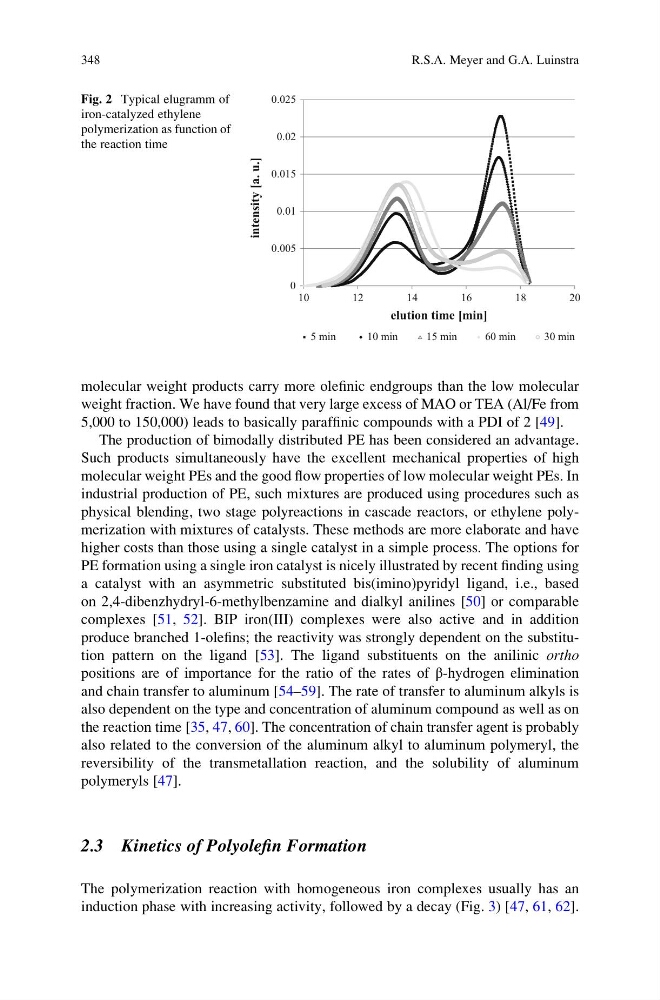
Fig. 2 Typical elugramm of
iron-catalyzed ethylene
polymerization as function of
the reaction time
348
R.S.A. Meyer and G.A. Luinstra
weight fraction. We have found that very large excess of MAO or TEA (Al/Fe from
5,000 to 150,000) leads to basically paraffinic compounds with a PDI of 2 [49].
The production of bimodally distributed PE has been considered an advantage.
Such products simultaneously have the excellent mechanical properties of high
molecular weight PEs and the good flow properties of low molecular weight PEs. In
industrial production of PE, such mixtures are produced using procedures such as
physical blending, two stage polyreactions in cascade reactors, or ethylene polymerization with mixtures of catalysts. These methods are more elaborate and have
higher costs than those using a single catalyst in a simple process. The options for
PE formation using a single iron catalyst is nicely illustrated by recent finding using
a catalyst with an asymmetric substituted bis(imino)pyridyl ligand, i.e., based
on 2,4-dibenzhydryl-6-methylbenzamine and dialkyl anilines [50] or comparable
complexes [51, 52]. BIP iron(III) complexes were also active and in addition
produce branched 1-olefins; the reactivity was strongly dependent on the substitution pattern on the ligand [53]. The ligand substituents on the anilinic ortho
positions are of importance for the ratio of the rates of β-hydrogen elimination
and chain transfer to aluminum [54–59]. The rate of transfer to aluminum alkyls is
also dependent on the type and concentration of aluminum compound as well as on
the reaction time [35, 47, 60]. The concentration of chain transfer agent is probably
also related to the conversion of the aluminum alkyl to aluminum polymeryl, the
reversibility of the transmetallation reaction, and the solubility of aluminum
polymeryls [47].
2.3 Kinetics of Polyolefin Formation
The polymerization reaction with homogeneous iron complexes usually has an
induction phase with increasing activity, followed by a decay (Fig. 3) [47, 61, 62].
0
0.005
0.01
0.015
0.02
0.025
10
12
14
16
18
20
intensity [a. u.]
elution time [min]
5 min
10 min
60 min
30 min
15 min
Fig. 2 Typical elugramm of
iron-catalyzed ethylene
polymerization as function of
the reaction time
348
R.S.A. Meyer and G.A. Luinstra