

MgCl 2 ∙nROH complexes and even MMT can swell in alcohols. When MMT is
immersed in MgCl 2 /alcohol solution, MMT can swell, thus allowing the diffusion
of MgCl 2 ∙nROH complexes into the space between the MMT layers. After removal
of the alcohol, MgCl 2 as microcrystallites may deposit on and between the surfaces of
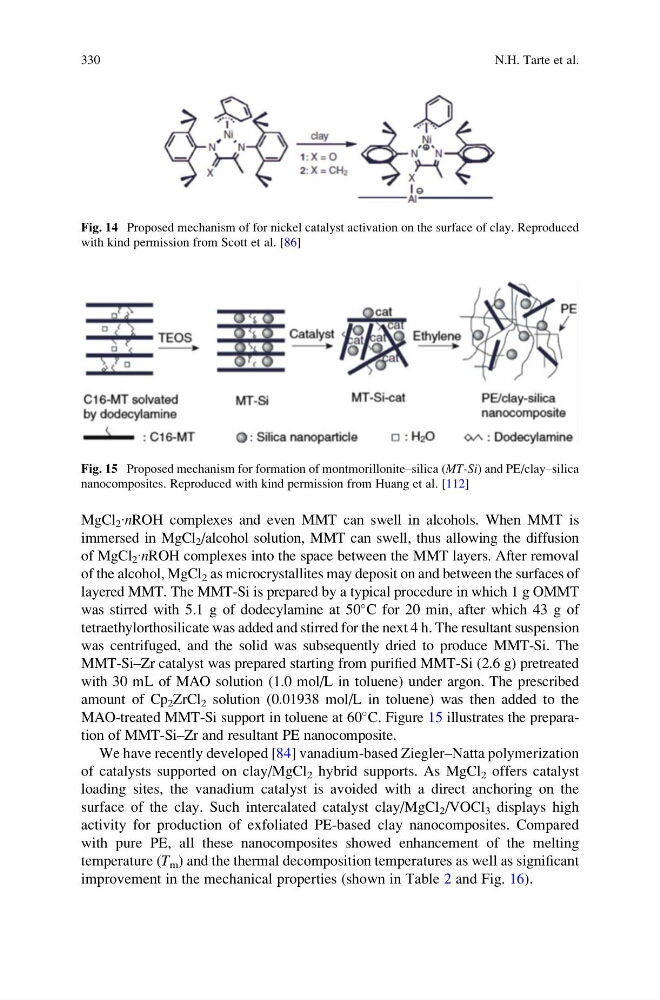
layered MMT. The MMT-Si is prepared by a typical procedure in which 1 g OMMT
was stirred with 5.1 g of dodecylamine at 50
C for 20 min, after which 43 g of
tetraethylorthosilicate was added and stirred for the next 4 h. The resultant suspension
was centrifuged, and the solid was subsequently dried to produce MMT-Si. The
MMT-Si–Zr catalyst was prepared starting from purified MMT-Si (2.6 g) pretreated
with 30 mL of MAO solution (1.0 mol/L in toluene) under argon. The prescribed
amount of Cp 2 ZrCl 2 solution (0.01938 mol/L in toluene) was then added to the
MAO-treated MMT-Si support in toluene at 60
C. Figure 15 illustrates the preparation of MMT-Si–Zr and resultant PE nanocomposite.
We have recently developed [84] vanadium-based Ziegler–Natta polymerization
of catalysts supported on clay/MgCl 2 hybrid supports. As MgCl 2 offers catalyst
loading sites, the vanadium catalyst is avoided with a direct anchoring on the
surface of the clay. Such intercalated catalyst clay/MgCl 2 /VOCl 3 displays high
activity for production of exfoliated PE-based clay nanocomposites. Compared
with pure PE, all these nanocomposites showed enhancement of the melting
temperature (T m ) and the thermal decomposition temperatures as well as significant
improvement in the mechanical properties (shown in Table 2 and Fig. 16).
Fig. 14 Proposed mechanism of for nickel catalyst activation on the surface of clay. Reproduced
with kind permission from Scott et al. [86]
Fig. 15 Proposed mechanism for formation of montmorillonite–silica (MT-Si) and PE/clay–silica
nanocomposites. Reproduced with kind permission from Huang et al. [112]
330
N.H. Tarte et al.
immersed in MgCl 2 /alcohol solution, MMT can swell, thus allowing the diffusion
of MgCl 2 ∙nROH complexes into the space between the MMT layers. After removal
of the alcohol, MgCl 2 as microcrystallites may deposit on and between the surfaces of
layered MMT. The MMT-Si is prepared by a typical procedure in which 1 g OMMT
was stirred with 5.1 g of dodecylamine at 50
C for 20 min, after which 43 g of
tetraethylorthosilicate was added and stirred for the next 4 h. The resultant suspension
was centrifuged, and the solid was subsequently dried to produce MMT-Si. The
MMT-Si–Zr catalyst was prepared starting from purified MMT-Si (2.6 g) pretreated
with 30 mL of MAO solution (1.0 mol/L in toluene) under argon. The prescribed
amount of Cp 2 ZrCl 2 solution (0.01938 mol/L in toluene) was then added to the
MAO-treated MMT-Si support in toluene at 60
C. Figure 15 illustrates the preparation of MMT-Si–Zr and resultant PE nanocomposite.
We have recently developed [84] vanadium-based Ziegler–Natta polymerization
of catalysts supported on clay/MgCl 2 hybrid supports. As MgCl 2 offers catalyst
loading sites, the vanadium catalyst is avoided with a direct anchoring on the
surface of the clay. Such intercalated catalyst clay/MgCl 2 /VOCl 3 displays high
activity for production of exfoliated PE-based clay nanocomposites. Compared
with pure PE, all these nanocomposites showed enhancement of the melting
temperature (T m ) and the thermal decomposition temperatures as well as significant
improvement in the mechanical properties (shown in Table 2 and Fig. 16).
Fig. 14 Proposed mechanism of for nickel catalyst activation on the surface of clay. Reproduced
with kind permission from Scott et al. [86]
Fig. 15 Proposed mechanism for formation of montmorillonite–silica (MT-Si) and PE/clay–silica
nanocomposites. Reproduced with kind permission from Huang et al. [112]
330
N.H. Tarte et al.