

discussed by Chen and coworkers [105, 106]. During coordination polymerization,
MAO has been proposed as being responsible for generation and stabilization of the
cationic alkyl metallocene by acting as a counterion [92, 107], resulting in a species
like (L 2 ·MtCH 3 )
+
·(MAO·X)
À . Hence, in metallocene activation by clay, a similar
role is thought to be played by the clay surface.
A number of reports [108] have shown that olefin polymerization catalysts can
be activated by acidic clay surfaces when combined with alkylaluminum
compounds such as trimethylaluminum or triisobuthylaluminum, generating
catalysts that are very active for polymerization. Note that alkylaluminum
compounds alone cannot properly activate metallocenes to high polymerization
activities. In this approach, the clay surface is thought to be the sole location where
polymerization takes place.
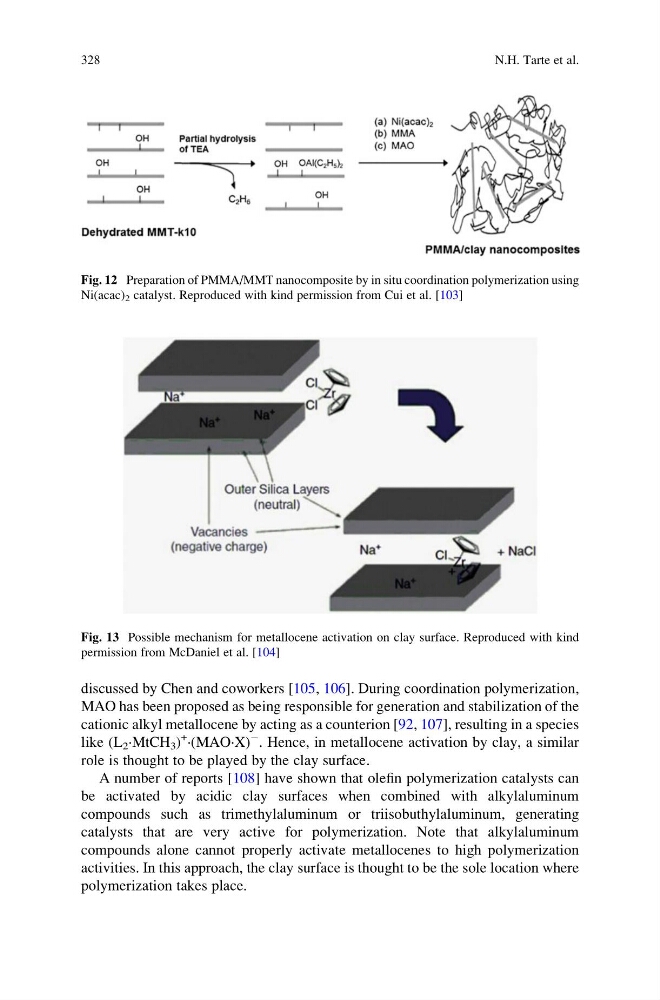
Fig. 12 Preparation of PMMA/MMT nanocomposite by in situ coordination polymerization using
Ni(acac) 2 catalyst. Reproduced with kind permission from Cui et al. [103]
Fig. 13 Possible mechanism for metallocene activation on clay surface. Reproduced with kind
permission from McDaniel et al. [104]
328
N.H. Tarte et al.
MAO has been proposed as being responsible for generation and stabilization of the
cationic alkyl metallocene by acting as a counterion [92, 107], resulting in a species
like (L 2 ·MtCH 3 )
+
·(MAO·X)
À . Hence, in metallocene activation by clay, a similar
role is thought to be played by the clay surface.
A number of reports [108] have shown that olefin polymerization catalysts can
be activated by acidic clay surfaces when combined with alkylaluminum
compounds such as trimethylaluminum or triisobuthylaluminum, generating
catalysts that are very active for polymerization. Note that alkylaluminum
compounds alone cannot properly activate metallocenes to high polymerization
activities. In this approach, the clay surface is thought to be the sole location where
polymerization takes place.
Fig. 12 Preparation of PMMA/MMT nanocomposite by in situ coordination polymerization using
Ni(acac) 2 catalyst. Reproduced with kind permission from Cui et al. [103]
Fig. 13 Possible mechanism for metallocene activation on clay surface. Reproduced with kind
permission from McDaniel et al. [104]
328
N.H. Tarte et al.