

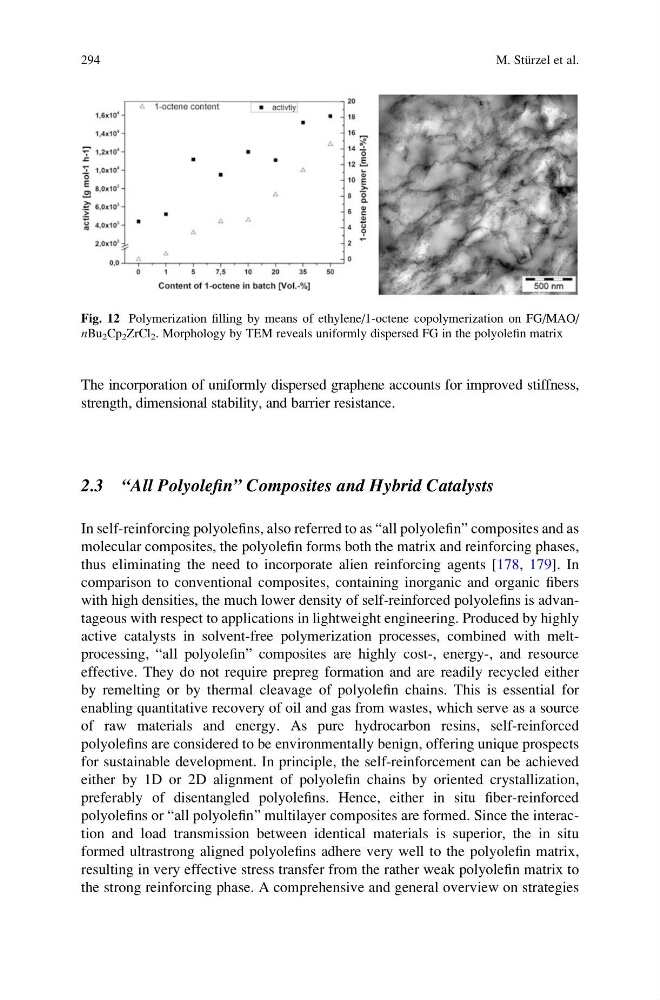
The incorporation of uniformly dispersed graphene accounts for improved stiffness,
strength, dimensional stability, and barrier resistance.
2.3 “All Polyolefin” Composites and Hybrid Catalysts
In self-reinforcing polyolefins, also referred to as “all polyolefin” composites and as
molecular composites, the polyolefin forms both the matrix and reinforcing phases,
thus eliminating the need to incorporate alien reinforcing agents [178, 179]. In
comparison to conventional composites, containing inorganic and organic fibers
with high densities, the much lower density of self-reinforced polyolefins is advantageous with respect to applications in lightweight engineering. Produced by highly
active catalysts in solvent-free polymerization processes, combined with meltprocessing, “all polyolefin” composites are highly cost-, energy-, and resource
effective. They do not require prepreg formation and are readily recycled either
by remelting or by thermal cleavage of polyolefin chains. This is essential for
enabling quantitative recovery of oil and gas from wastes, which serve as a source
of raw materials and energy. As pure hydrocarbon resins, self-reinforced
polyolefins are considered to be environmentally benign, offering unique prospects
for sustainable development. In principle, the self-reinforcement can be achieved
either by 1D or 2D alignment of polyolefin chains by oriented crystallization,
preferably of disentangled polyolefins. Hence, either in situ fiber-reinforced
polyolefins or “all polyolefin” multilayer composites are formed. Since the interaction and load transmission between identical materials is superior, the in situ
formed ultrastrong aligned polyolefins adhere very well to the polyolefin matrix,
resulting in very effective stress transfer from the rather weak polyolefin matrix to
the strong reinforcing phase. A comprehensive and general overview on strategies
Fig. 12 Polymerization filling by means of ethylene/1-octene copolymerization on FG/MAO/
nBu 2 Cp 2 ZrCl 2 . Morphology by TEM reveals uniformly dispersed FG in the polyolefin matrix
294
M. Stu ¨rzel et al.
strength, dimensional stability, and barrier resistance.
2.3 “All Polyolefin” Composites and Hybrid Catalysts
In self-reinforcing polyolefins, also referred to as “all polyolefin” composites and as
molecular composites, the polyolefin forms both the matrix and reinforcing phases,
thus eliminating the need to incorporate alien reinforcing agents [178, 179]. In
comparison to conventional composites, containing inorganic and organic fibers
with high densities, the much lower density of self-reinforced polyolefins is advantageous with respect to applications in lightweight engineering. Produced by highly
active catalysts in solvent-free polymerization processes, combined with meltprocessing, “all polyolefin” composites are highly cost-, energy-, and resource
effective. They do not require prepreg formation and are readily recycled either
by remelting or by thermal cleavage of polyolefin chains. This is essential for
enabling quantitative recovery of oil and gas from wastes, which serve as a source
of raw materials and energy. As pure hydrocarbon resins, self-reinforced
polyolefins are considered to be environmentally benign, offering unique prospects
for sustainable development. In principle, the self-reinforcement can be achieved
either by 1D or 2D alignment of polyolefin chains by oriented crystallization,
preferably of disentangled polyolefins. Hence, either in situ fiber-reinforced
polyolefins or “all polyolefin” multilayer composites are formed. Since the interaction and load transmission between identical materials is superior, the in situ
formed ultrastrong aligned polyolefins adhere very well to the polyolefin matrix,
resulting in very effective stress transfer from the rather weak polyolefin matrix to
the strong reinforcing phase. A comprehensive and general overview on strategies
Fig. 12 Polymerization filling by means of ethylene/1-octene copolymerization on FG/MAO/
nBu 2 Cp 2 ZrCl 2 . Morphology by TEM reveals uniformly dispersed FG in the polyolefin matrix
294
M. Stu ¨rzel et al.