

In summary, we have systematically examined the structure–property relationship of PP copolymers containing various comonomer units. Both PP–OH and x-PP
copolymers having a network structure show reversible polarization with low loss
and narrow breakdown distribution. Their dielectric constant remains constant over
a wide range of temperatures (between À20 and 100
C), frequencies (between
100 and 1 MHz), and applied electric fields (>600 MV/m). The PP–OH (having
4.2 mol% OH content)-based thin film capacitor displays a linear reversible charge
storage capacity with high releasing energy density of >7 J/cm
3 (two to three times
that of BOPP) after an applied electric field at E ¼ 600 MV/m, without showing
any significant increase in energy loss and remnant polarization at zero
electric field.
5 Conclusions
It is both a scientific challenge and an industrial goal to develop a general method of
preparing functional polyolefins and polyolefin block and graft copolymers
containing a polyolefin block and a functional polymer block. The combination
of a well-defined metallocene catalysis, the designed “reactive” comonomers (i.e.,
borane, p-MS/H 2 , and styrenic dienes), and chain transfer agents (i.e., H–B and
CH 3 –B moieties, and St-f/H 2 ) offers a very attractive route with a convenient, direct
polymerization process. The resulting functional polyolefins with side chains and
chain-end functional (polar) groups show good control of molecular structures.
Although only some examples are included in this chapter, this functionalization
chemistry is very general, applicable to all polyolefins (including PE, PP, s-PS, and
their co- and terpolymers), and can achieve most desirable functional (polar)
groups. In addition, the “reactive” sites in the polyolefin permit the facile transformation of metallocene-mediated olefin polymerization to controlled radical or
living anionic polymerization. This sequential polymerization process, with both
changes of catalytic sites and monomers, allows for the employment of the best
suitable polymerization mechanisms for preparing individual polymer blocks,
including metallocene polymerization for polyolefins and controlled radical and
anionic polymerization for functional (polar) polymers in the polyolefin block and
graft copolymers.
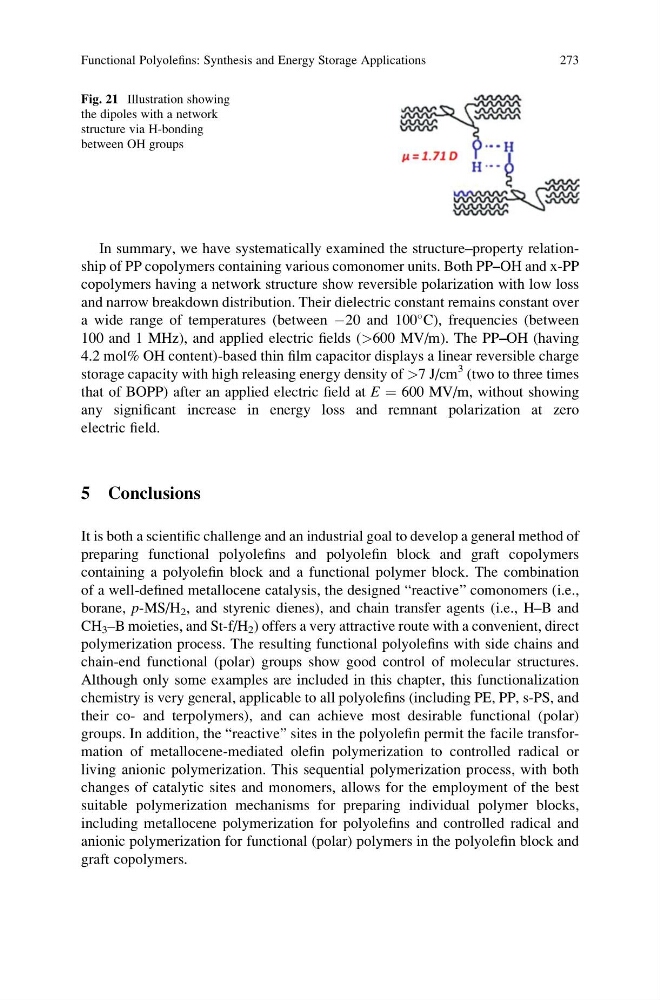
Fig. 21 Illustration showing
the dipoles with a network
structure via H-bonding
between OH groups
Functional Polyolefins: Synthesis and Energy Storage Applications
273
copolymers having a network structure show reversible polarization with low loss
and narrow breakdown distribution. Their dielectric constant remains constant over
a wide range of temperatures (between À20 and 100
C), frequencies (between
100 and 1 MHz), and applied electric fields (>600 MV/m). The PP–OH (having
4.2 mol% OH content)-based thin film capacitor displays a linear reversible charge
storage capacity with high releasing energy density of >7 J/cm
3 (two to three times
that of BOPP) after an applied electric field at E ¼ 600 MV/m, without showing
any significant increase in energy loss and remnant polarization at zero
electric field.
5 Conclusions
It is both a scientific challenge and an industrial goal to develop a general method of
preparing functional polyolefins and polyolefin block and graft copolymers
containing a polyolefin block and a functional polymer block. The combination
of a well-defined metallocene catalysis, the designed “reactive” comonomers (i.e.,
borane, p-MS/H 2 , and styrenic dienes), and chain transfer agents (i.e., H–B and
CH 3 –B moieties, and St-f/H 2 ) offers a very attractive route with a convenient, direct
polymerization process. The resulting functional polyolefins with side chains and
chain-end functional (polar) groups show good control of molecular structures.
Although only some examples are included in this chapter, this functionalization
chemistry is very general, applicable to all polyolefins (including PE, PP, s-PS, and
their co- and terpolymers), and can achieve most desirable functional (polar)
groups. In addition, the “reactive” sites in the polyolefin permit the facile transformation of metallocene-mediated olefin polymerization to controlled radical or
living anionic polymerization. This sequential polymerization process, with both
changes of catalytic sites and monomers, allows for the employment of the best
suitable polymerization mechanisms for preparing individual polymer blocks,
including metallocene polymerization for polyolefins and controlled radical and
anionic polymerization for functional (polar) polymers in the polyolefin block and
graft copolymers.
Fig. 21 Illustration showing
the dipoles with a network
structure via H-bonding
between OH groups
Functional Polyolefins: Synthesis and Energy Storage Applications
273