

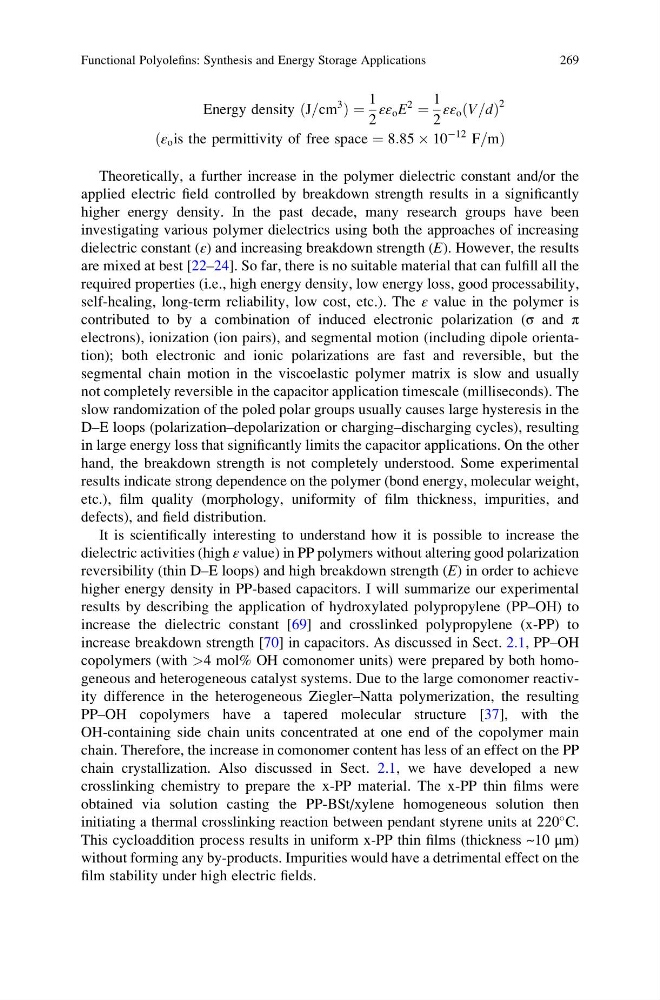
Energy density ðJ=cm
3
Þ ¼
1
2
εε o E
2
¼
1
2
εε o ðV=dÞ
2
ðε o is the permittivity of free space ¼ 8:85 Â 10
À12 F=mÞ
Theoretically, a further increase in the polymer dielectric constant and/or the
applied electric field controlled by breakdown strength results in a significantly
higher energy density. In the past decade, many research groups have been
investigating various polymer dielectrics using both the approaches of increasing
dielectric constant (ε) and increasing breakdown strength (E). However, the results
are mixed at best [22–24]. So far, there is no suitable material that can fulfill all the
required properties (i.e., high energy density, low energy loss, good processability,
self-healing, long-term reliability, low cost, etc.). The ε value in the polymer is
contributed to by a combination of induced electronic polarization (σ and π
electrons), ionization (ion pairs), and segmental motion (including dipole orientation); both electronic and ionic polarizations are fast and reversible, but the
segmental chain motion in the viscoelastic polymer matrix is slow and usually
not completely reversible in the capacitor application timescale (milliseconds). The
slow randomization of the poled polar groups usually causes large hysteresis in the
D–E loops (polarization–depolarization or charging–discharging cycles), resulting
in large energy loss that significantly limits the capacitor applications. On the other
hand, the breakdown strength is not completely understood. Some experimental
results indicate strong dependence on the polymer (bond energy, molecular weight,
etc.), film quality (morphology, uniformity of film thickness, impurities, and
defects), and field distribution.
It is scientifically interesting to understand how it is possible to increase the
dielectric activities (high ε value) in PP polymers without altering good polarization
reversibility (thin D–E loops) and high breakdown strength (E) in order to achieve
higher energy density in PP-based capacitors. I will summarize our experimental
results by describing the application of hydroxylated polypropylene (PP–OH) to
increase the dielectric constant [69] and crosslinked polypropylene (x-PP) to
increase breakdown strength [70] in capacitors. As discussed in Sect. 2.1, PP–OH
copolymers (with >4 mol% OH comonomer units) were prepared by both homogeneous and heterogeneous catalyst systems. Due to the large comonomer reactivity difference in the heterogeneous Ziegler–Natta polymerization, the resulting
PP–OH copolymers have a tapered molecular structure [37], with the
OH-containing side chain units concentrated at one end of the copolymer main
chain. Therefore, the increase in comonomer content has less of an effect on the PP
chain crystallization. Also discussed in Sect. 2.1, we have developed a new
crosslinking chemistry to prepare the x-PP material. The x-PP thin films were
obtained via solution casting the PP-BSt/xylene homogeneous solution then
initiating a thermal crosslinking reaction between pendant styrene units at 220
C.
This cycloaddition process results in uniform x-PP thin films (thickness ~10 μm)
without forming any by-products. Impurities would have a detrimental effect on the
film stability under high electric fields.
Functional Polyolefins: Synthesis and Energy Storage Applications
269
3
Þ ¼
1
2
εε o E
2
¼
1
2
εε o ðV=dÞ
2
ðε o is the permittivity of free space ¼ 8:85 Â 10
À12 F=mÞ
Theoretically, a further increase in the polymer dielectric constant and/or the
applied electric field controlled by breakdown strength results in a significantly
higher energy density. In the past decade, many research groups have been
investigating various polymer dielectrics using both the approaches of increasing
dielectric constant (ε) and increasing breakdown strength (E). However, the results
are mixed at best [22–24]. So far, there is no suitable material that can fulfill all the
required properties (i.e., high energy density, low energy loss, good processability,
self-healing, long-term reliability, low cost, etc.). The ε value in the polymer is
contributed to by a combination of induced electronic polarization (σ and π
electrons), ionization (ion pairs), and segmental motion (including dipole orientation); both electronic and ionic polarizations are fast and reversible, but the
segmental chain motion in the viscoelastic polymer matrix is slow and usually
not completely reversible in the capacitor application timescale (milliseconds). The
slow randomization of the poled polar groups usually causes large hysteresis in the
D–E loops (polarization–depolarization or charging–discharging cycles), resulting
in large energy loss that significantly limits the capacitor applications. On the other
hand, the breakdown strength is not completely understood. Some experimental
results indicate strong dependence on the polymer (bond energy, molecular weight,
etc.), film quality (morphology, uniformity of film thickness, impurities, and
defects), and field distribution.
It is scientifically interesting to understand how it is possible to increase the
dielectric activities (high ε value) in PP polymers without altering good polarization
reversibility (thin D–E loops) and high breakdown strength (E) in order to achieve
higher energy density in PP-based capacitors. I will summarize our experimental
results by describing the application of hydroxylated polypropylene (PP–OH) to
increase the dielectric constant [69] and crosslinked polypropylene (x-PP) to
increase breakdown strength [70] in capacitors. As discussed in Sect. 2.1, PP–OH
copolymers (with >4 mol% OH comonomer units) were prepared by both homogeneous and heterogeneous catalyst systems. Due to the large comonomer reactivity difference in the heterogeneous Ziegler–Natta polymerization, the resulting
PP–OH copolymers have a tapered molecular structure [37], with the
OH-containing side chain units concentrated at one end of the copolymer main
chain. Therefore, the increase in comonomer content has less of an effect on the PP
chain crystallization. Also discussed in Sect. 2.1, we have developed a new
crosslinking chemistry to prepare the x-PP material. The x-PP thin films were
obtained via solution casting the PP-BSt/xylene homogeneous solution then
initiating a thermal crosslinking reaction between pendant styrene units at 220
C.
This cycloaddition process results in uniform x-PP thin films (thickness ~10 μm)
without forming any by-products. Impurities would have a detrimental effect on the
film stability under high electric fields.
Functional Polyolefins: Synthesis and Energy Storage Applications
269