

remove any PS homopolymer. In all cases (including high molecular weight
PP-t-p-MS polymer cases), the soluble PS homopolymer fraction was negligible.
Figure 18 (top) shows the
1 H NMR spectra of PP-b-PS (M n ¼ 44 Â 10
3 g/mol;
M w /M n ¼ 2.3), and Fig. 18 (bottom) compares the GPC curve of PP-b-PS with the
starting PP-t-p-MS (M n ¼ 26 Â 10
3 g/mol; M w /M n ¼ 2.3). Despite the doubling of
polymer molecular weight, the molecular weight distribution remains very
constant. Diblock copolymer composition was calculated using the ratio of two
integrated intensities between the aromatic protons (δ ¼ 6.4–7.3 ppm) in the PS
segment and the methylene protons (δ ¼ 1.35–1.55 ppm) in the PP segment, along
with the number of protons both chemical shifts represent.
Overall, the transformation from metallocene to living anionic polymerization
was very effective (>80%), and the molecular structure of the copolymer could be
easily controlled by the starting p-MS-terminated polyolefin and the quantity of
monomer introduced during the living anionic chain extension reaction. This
diblock reaction benefits from the known and well-defined living anionic polymerization process, and offers a complementary method to the previous one, i.e.,
transformation from metallocene to living free radical polymerization. The combination provides a powerful tool for preparation of a broad range of polyolefin
diblock copolymers containing a metallocene-prepared polyolefin block and an
anionic or free-radical-prepared polymer block.
4 Functional PP Capacitors for Energy Storage
As discussed, BOPP thin films are currently used as dielectrics in state-of-the-art
capacitors [18–21], which can produce a energy density in the range of 2–3 J/cm
3
after applying a high external electric field (E ¼ 600 MV/m). Despite the low
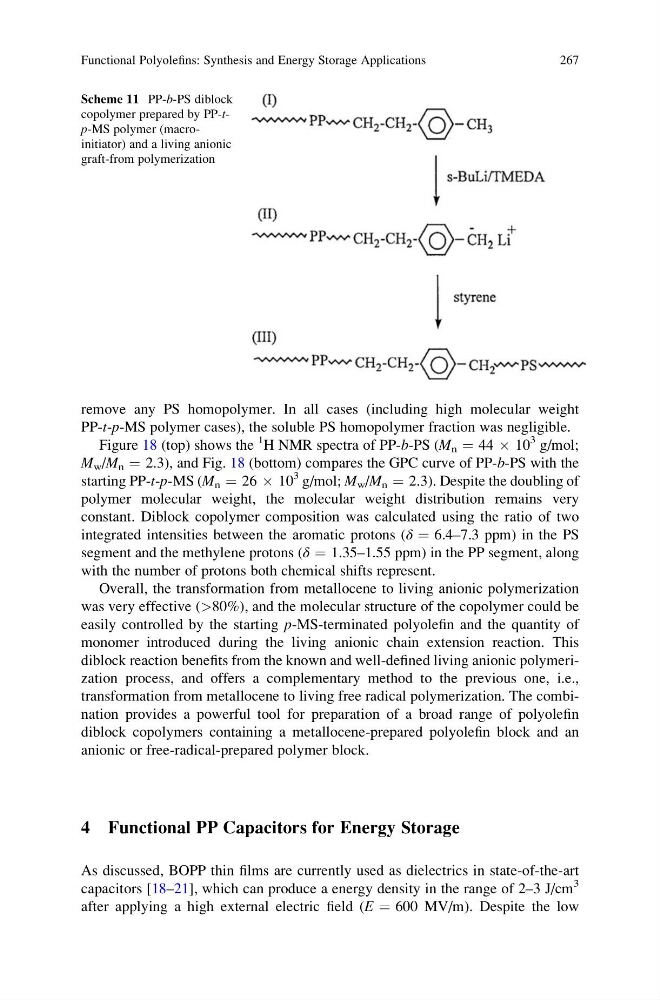
Scheme 11 PP-b-PS diblock
copolymer prepared by PP-tp-MS polymer (macroinitiator) and a living anionic
graft-from polymerization
Functional Polyolefins: Synthesis and Energy Storage Applications
267
PP-t-p-MS polymer cases), the soluble PS homopolymer fraction was negligible.
Figure 18 (top) shows the
1 H NMR spectra of PP-b-PS (M n ¼ 44 Â 10
3 g/mol;
M w /M n ¼ 2.3), and Fig. 18 (bottom) compares the GPC curve of PP-b-PS with the
starting PP-t-p-MS (M n ¼ 26 Â 10
3 g/mol; M w /M n ¼ 2.3). Despite the doubling of
polymer molecular weight, the molecular weight distribution remains very
constant. Diblock copolymer composition was calculated using the ratio of two
integrated intensities between the aromatic protons (δ ¼ 6.4–7.3 ppm) in the PS
segment and the methylene protons (δ ¼ 1.35–1.55 ppm) in the PP segment, along
with the number of protons both chemical shifts represent.
Overall, the transformation from metallocene to living anionic polymerization
was very effective (>80%), and the molecular structure of the copolymer could be
easily controlled by the starting p-MS-terminated polyolefin and the quantity of
monomer introduced during the living anionic chain extension reaction. This
diblock reaction benefits from the known and well-defined living anionic polymerization process, and offers a complementary method to the previous one, i.e.,
transformation from metallocene to living free radical polymerization. The combination provides a powerful tool for preparation of a broad range of polyolefin
diblock copolymers containing a metallocene-prepared polyolefin block and an
anionic or free-radical-prepared polymer block.
4 Functional PP Capacitors for Energy Storage
As discussed, BOPP thin films are currently used as dielectrics in state-of-the-art
capacitors [18–21], which can produce a energy density in the range of 2–3 J/cm
3
after applying a high external electric field (E ¼ 600 MV/m). Despite the low
Scheme 11 PP-b-PS diblock
copolymer prepared by PP-tp-MS polymer (macroinitiator) and a living anionic
graft-from polymerization
Functional Polyolefins: Synthesis and Energy Storage Applications
267