

have also been proposed for comparing the relative contributions of elastic and
viscous responses from the dynamic rheological analysis [13, 96, 99, 108–111]
with aim of describing the rheological polydispersity in the high molecular weight
end of the MWD. Of the various ways to present low shear rheological data, plotting
the phase angle δ against either frequency, ω, or complex modulus G* (Van Gurp
profile) have proven practical and are widely used to showing the effects and
presence of a low amount of LCB [13, 84, 86, 96, 109–111]. Common to these
procedures is that they start from the simple assumption that LCB varies only in the
amount of branches.
Presence of LCB gives increased temperature dependence of the viscoelastic
properties, giving increased value of the flow activation energy, E a . Enhanced temperature sensitivity results from the additional relaxation processes that the long-chain
branched chains require and that possess a different temperature dependence to the
simple reptation [112, 113] and thus are not seen in linear polymers even when of
broad MWD. Even though short-chain branching has almost no effect on the flow
curves up to comonomer content of about 30 wt%, the E a increases with comonomer
level in linear polymers [97, 101, 107, 114, 115]. Thus, E a of 25–28 kJ/mol is
derived for HDPE samples and 30–34 kJ/mol for LLDPE samples [116, 117]. For
higher E a , the higher the comonomer content and the longer the comonomer is
[97]. For long-chain branched LDPE, clearly higher values of above 50 kJ/mol are
obtained [101, 117].
Flow E a for polymers with a small amount of LCB cannot always be distinguished from the E a of linear polymers [99, 115], but often E a appears increase with
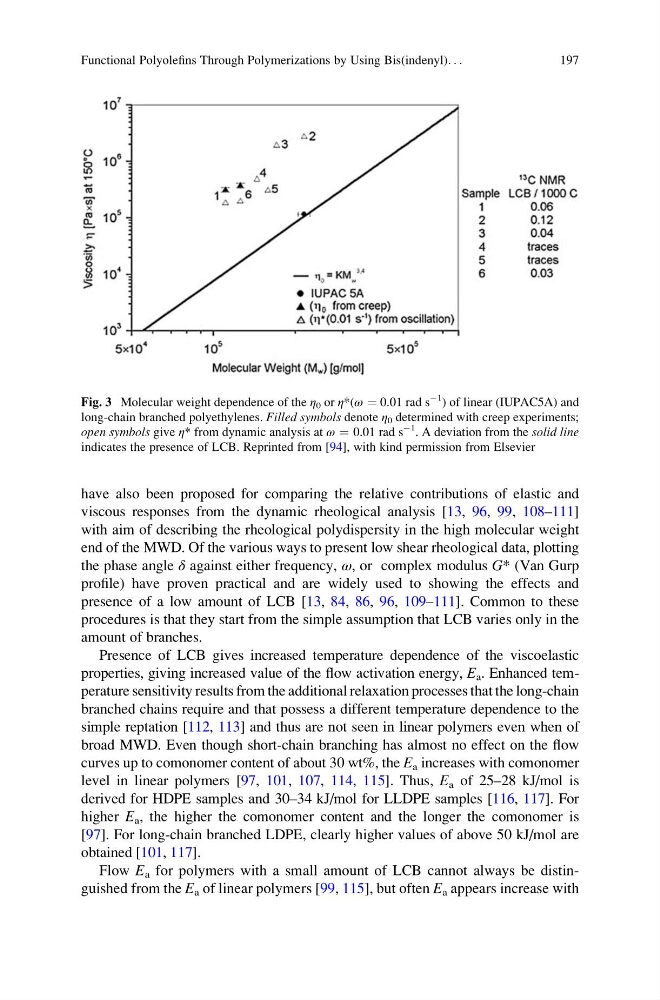
Fig. 3 Molecular weight dependence of the η 0 or η*(ω ¼ 0.01 rad s
À1
) of linear (IUPAC5A) and
long-chain branched polyethylenes. Filled symbols denote η 0 determined with creep experiments;
open symbols give η* from dynamic analysis at ω ¼ 0.01 rad s
À1
. A deviation from the solid line
indicates the presence of LCB. Reprinted from [94], with kind permission from Elsevier
Functional Polyolefins Through Polymerizations by Using Bis(indenyl). . .
197
viscous responses from the dynamic rheological analysis [13, 96, 99, 108–111]
with aim of describing the rheological polydispersity in the high molecular weight
end of the MWD. Of the various ways to present low shear rheological data, plotting
the phase angle δ against either frequency, ω, or complex modulus G* (Van Gurp
profile) have proven practical and are widely used to showing the effects and
presence of a low amount of LCB [13, 84, 86, 96, 109–111]. Common to these
procedures is that they start from the simple assumption that LCB varies only in the
amount of branches.
Presence of LCB gives increased temperature dependence of the viscoelastic
properties, giving increased value of the flow activation energy, E a . Enhanced temperature sensitivity results from the additional relaxation processes that the long-chain
branched chains require and that possess a different temperature dependence to the
simple reptation [112, 113] and thus are not seen in linear polymers even when of
broad MWD. Even though short-chain branching has almost no effect on the flow
curves up to comonomer content of about 30 wt%, the E a increases with comonomer
level in linear polymers [97, 101, 107, 114, 115]. Thus, E a of 25–28 kJ/mol is
derived for HDPE samples and 30–34 kJ/mol for LLDPE samples [116, 117]. For
higher E a , the higher the comonomer content and the longer the comonomer is
[97]. For long-chain branched LDPE, clearly higher values of above 50 kJ/mol are
obtained [101, 117].
Flow E a for polymers with a small amount of LCB cannot always be distinguished from the E a of linear polymers [99, 115], but often E a appears increase with
Fig. 3 Molecular weight dependence of the η 0 or η*(ω ¼ 0.01 rad s
À1
) of linear (IUPAC5A) and
long-chain branched polyethylenes. Filled symbols denote η 0 determined with creep experiments;
open symbols give η* from dynamic analysis at ω ¼ 0.01 rad s
À1
. A deviation from the solid line
indicates the presence of LCB. Reprinted from [94], with kind permission from Elsevier
Functional Polyolefins Through Polymerizations by Using Bis(indenyl). . .
197