

crystallizes and precipitates as particles as it is formed. Therefore, macromer might
not move from one active site to another, but instead insertion of the macromer to
another chain takes place at the same site where it was formed.
3.2 LCB Analytics
In contrast to the LCB in LDPE, a characteristic of the metallocene-LCB is the
sparse amounts present. Three methods are well established for charactering this
LCB: melt rheological measurements,
13 C-NMR, and SEC with multiple detectors
(especially SEC-MALLS). Low shear rate melt rheology requires comparison to the
results from conventional SEC for polymer average molecular weight and MWD.
Analysis of LCB is best achieved with a combination of all these methods.
LCB density in single-site catalyzed polyethylenes is typically in the range of
0.01–0.2 branch points per 1,000 main chain carbons [14, 85, 91–93]. Sensitivity of
modern
13 C-NMR instruments is by far sufficient to detect the low levels of 0.02
branches/1,000 carbon atoms that already have a significant impact on rheological
behavior. Furthermore,
13 C-NMR is an attractive technique because it can give a
number for the amount of LCB per chain. However, with regard to LCB determination,
13 C-NMR has a big drawback in that it cannot differentiate between side
branches that are six carbons in length or longer. Therefore, it is of limited use in
copolymers; moreover, it cannot differentiate between the rheologically significant
difference between side chains of, e.g., 16 carbon atoms and 250 atoms in length.
SEC with multiple detectors, especially with multi-angle laser light scattering
(SEC-MALLS), has high sensitivity towards high molecular weights and
improved differentiation between LCB and linear high molecular weight species.
SEC-MALLS has emerged as a complementary technique to detect low levels of
LCB [86, 87, 94–97]. Multiple detector SEC most usefully yields information
on the branching along with the MWD. Branched molecules have a smaller
P
M
1
P 1
M +
+
P 1
P
M
2
P
M
2
P 1
1)
2)
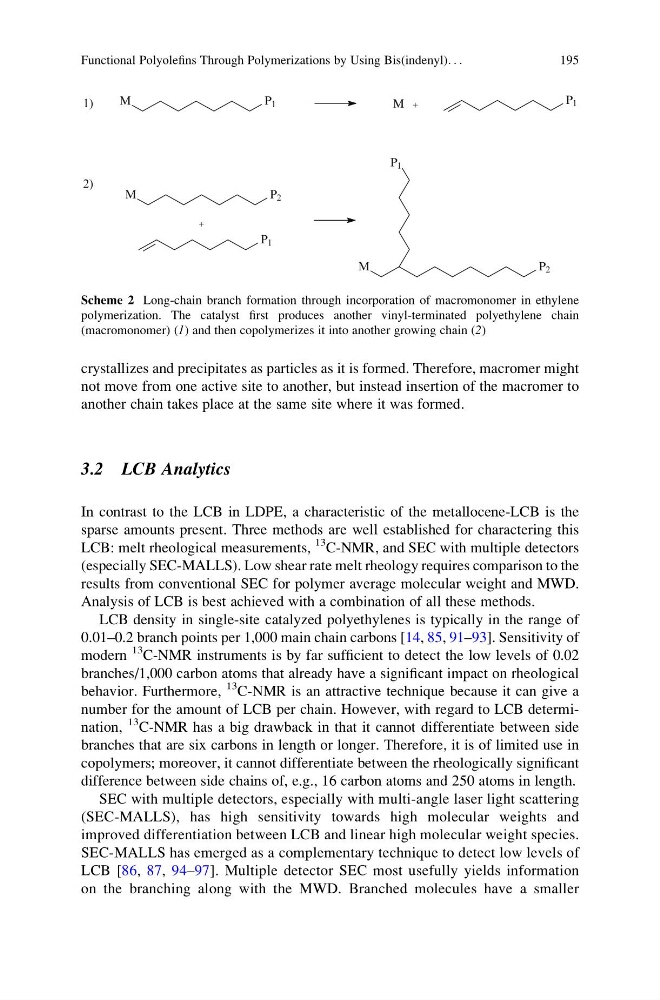
Scheme 2 Long-chain branch formation through incorporation of macromonomer in ethylene
polymerization. The catalyst first produces another vinyl-terminated polyethylene chain
(macromonomer) (1) and then copolymerizes it into another growing chain (2)
Functional Polyolefins Through Polymerizations by Using Bis(indenyl). . .
195
not move from one active site to another, but instead insertion of the macromer to
another chain takes place at the same site where it was formed.
3.2 LCB Analytics
In contrast to the LCB in LDPE, a characteristic of the metallocene-LCB is the
sparse amounts present. Three methods are well established for charactering this
LCB: melt rheological measurements,
13 C-NMR, and SEC with multiple detectors
(especially SEC-MALLS). Low shear rate melt rheology requires comparison to the
results from conventional SEC for polymer average molecular weight and MWD.
Analysis of LCB is best achieved with a combination of all these methods.
LCB density in single-site catalyzed polyethylenes is typically in the range of
0.01–0.2 branch points per 1,000 main chain carbons [14, 85, 91–93]. Sensitivity of
modern
13 C-NMR instruments is by far sufficient to detect the low levels of 0.02
branches/1,000 carbon atoms that already have a significant impact on rheological
behavior. Furthermore,
13 C-NMR is an attractive technique because it can give a
number for the amount of LCB per chain. However, with regard to LCB determination,
13 C-NMR has a big drawback in that it cannot differentiate between side
branches that are six carbons in length or longer. Therefore, it is of limited use in
copolymers; moreover, it cannot differentiate between the rheologically significant
difference between side chains of, e.g., 16 carbon atoms and 250 atoms in length.
SEC with multiple detectors, especially with multi-angle laser light scattering
(SEC-MALLS), has high sensitivity towards high molecular weights and
improved differentiation between LCB and linear high molecular weight species.
SEC-MALLS has emerged as a complementary technique to detect low levels of
LCB [86, 87, 94–97]. Multiple detector SEC most usefully yields information
on the branching along with the MWD. Branched molecules have a smaller
P
M
1
P 1
M +
+
P 1
P
M
2
P
M
2
P 1
1)
2)
Scheme 2 Long-chain branch formation through incorporation of macromonomer in ethylene
polymerization. The catalyst first produces another vinyl-terminated polyethylene chain
(macromonomer) (1) and then copolymerizes it into another growing chain (2)
Functional Polyolefins Through Polymerizations by Using Bis(indenyl). . .
195