

Hf. Such and similar metallocenes are used for the polymerization of ethene,
propene, and other olefins. Table 2 compares the polymerization of ethene by
selected metallocene/MAO catalysts [71, 72].
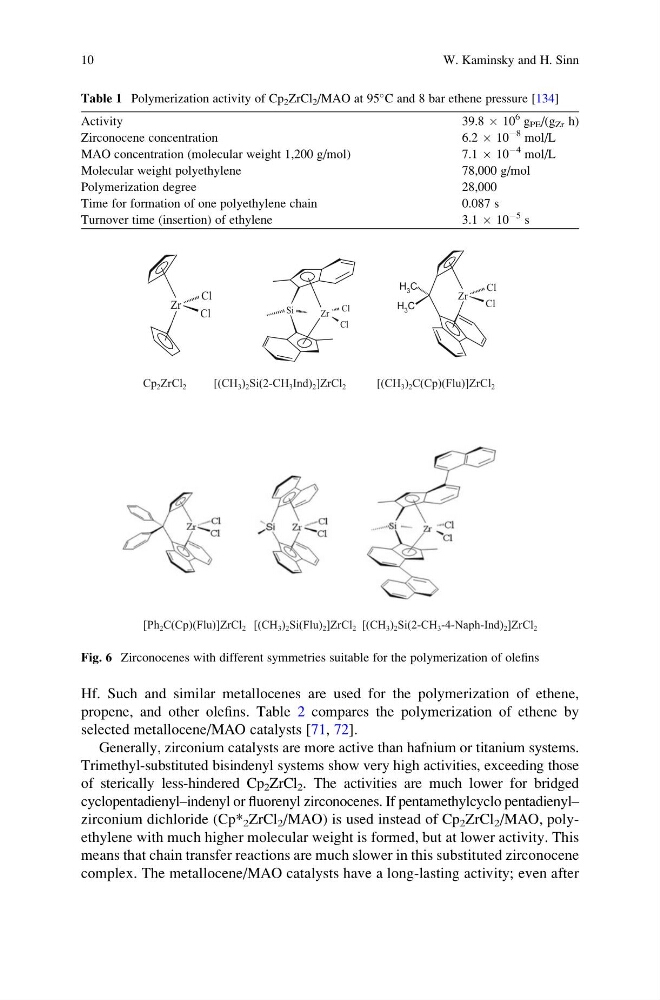
Generally, zirconium catalysts are more active than hafnium or titanium systems.
Trimethyl-substituted bisindenyl systems show very high activities, exceeding those
of sterically less-hindered Cp 2 ZrCl 2 . The activities are much lower for bridged
cyclopentadienyl–indenyl or fluorenyl zirconocenes. If pentamethylcyclo pentadienyl–
zirconium dichloride (Cp* 2 ZrCl 2 /MAO) is used instead of Cp 2 ZrCl 2 /MAO, polyethylene with much higher molecular weight is formed, but at lower activity. This
means that chain transfer reactions are much slower in this substituted zirconocene
complex. The metallocene/MAO catalysts have a long-lasting activity; even after
Table 1 Polymerization activity of Cp 2 ZrCl 2 /MAO at 95
C and 8 bar ethene pressure [134]
Activity
39.8 Â 10
6 g PE /(g Zr h)
Zirconocene concentration
6.2 Â 10
À8 mol/L
MAO concentration (molecular weight 1,200 g/mol)
7.1 Â 10
À4 mol/L
Molecular weight polyethylene
78,000 g/mol
Polymerization degree
28,000
Time for formation of one polyethylene chain
0.087 s
Turnover time (insertion) of ethylene
3.1 Â 10
À5 s
Zr
Cl
Cl
Zr
Cl
Cl
Si
Zr
Cl
Cl
H 3 C
H 3 C
Cp 2 ZrCl 2
[(CH 3 ) 2 Si(2-CH 3 Ind) 2 ]ZrCl 2
[(CH 3 ) 2 C(Cp)(Flu)]ZrCl 2
[Ph 2 C(Cp)(Flu)]ZrCl 2 [(CH 3 ) 2 Si(Flu) 2 ]ZrCl 2 [(CH 3 ) 2 Si(2-CH 3 -4-Naph-Ind) 2 ]ZrCl 2
Fig. 6 Zirconocenes with different symmetries suitable for the polymerization of olefins
10
W. Kaminsky and H. Sinn
propene, and other olefins. Table 2 compares the polymerization of ethene by
selected metallocene/MAO catalysts [71, 72].
Generally, zirconium catalysts are more active than hafnium or titanium systems.
Trimethyl-substituted bisindenyl systems show very high activities, exceeding those
of sterically less-hindered Cp 2 ZrCl 2 . The activities are much lower for bridged
cyclopentadienyl–indenyl or fluorenyl zirconocenes. If pentamethylcyclo pentadienyl–
zirconium dichloride (Cp* 2 ZrCl 2 /MAO) is used instead of Cp 2 ZrCl 2 /MAO, polyethylene with much higher molecular weight is formed, but at lower activity. This
means that chain transfer reactions are much slower in this substituted zirconocene
complex. The metallocene/MAO catalysts have a long-lasting activity; even after
Table 1 Polymerization activity of Cp 2 ZrCl 2 /MAO at 95
C and 8 bar ethene pressure [134]
Activity
39.8 Â 10
6 g PE /(g Zr h)
Zirconocene concentration
6.2 Â 10
À8 mol/L
MAO concentration (molecular weight 1,200 g/mol)
7.1 Â 10
À4 mol/L
Molecular weight polyethylene
78,000 g/mol
Polymerization degree
28,000
Time for formation of one polyethylene chain
0.087 s
Turnover time (insertion) of ethylene
3.1 Â 10
À5 s
Zr
Cl
Cl
Zr
Cl
Cl
Si
Zr
Cl
Cl
H 3 C
H 3 C
Cp 2 ZrCl 2
[(CH 3 ) 2 Si(2-CH 3 Ind) 2 ]ZrCl 2
[(CH 3 ) 2 C(Cp)(Flu)]ZrCl 2
[Ph 2 C(Cp)(Flu)]ZrCl 2 [(CH 3 ) 2 Si(Flu) 2 ]ZrCl 2 [(CH 3 ) 2 Si(2-CH 3 -4-Naph-Ind) 2 ]ZrCl 2
Fig. 6 Zirconocenes with different symmetries suitable for the polymerization of olefins
10
W. Kaminsky and H. Sinn