

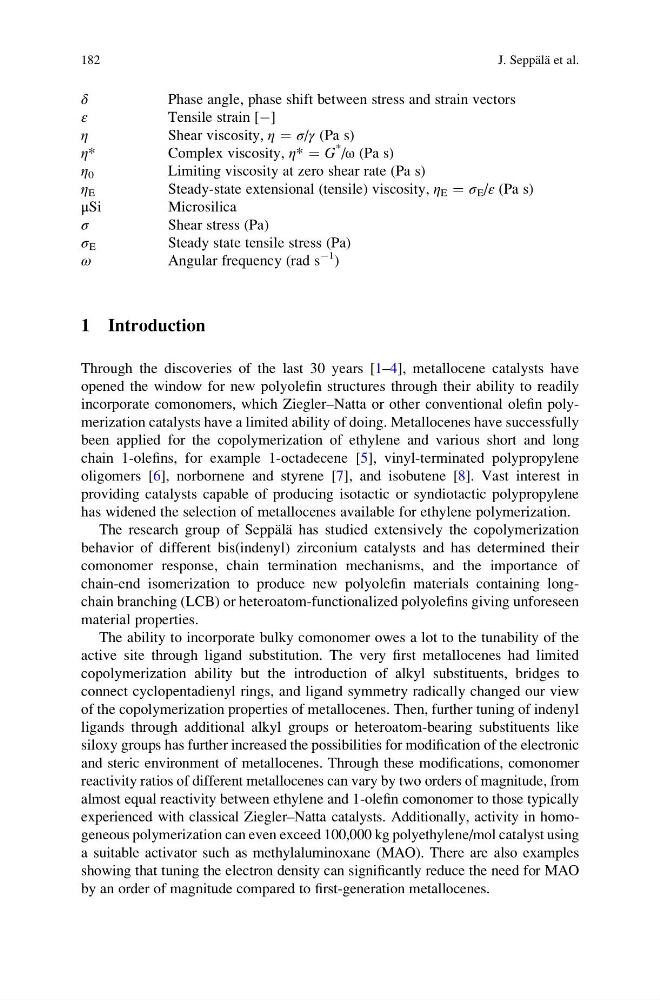
δ
Phase angle, phase shift between stress and strain vectors
ε
Tensile strain [À]
η
Shear viscosity, η ¼ σ/γ (Pa s)
η*
Complex viscosity, η* ¼ G
* /ω (Pa s)
η 0
Limiting viscosity at zero shear rate (Pa s)
η E
Steady-state extensional (tensile) viscosity, η E ¼ σ E /ε (Pa s)
μSi
Microsilica
σ
Shear stress (Pa)
σ E
Steady state tensile stress (Pa)
ω
Angular frequency (rad s
À1 )
1 Introduction
Through the discoveries of the last 30 years [1–4], metallocene catalysts have
opened the window for new polyolefin structures through their ability to readily
incorporate comonomers, which Ziegler–Natta or other conventional olefin polymerization catalysts have a limited ability of doing. Metallocenes have successfully
been applied for the copolymerization of ethylene and various short and long
chain 1-olefins, for example 1-octadecene [5], vinyl-terminated polypropylene
oligomers [6], norbornene and styrene [7], and isobutene [8]. Vast interest in
providing catalysts capable of producing isotactic or syndiotactic polypropylene
has widened the selection of metallocenes available for ethylene polymerization.
The research group of Seppa ¨la ¨ has studied extensively the copolymerization
behavior of different bis(indenyl) zirconium catalysts and has determined their
comonomer response, chain termination mechanisms, and the importance of
chain-end isomerization to produce new polyolefin materials containing longchain branching (LCB) or heteroatom-functionalized polyolefins giving unforeseen
material properties.
The ability to incorporate bulky comonomer owes a lot to the tunability of the
active site through ligand substitution. The very first metallocenes had limited
copolymerization ability but the introduction of alkyl substituents, bridges to
connect cyclopentadienyl rings, and ligand symmetry radically changed our view
of the copolymerization properties of metallocenes. Then, further tuning of indenyl
ligands through additional alkyl groups or heteroatom-bearing substituents like
siloxy groups has further increased the possibilities for modification of the electronic
and steric environment of metallocenes. Through these modifications, comonomer
reactivity ratios of different metallocenes can vary by two orders of magnitude, from
almost equal reactivity between ethylene and 1-olefin comonomer to those typically
experienced with classical Ziegler–Natta catalysts. Additionally, activity in homogeneous polymerization can even exceed 100,000 kg polyethylene/mol catalyst using
a suitable activator such as methylaluminoxane (MAO). There are also examples
showing that tuning the electron density can significantly reduce the need for MAO
by an order of magnitude compared to first-generation metallocenes.
182
J. Seppa ¨la ¨ et al.
Phase angle, phase shift between stress and strain vectors
ε
Tensile strain [À]
η
Shear viscosity, η ¼ σ/γ (Pa s)
η*
Complex viscosity, η* ¼ G
* /ω (Pa s)
η 0
Limiting viscosity at zero shear rate (Pa s)
η E
Steady-state extensional (tensile) viscosity, η E ¼ σ E /ε (Pa s)
μSi
Microsilica
σ
Shear stress (Pa)
σ E
Steady state tensile stress (Pa)
ω
Angular frequency (rad s
À1 )
1 Introduction
Through the discoveries of the last 30 years [1–4], metallocene catalysts have
opened the window for new polyolefin structures through their ability to readily
incorporate comonomers, which Ziegler–Natta or other conventional olefin polymerization catalysts have a limited ability of doing. Metallocenes have successfully
been applied for the copolymerization of ethylene and various short and long
chain 1-olefins, for example 1-octadecene [5], vinyl-terminated polypropylene
oligomers [6], norbornene and styrene [7], and isobutene [8]. Vast interest in
providing catalysts capable of producing isotactic or syndiotactic polypropylene
has widened the selection of metallocenes available for ethylene polymerization.
The research group of Seppa ¨la ¨ has studied extensively the copolymerization
behavior of different bis(indenyl) zirconium catalysts and has determined their
comonomer response, chain termination mechanisms, and the importance of
chain-end isomerization to produce new polyolefin materials containing longchain branching (LCB) or heteroatom-functionalized polyolefins giving unforeseen
material properties.
The ability to incorporate bulky comonomer owes a lot to the tunability of the
active site through ligand substitution. The very first metallocenes had limited
copolymerization ability but the introduction of alkyl substituents, bridges to
connect cyclopentadienyl rings, and ligand symmetry radically changed our view
of the copolymerization properties of metallocenes. Then, further tuning of indenyl
ligands through additional alkyl groups or heteroatom-bearing substituents like
siloxy groups has further increased the possibilities for modification of the electronic
and steric environment of metallocenes. Through these modifications, comonomer
reactivity ratios of different metallocenes can vary by two orders of magnitude, from
almost equal reactivity between ethylene and 1-olefin comonomer to those typically
experienced with classical Ziegler–Natta catalysts. Additionally, activity in homogeneous polymerization can even exceed 100,000 kg polyethylene/mol catalyst using
a suitable activator such as methylaluminoxane (MAO). There are also examples
showing that tuning the electron density can significantly reduce the need for MAO
by an order of magnitude compared to first-generation metallocenes.
182
J. Seppa ¨la ¨ et al.