

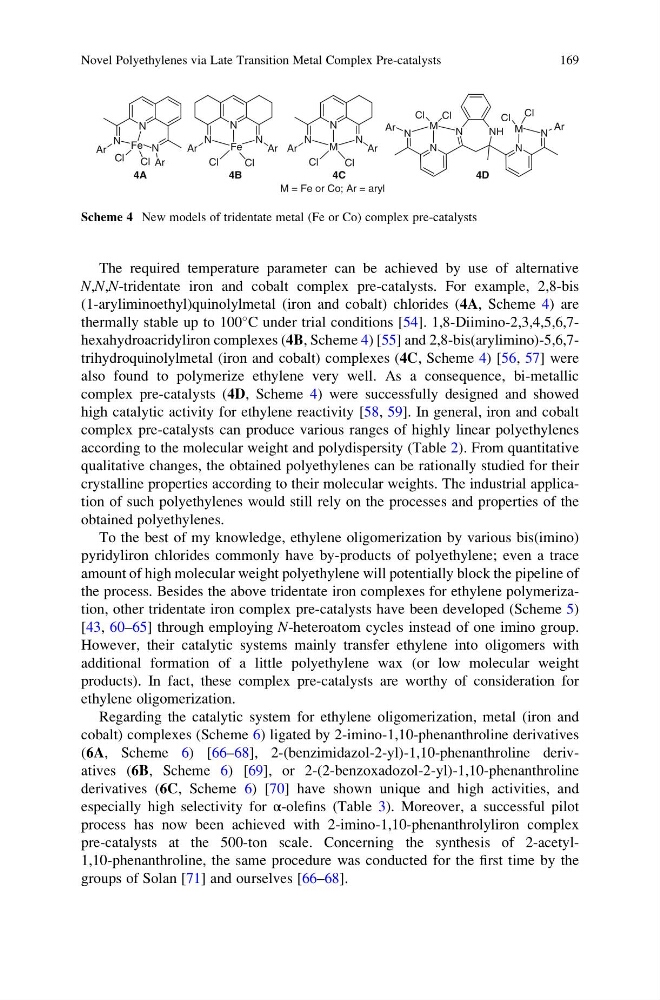
The required temperature parameter can be achieved by use of alternative
N,N,N-tridentate iron and cobalt complex pre-catalysts. For example, 2,8-bis
(1-aryliminoethyl)quinolylmetal (iron and cobalt) chlorides (4A, Scheme 4) are
thermally stable up to 100
C under trial conditions [54]. 1,8-Diimino-2,3,4,5,6,7hexahydroacridyliron complexes (4B, Scheme 4) [55] and 2,8-bis(arylimino)-5,6,7trihydroquinolylmetal (iron and cobalt) complexes (4C, Scheme 4) [56, 57] were
also found to polymerize ethylene very well. As a consequence, bi-metallic
complex pre-catalysts (4D, Scheme 4) were successfully designed and showed
high catalytic activity for ethylene reactivity [58, 59]. In general, iron and cobalt
complex pre-catalysts can produce various ranges of highly linear polyethylenes
according to the molecular weight and polydispersity (Table 2). From quantitative
qualitative changes, the obtained polyethylenes can be rationally studied for their
crystalline properties according to their molecular weights. The industrial application of such polyethylenes would still rely on the processes and properties of the
obtained polyethylenes.
To the best of my knowledge, ethylene oligomerization by various bis(imino)
pyridyliron chlorides commonly have by-products of polyethylene; even a trace
amount of high molecular weight polyethylene will potentially block the pipeline of
the process. Besides the above tridentate iron complexes for ethylene polymerization, other tridentate iron complex pre-catalysts have been developed (Scheme 5)
[43, 60–65] through employing N-heteroatom cycles instead of one imino group.
However, their catalytic systems mainly transfer ethylene into oligomers with
additional formation of a little polyethylene wax (or low molecular weight
products). In fact, these complex pre-catalysts are worthy of consideration for
ethylene oligomerization.
Regarding the catalytic system for ethylene oligomerization, metal (iron and
cobalt) complexes (Scheme 6) ligated by 2-imino-1,10-phenanthroline derivatives
(6A, Scheme 6) [66–68], 2-(benzimidazol-2-yl)-1,10-phenanthroline derivatives (6B, Scheme 6) [69], or 2-(2-benzoxadozol-2-yl)-1,10-phenanthroline
derivatives (6C, Scheme 6) [70] have shown unique and high activities, and
especially high selectivity for α-olefins (Table 3). Moreover, a successful pilot
process has now been achieved with 2-imino-1,10-phenanthrolyliron complex
pre-catalysts at the 500-ton scale. Concerning the synthesis of 2-acetyl1,10-phenanthroline, the same procedure was conducted for the first time by the
groups of Solan [71] and ourselves [66–68].
N
N Fe
Ar
N
Cl
Cl
N
N
N
Fe
Cl
Ar
Ar
Cl
N
N
N
M
Cl
Ar
Ar
Cl
NH
N
N
N
N
N
Ar
Ar
M
Cl
M
Cl
Cl
Cl
M = Fe or Co; Ar = aryl
Ar
4A
4B
4C
4D
Scheme 4 New models of tridentate metal (Fe or Co) complex pre-catalysts
Novel Polyethylenes via Late Transition Metal Complex Pre-catalysts
169
N,N,N-tridentate iron and cobalt complex pre-catalysts. For example, 2,8-bis
(1-aryliminoethyl)quinolylmetal (iron and cobalt) chlorides (4A, Scheme 4) are
thermally stable up to 100
C under trial conditions [54]. 1,8-Diimino-2,3,4,5,6,7hexahydroacridyliron complexes (4B, Scheme 4) [55] and 2,8-bis(arylimino)-5,6,7trihydroquinolylmetal (iron and cobalt) complexes (4C, Scheme 4) [56, 57] were
also found to polymerize ethylene very well. As a consequence, bi-metallic
complex pre-catalysts (4D, Scheme 4) were successfully designed and showed
high catalytic activity for ethylene reactivity [58, 59]. In general, iron and cobalt
complex pre-catalysts can produce various ranges of highly linear polyethylenes
according to the molecular weight and polydispersity (Table 2). From quantitative
qualitative changes, the obtained polyethylenes can be rationally studied for their
crystalline properties according to their molecular weights. The industrial application of such polyethylenes would still rely on the processes and properties of the
obtained polyethylenes.
To the best of my knowledge, ethylene oligomerization by various bis(imino)
pyridyliron chlorides commonly have by-products of polyethylene; even a trace
amount of high molecular weight polyethylene will potentially block the pipeline of
the process. Besides the above tridentate iron complexes for ethylene polymerization, other tridentate iron complex pre-catalysts have been developed (Scheme 5)
[43, 60–65] through employing N-heteroatom cycles instead of one imino group.
However, their catalytic systems mainly transfer ethylene into oligomers with
additional formation of a little polyethylene wax (or low molecular weight
products). In fact, these complex pre-catalysts are worthy of consideration for
ethylene oligomerization.
Regarding the catalytic system for ethylene oligomerization, metal (iron and
cobalt) complexes (Scheme 6) ligated by 2-imino-1,10-phenanthroline derivatives
(6A, Scheme 6) [66–68], 2-(benzimidazol-2-yl)-1,10-phenanthroline derivatives (6B, Scheme 6) [69], or 2-(2-benzoxadozol-2-yl)-1,10-phenanthroline
derivatives (6C, Scheme 6) [70] have shown unique and high activities, and
especially high selectivity for α-olefins (Table 3). Moreover, a successful pilot
process has now been achieved with 2-imino-1,10-phenanthrolyliron complex
pre-catalysts at the 500-ton scale. Concerning the synthesis of 2-acetyl1,10-phenanthroline, the same procedure was conducted for the first time by the
groups of Solan [71] and ourselves [66–68].
N
N Fe
Ar
N
Cl
Cl
N
N
N
Fe
Cl
Ar
Ar
Cl
N
N
N
M
Cl
Ar
Ar
Cl
NH
N
N
N
N
N
Ar
Ar
M
Cl
M
Cl
Cl
Cl
M = Fe or Co; Ar = aryl
Ar
4A
4B
4C
4D
Scheme 4 New models of tridentate metal (Fe or Co) complex pre-catalysts
Novel Polyethylenes via Late Transition Metal Complex Pre-catalysts
169