

advanced polyethylenes, one needs to tailor the molecular weight and polydispersity as well as the number and types of branches present. It is likely that nickel
pre-catalysts could be used to achieve new branched polyethylenes with new
properties.
2 Variations in Iron and Cobalt Complex Pre-catalysts
In homogeneous catalysis, it is common for the first complex model to provide the
best catalyst in terms of activity, as it tends to be the most studied. To have a useful
catalytic model, various modifications are conducted in order to improve the
productivity and selectivity, along with overcoming any problems in controlling
the reaction parameters. That is exactly what happened with the bis(imino)
pyridylmetal (iron or cobalt) chlorides in ethylene oligomerization and polymerization [13–16], which is well-reflected in the citations of the first publications in
1998. According to the Web of Science (December 3rd of 2012), there were
[C]
[I]
M
R
M
R
M
CH 2 CH 2 R
[C]
M
(CH 2 CH 2 ) 2 R
[I]
M
CH 2 CH 2 R
Linear
PE
[C]
[S]
M
M
H
R
R
M
R
[I]
M
R
Methyl-Branched
PE
[C]
M
(CH 2 CH 2 ) m R
M
H
P
n
[S]
M
(CH 2 ) n CH 3
R
M
(CH 2 ) n CH 3
R
M
R
(CH 2 ) n CH 3
Alkyl-Branched
PE
[I]
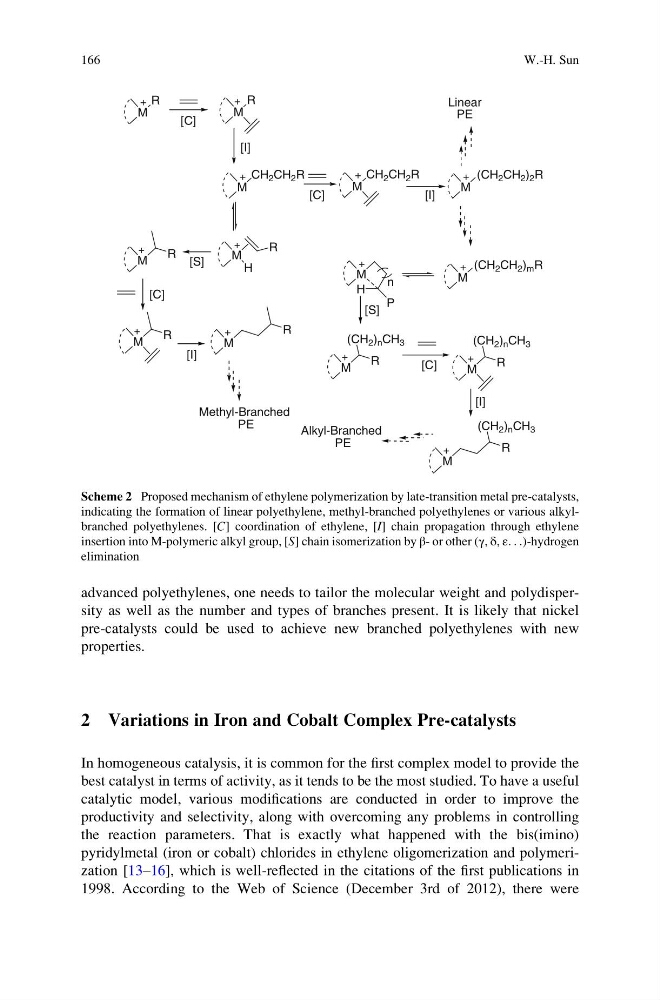
Scheme 2 Proposed mechanism of ethylene polymerization by late-transition metal pre-catalysts,
indicating the formation of linear polyethylene, methyl-branched polyethylenes or various alkylbranched polyethylenes. [C] coordination of ethylene, [I] chain propagation through ethylene
insertion into M-polymeric alkyl group, [S] chain isomerization by β- or other (γ, δ, ε. . .)-hydrogen
elimination
166
W.-H. Sun
pre-catalysts could be used to achieve new branched polyethylenes with new
properties.
2 Variations in Iron and Cobalt Complex Pre-catalysts
In homogeneous catalysis, it is common for the first complex model to provide the
best catalyst in terms of activity, as it tends to be the most studied. To have a useful
catalytic model, various modifications are conducted in order to improve the
productivity and selectivity, along with overcoming any problems in controlling
the reaction parameters. That is exactly what happened with the bis(imino)
pyridylmetal (iron or cobalt) chlorides in ethylene oligomerization and polymerization [13–16], which is well-reflected in the citations of the first publications in
1998. According to the Web of Science (December 3rd of 2012), there were
[C]
[I]
M
R
M
R
M
CH 2 CH 2 R
[C]
M
(CH 2 CH 2 ) 2 R
[I]
M
CH 2 CH 2 R
Linear
PE
[C]
[S]
M
M
H
R
R
M
R
[I]
M
R
Methyl-Branched
PE
[C]
M
(CH 2 CH 2 ) m R
M
H
P
n
[S]
M
(CH 2 ) n CH 3
R
M
(CH 2 ) n CH 3
R
M
R
(CH 2 ) n CH 3
Alkyl-Branched
PE
[I]
Scheme 2 Proposed mechanism of ethylene polymerization by late-transition metal pre-catalysts,
indicating the formation of linear polyethylene, methyl-branched polyethylenes or various alkylbranched polyethylenes. [C] coordination of ethylene, [I] chain propagation through ethylene
insertion into M-polymeric alkyl group, [S] chain isomerization by β- or other (γ, δ, ε. . .)-hydrogen
elimination
166
W.-H. Sun