

Huge amounts of polyolefins provide cheap and light substances for the everyday
world, for example they are used in the construction of furniture as well as for
decorative and constructive parts. Other articles have highlighted the importance of
Ziegler–Natta [1–4], Phillips [5], and the rapidly developing metallocene catalyst field
[6–8]. Nothing is perfect in science, and therefore there is no end to the exploration of
new catalysts in any catalytic system, including polyolefin formation. Although there
are well-developed operating systems in olefin polymerization, industry is keen to
develop new catalytic systems and to produce new polyolefin materials. With the
knowledge accrued to date, it is reasonable to assume that late-transition metal
complex pre-catalysts can provide alternative options in catalyst design and also
potentially create new advanced and unique polyethylenes. With emphasis on the
electronic configuration, 14-electron active species are common to both metallocenes
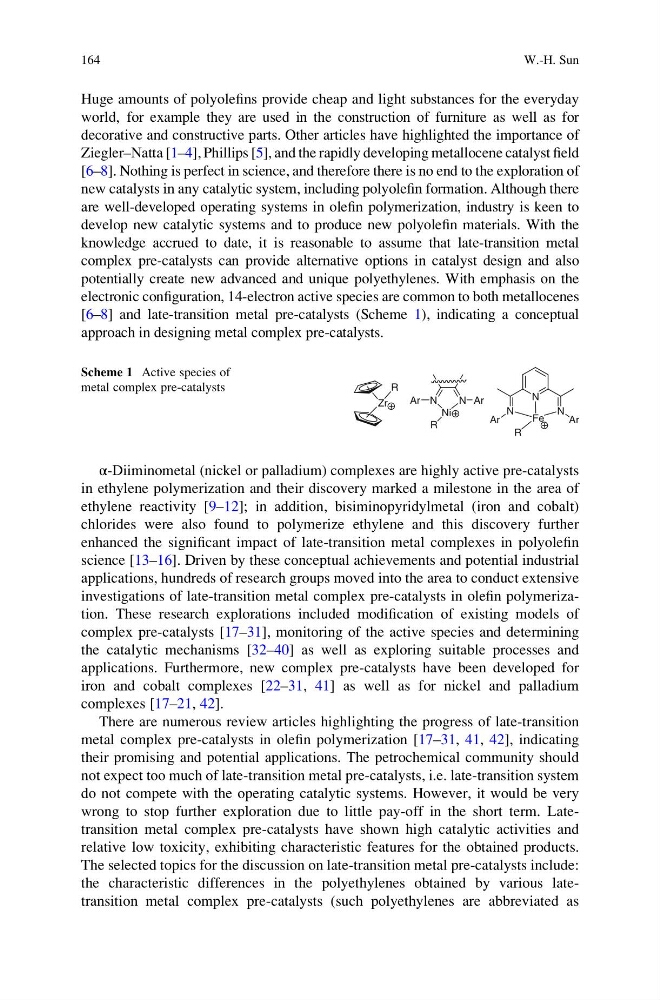
[6–8] and late-transition metal pre-catalysts (Scheme 1), indicating a conceptual
approach in designing metal complex pre-catalysts.
α-Diiminometal (nickel or palladium) complexes are highly active pre-catalysts
in ethylene polymerization and their discovery marked a milestone in the area of
ethylene reactivity [9–12]; in addition, bisiminopyridylmetal (iron and cobalt)
chlorides were also found to polymerize ethylene and this discovery further
enhanced the significant impact of late-transition metal complexes in polyolefin
science [13–16]. Driven by these conceptual achievements and potential industrial
applications, hundreds of research groups moved into the area to conduct extensive
investigations of late-transition metal complex pre-catalysts in olefin polymerization. These research explorations included modification of existing models of
complex pre-catalysts [17–31], monitoring of the active species and determining
the catalytic mechanisms [32–40] as well as exploring suitable processes and
applications. Furthermore, new complex pre-catalysts have been developed for
iron and cobalt complexes [22–31, 41] as well as for nickel and palladium
complexes [17–21, 42].
There are numerous review articles highlighting the progress of late-transition
metal complex pre-catalysts in olefin polymerization [17–31, 41, 42], indicating
their promising and potential applications. The petrochemical community should
not expect too much of late-transition metal pre-catalysts, i.e. late-transition system
do not compete with the operating catalytic systems. However, it would be very
wrong to stop further exploration due to little pay-off in the short term. Latetransition metal complex pre-catalysts have shown high catalytic activities and
relative low toxicity, exhibiting characteristic features for the obtained products.
The selected topics for the discussion on late-transition metal pre-catalysts include:
the characteristic differences in the polyethylenes obtained by various latetransition metal complex pre-catalysts (such polyethylenes are abbreviated as
Zr
R
N
N
Ni
Ar
Ar
R
N
N
N
Fe
R
Ar
Ar
Scheme 1 Active species of
metal complex pre-catalysts
164
W.-H. Sun
world, for example they are used in the construction of furniture as well as for
decorative and constructive parts. Other articles have highlighted the importance of
Ziegler–Natta [1–4], Phillips [5], and the rapidly developing metallocene catalyst field
[6–8]. Nothing is perfect in science, and therefore there is no end to the exploration of
new catalysts in any catalytic system, including polyolefin formation. Although there
are well-developed operating systems in olefin polymerization, industry is keen to
develop new catalytic systems and to produce new polyolefin materials. With the
knowledge accrued to date, it is reasonable to assume that late-transition metal
complex pre-catalysts can provide alternative options in catalyst design and also
potentially create new advanced and unique polyethylenes. With emphasis on the
electronic configuration, 14-electron active species are common to both metallocenes
[6–8] and late-transition metal pre-catalysts (Scheme 1), indicating a conceptual
approach in designing metal complex pre-catalysts.
α-Diiminometal (nickel or palladium) complexes are highly active pre-catalysts
in ethylene polymerization and their discovery marked a milestone in the area of
ethylene reactivity [9–12]; in addition, bisiminopyridylmetal (iron and cobalt)
chlorides were also found to polymerize ethylene and this discovery further
enhanced the significant impact of late-transition metal complexes in polyolefin
science [13–16]. Driven by these conceptual achievements and potential industrial
applications, hundreds of research groups moved into the area to conduct extensive
investigations of late-transition metal complex pre-catalysts in olefin polymerization. These research explorations included modification of existing models of
complex pre-catalysts [17–31], monitoring of the active species and determining
the catalytic mechanisms [32–40] as well as exploring suitable processes and
applications. Furthermore, new complex pre-catalysts have been developed for
iron and cobalt complexes [22–31, 41] as well as for nickel and palladium
complexes [17–21, 42].
There are numerous review articles highlighting the progress of late-transition
metal complex pre-catalysts in olefin polymerization [17–31, 41, 42], indicating
their promising and potential applications. The petrochemical community should
not expect too much of late-transition metal pre-catalysts, i.e. late-transition system
do not compete with the operating catalytic systems. However, it would be very
wrong to stop further exploration due to little pay-off in the short term. Latetransition metal complex pre-catalysts have shown high catalytic activities and
relative low toxicity, exhibiting characteristic features for the obtained products.
The selected topics for the discussion on late-transition metal pre-catalysts include:
the characteristic differences in the polyethylenes obtained by various latetransition metal complex pre-catalysts (such polyethylenes are abbreviated as
Zr
R
N
N
Ni
Ar
Ar
R
N
N
N
Fe
R
Ar
Ar
Scheme 1 Active species of
metal complex pre-catalysts
164
W.-H. Sun