

weight of 1,000 but has only a very poor polymerization activity compared with
MAO [42].
The use of separately produced MAO together with Cp 2 Ti(CH 3 ) 2 further
increased the activity by a factor of 100 compared to the system of Cp 2 Ti(CH 3 ) 2 /
Al(CH 3 ) 3 /H 2 O [31]. For the first time it was possible to polymerize propene with a
soluble biscyclopentadienyl-titanium/MAO catalyst to obtain atactic polypropylene
and to generate ethene/propene copolymers. We used bis(cyclopentadienyl)zirconium dimethyl and MAO for polymerization of ethene and propene and obtained
extremely high activities, higher than for the titanium system. To date, biscyclopentadienyl–zirconium complexes, activated by aluminum alkyls have been
described as totally inactive for olefin polymerization. A patent application was
written covering these exciting results [43], but the interest in industry was not very
enthusiastic for this new catalyst system. It was also discovered that Cp 2 ZrCl 2 ,
which can be synthesized more easily and is more stable than Cp 2 Zr(CH 3 ) 2 , is also
an active catalyst precursor in combination with MAO. The nature of the active site
and the role of MAO are not totally clear. One function of MAO is the alkylation of
the metallocene complex if a dichloride is used. The other function is the formation
of an ion pair. Shilov and Dyachkovsky [44], Eisch [45], Jordan [46], and
Bochmann [47] all showed that the activity of metallocene catalysts depends on
the formation of cationic species. Today, most research groups agree with this
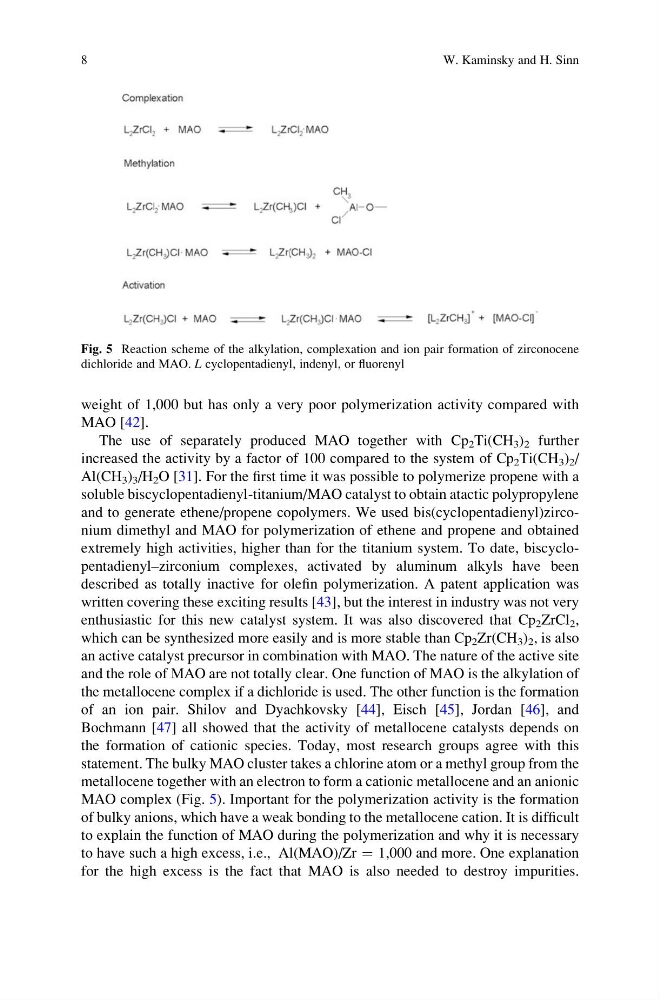
statement. The bulky MAO cluster takes a chlorine atom or a methyl group from the
metallocene together with an electron to form a cationic metallocene and an anionic
MAO complex (Fig. 5). Important for the polymerization activity is the formation
of bulky anions, which have a weak bonding to the metallocene cation. It is difficult
to explain the function of MAO during the polymerization and why it is necessary
to have such a high excess, i.e., Al(MAO)/Zr ¼ 1,000 and more. One explanation
for the high excess is the fact that MAO is also needed to destroy impurities.
Fig. 5 Reaction scheme of the alkylation, complexation and ion pair formation of zirconocene
dichloride and MAO. L cyclopentadienyl, indenyl, or fluorenyl
8
W. Kaminsky and H. Sinn
MAO [42].
The use of separately produced MAO together with Cp 2 Ti(CH 3 ) 2 further
increased the activity by a factor of 100 compared to the system of Cp 2 Ti(CH 3 ) 2 /
Al(CH 3 ) 3 /H 2 O [31]. For the first time it was possible to polymerize propene with a
soluble biscyclopentadienyl-titanium/MAO catalyst to obtain atactic polypropylene
and to generate ethene/propene copolymers. We used bis(cyclopentadienyl)zirconium dimethyl and MAO for polymerization of ethene and propene and obtained
extremely high activities, higher than for the titanium system. To date, biscyclopentadienyl–zirconium complexes, activated by aluminum alkyls have been
described as totally inactive for olefin polymerization. A patent application was
written covering these exciting results [43], but the interest in industry was not very
enthusiastic for this new catalyst system. It was also discovered that Cp 2 ZrCl 2 ,
which can be synthesized more easily and is more stable than Cp 2 Zr(CH 3 ) 2 , is also
an active catalyst precursor in combination with MAO. The nature of the active site
and the role of MAO are not totally clear. One function of MAO is the alkylation of
the metallocene complex if a dichloride is used. The other function is the formation
of an ion pair. Shilov and Dyachkovsky [44], Eisch [45], Jordan [46], and
Bochmann [47] all showed that the activity of metallocene catalysts depends on
the formation of cationic species. Today, most research groups agree with this
statement. The bulky MAO cluster takes a chlorine atom or a methyl group from the
metallocene together with an electron to form a cationic metallocene and an anionic
MAO complex (Fig. 5). Important for the polymerization activity is the formation
of bulky anions, which have a weak bonding to the metallocene cation. It is difficult
to explain the function of MAO during the polymerization and why it is necessary
to have such a high excess, i.e., Al(MAO)/Zr ¼ 1,000 and more. One explanation
for the high excess is the fact that MAO is also needed to destroy impurities.
Fig. 5 Reaction scheme of the alkylation, complexation and ion pair formation of zirconocene
dichloride and MAO. L cyclopentadienyl, indenyl, or fluorenyl
8
W. Kaminsky and H. Sinn