

EÀN copolymerization. All propene consecutive monomer units have the methyls
in erythro relationships, as in an isotactic polypropene chain.
Boggioni et al. [103] proposed a general scheme for describing the microstructure
of PÀN copolymers at triad level from
13
C NMR spectra. This scheme includes
(1) definition of the possible triads composing the copolymer chain; (2) use of NMR
techniques for assigning new signals; and (3) a best-fitting procedure to determine the
copolymer microstructure [103]. This procedure, which allows for a quantitative
analysis of copolymer sequences as accurate as possible, has been applied to analysis
of the
13
C NMR spectra of a number of PÀN copolymers prepared with catalyst
precursors rac-[Et(Ind) 2 ]ZrCl 2 (I-1) and rac-[Me 2 Si(2-Me-Ind) 2 ]ZrCl 2 (I-4).
The microstructural analysis by
13 C NMR of the copolymers gives evidence of
the tendency of I-1 to alternate propene and norbornene comonomers and of I-4 not
to alternate the comonomers, as well as information on the probability of insertion
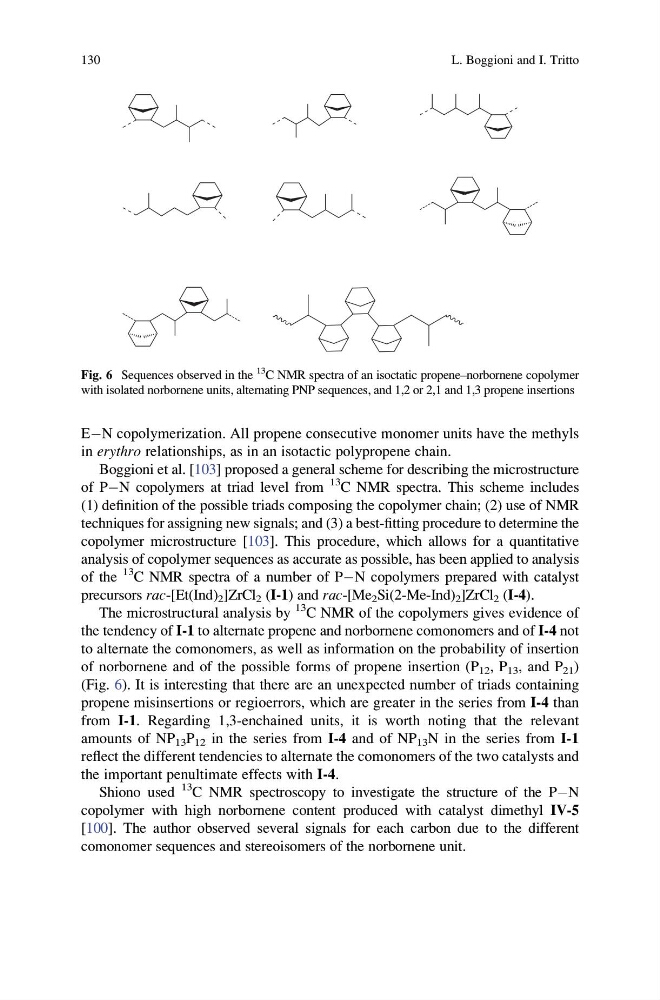
of norbornene and of the possible forms of propene insertion (P 12 , P 13 , and P 21 )
(Fig. 6). It is interesting that there are an unexpected number of triads containing
propene misinsertions or regioerrors, which are greater in the series from I-4 than
from I-1. Regarding 1,3-enchained units, it is worth noting that the relevant
amounts of NP 13 P 12 in the series from I-4 and of NP 13 N in the series from I-1
reflect the different tendencies to alternate the comonomers of the two catalysts and
the important penultimate effects with I-4.
Shiono used
13
C NMR spectroscopy to investigate the structure of the PÀN
copolymer with high norbornene content produced with catalyst dimethyl IV-5
[100]. The author observed several signals for each carbon due to the different
comonomer sequences and stereoisomers of the norbornene unit.
Fig. 6 Sequences observed in the
13
C NMR spectra of an isoctatic propene–norbornene copolymer
with isolated norbornene units, alternating PNP sequences, and 1,2 or 2,1 and 1,3 propene insertions
130
L. Boggioni and I. Tritto
in erythro relationships, as in an isotactic polypropene chain.
Boggioni et al. [103] proposed a general scheme for describing the microstructure
of PÀN copolymers at triad level from
13
C NMR spectra. This scheme includes
(1) definition of the possible triads composing the copolymer chain; (2) use of NMR
techniques for assigning new signals; and (3) a best-fitting procedure to determine the
copolymer microstructure [103]. This procedure, which allows for a quantitative
analysis of copolymer sequences as accurate as possible, has been applied to analysis
of the
13
C NMR spectra of a number of PÀN copolymers prepared with catalyst
precursors rac-[Et(Ind) 2 ]ZrCl 2 (I-1) and rac-[Me 2 Si(2-Me-Ind) 2 ]ZrCl 2 (I-4).
The microstructural analysis by
13 C NMR of the copolymers gives evidence of
the tendency of I-1 to alternate propene and norbornene comonomers and of I-4 not
to alternate the comonomers, as well as information on the probability of insertion
of norbornene and of the possible forms of propene insertion (P 12 , P 13 , and P 21 )
(Fig. 6). It is interesting that there are an unexpected number of triads containing
propene misinsertions or regioerrors, which are greater in the series from I-4 than
from I-1. Regarding 1,3-enchained units, it is worth noting that the relevant
amounts of NP 13 P 12 in the series from I-4 and of NP 13 N in the series from I-1
reflect the different tendencies to alternate the comonomers of the two catalysts and
the important penultimate effects with I-4.
Shiono used
13
C NMR spectroscopy to investigate the structure of the PÀN
copolymer with high norbornene content produced with catalyst dimethyl IV-5
[100]. The author observed several signals for each carbon due to the different
comonomer sequences and stereoisomers of the norbornene unit.
Fig. 6 Sequences observed in the
13
C NMR spectra of an isoctatic propene–norbornene copolymer
with isolated norbornene units, alternating PNP sequences, and 1,2 or 2,1 and 1,3 propene insertions
130
L. Boggioni and I. Tritto