

endotherms and a broad composition distribution. One explanation for the broad
composition or molecular weight distribution could be the fact that the chiral forms
(R, S) and the small amounts of the meso form of the zirconocene complex produce
different microstructures and molecular weights of the cyclopentene/ethene
copolymers [31]. A narrow copolymer composition distribution was obtained with
rac-[Me 2 Si(Ind) 2 ]ZrCl 2 (I-2 in Fig. 3).
Coates and Fujita [32] succeeded in the synthesis of highly alternating atactic
cyclopentene/ethene copolymer using a bis(phenoximine)titanium dichloride complex
activated by MAO. Copolymers show glass transition temperatures (T g ) between
À27
C (27 mol% Cp) and 10.1
C (47 mol% Cp). Similar alternating copolymers
were obtained by Waymouth and coworkers [33] using a constrained geometry titanium catalyst, dimethylsilylene[tetramethylcyclopentadienyl][N-tert-butyl]titanium
dichloride, and modified MAO. The cyclopentene units are inserted by cis-1,
2-enchainment. Such a cyclopentene/ethene copolymer with nearly 50 mol% of
Cp units shows a melting point of 182.5
C and T g of 16.3
C.
If the C 2 zirconocenes rac-[Et(Ind) 2 ]ZrCl 2 (I-1) [36] or rac-[Me 2 Si(Ind) 2 ]ZrCl 2
(I-2) activated by MAO are used, the resulting copolymers contain 2–5 mol% of
Cp units incorporated by 1,2-enchainment mode. The molecular weights of the
copolymers are low and lie between 35,000 (0
C) and 17,000 g/mol (30
C copolymerization temperature).
Cycloheptene and cyclooctene can be copolymerized with ethene, though
copolymer yields are about 25% of that obtained with cyclopentene [28].
Copolymers with up to 4.5 mol% of cycloheptene and 1 mol% of cyclooctene
could be produced using rac-[Et(Ind) 2 ]ZrCl 2 /MAO (I-1) as catalyst. Alternating
copolymers of cycloheptene and cyclooctene using a constrained geometry catalyst
with a benzindenyl ligand were obtained by Lavoie and Waymouth [36].
Cyclohexene could not be copolymerized using ansa-metallocenes. Recently,
copolymerization of ethene with cyclohexene with efficient cyclohexene
incorporation by using non-bridged half-titanocenes containing an aryloxo ligand
was reported by Nomura [37].
cat +
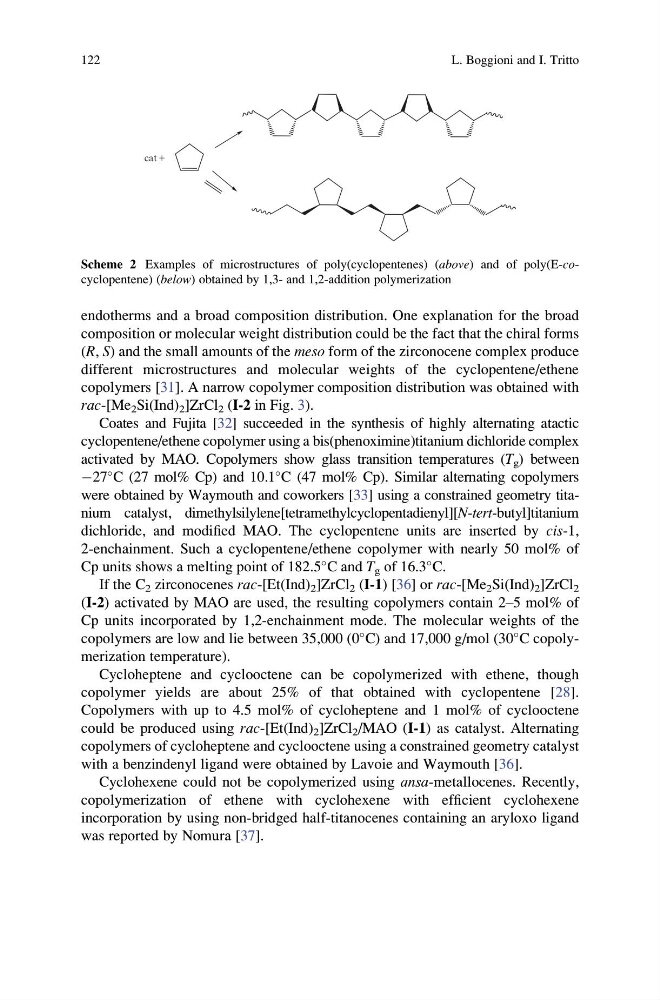
Scheme 2 Examples of microstructures of poly(cyclopentenes) (above) and of poly(E-cocyclopentene) (below) obtained by 1,3- and 1,2-addition polymerization
122
L. Boggioni and I. Tritto
composition or molecular weight distribution could be the fact that the chiral forms
(R, S) and the small amounts of the meso form of the zirconocene complex produce
different microstructures and molecular weights of the cyclopentene/ethene
copolymers [31]. A narrow copolymer composition distribution was obtained with
rac-[Me 2 Si(Ind) 2 ]ZrCl 2 (I-2 in Fig. 3).
Coates and Fujita [32] succeeded in the synthesis of highly alternating atactic
cyclopentene/ethene copolymer using a bis(phenoximine)titanium dichloride complex
activated by MAO. Copolymers show glass transition temperatures (T g ) between
À27
C (27 mol% Cp) and 10.1
C (47 mol% Cp). Similar alternating copolymers
were obtained by Waymouth and coworkers [33] using a constrained geometry titanium catalyst, dimethylsilylene[tetramethylcyclopentadienyl][N-tert-butyl]titanium
dichloride, and modified MAO. The cyclopentene units are inserted by cis-1,
2-enchainment. Such a cyclopentene/ethene copolymer with nearly 50 mol% of
Cp units shows a melting point of 182.5
C and T g of 16.3
C.
If the C 2 zirconocenes rac-[Et(Ind) 2 ]ZrCl 2 (I-1) [36] or rac-[Me 2 Si(Ind) 2 ]ZrCl 2
(I-2) activated by MAO are used, the resulting copolymers contain 2–5 mol% of
Cp units incorporated by 1,2-enchainment mode. The molecular weights of the
copolymers are low and lie between 35,000 (0
C) and 17,000 g/mol (30
C copolymerization temperature).
Cycloheptene and cyclooctene can be copolymerized with ethene, though
copolymer yields are about 25% of that obtained with cyclopentene [28].
Copolymers with up to 4.5 mol% of cycloheptene and 1 mol% of cyclooctene
could be produced using rac-[Et(Ind) 2 ]ZrCl 2 /MAO (I-1) as catalyst. Alternating
copolymers of cycloheptene and cyclooctene using a constrained geometry catalyst
with a benzindenyl ligand were obtained by Lavoie and Waymouth [36].
Cyclohexene could not be copolymerized using ansa-metallocenes. Recently,
copolymerization of ethene with cyclohexene with efficient cyclohexene
incorporation by using non-bridged half-titanocenes containing an aryloxo ligand
was reported by Nomura [37].
cat +
Scheme 2 Examples of microstructures of poly(cyclopentenes) (above) and of poly(E-cocyclopentene) (below) obtained by 1,3- and 1,2-addition polymerization
122
L. Boggioni and I. Tritto