

2 Copolymers with Monocyclic Olefins
Copolymerization of cyclic olefins such as cyclopentene and norbornene with
ethene or propene yield cycloolefin copolymers in which the presence of
non-cyclic units introduce flexibility in the polymer chain. Thus, the copolymers
are amorphous, processable, and soluble in common organic solvents. Early
attempts at such copolymerizations were made by using heterogeneous TiCl 4 /
AlEt 2 Cl or vanadium catalysts, but real advancements were made utilizing
metallocenes and other single-site catalysts, which are about ten times more active
than vanadium systems and other Ziegler–Natta catalysts.
Cyclopentene can be copolymerized with ethene or propene using heterogeneous and homogeneous Ziegler–Natta catalysts [1, 27–35]. Crystalline or elastomeric copolymers are obtained, depending on the cyclopentene content and the ring
opening or vinyl-type polymerization mechanism [27]. Metallocene/MAO catalysts
are very active in the copolymerization of cyclopentene with ethene. In contrast to
the homopolymerization of cyclopentene, the cyclic olefin is incorporated into the
copolymer chain by 1,2-enchainment. The polymerization activity increases with
increasing reaction temperature and reaches 19 kg of copolymer by 1 mol of
catalyst in 1 s using a low zirconocene rac-[Et(Ind) 2 ]ZrCl 2 (I-1 in Fig. 3) concentration of around 10
À6 mol/L [28].
The activities and the molecular weights of the obtained copolymers are not
much influenced by the molar ratio of cyclopentene/ethene in the starting mixture.
Cyclopentene incorporation increases with decreasing polymerization temperature
and increasing cyclopentene/ethene ratio. Statistic copolymers with cyclopentene
units from 1.7 to 18 mol% are obtained.
13
C-NMR spectroscopy showed that cyclopentene is incorporated in the copolymer
chain through a 1,2-insertion, without ring-opening metathesis. This is in contrast
to the homopolymerization of cyclopentene, where 1,3-insertion was observed
(Scheme 2). The 1,2-enchainment results from the easy coordination to the zirconium
center when the last insertion is an ethene unit. The β-hydride elimination of a
cyclopentene unit at the end of the growing chain, needed to form a 1,3-enchained
cyclopentene unit, is relatively slow compared to a next ethene insertion. Therefore, it
is difficult to synthesize copolymers with more than 50 mol% of cyclic olefin units.
Higher incorporation rates up to 64 mol% of cyclopentene were obtained if highly
substituted cyclopentadienyl/fluorenyl zirconium complexes such as rac-dimethylsilandiyl(ferroceno[2,3]inden-1-yl)(cyclopentadienyl)zirconiumdichloride were used
[29]. The copolymers show small cyclopentene blocks with 1,3-enchained units and
isolated 1,2-enchained units. The cis/trans ratio was quantified to be 10% trans of the
1,3-units and 2.9% trans of the 1,2-units, thus copolymers contain mainly cis-units.
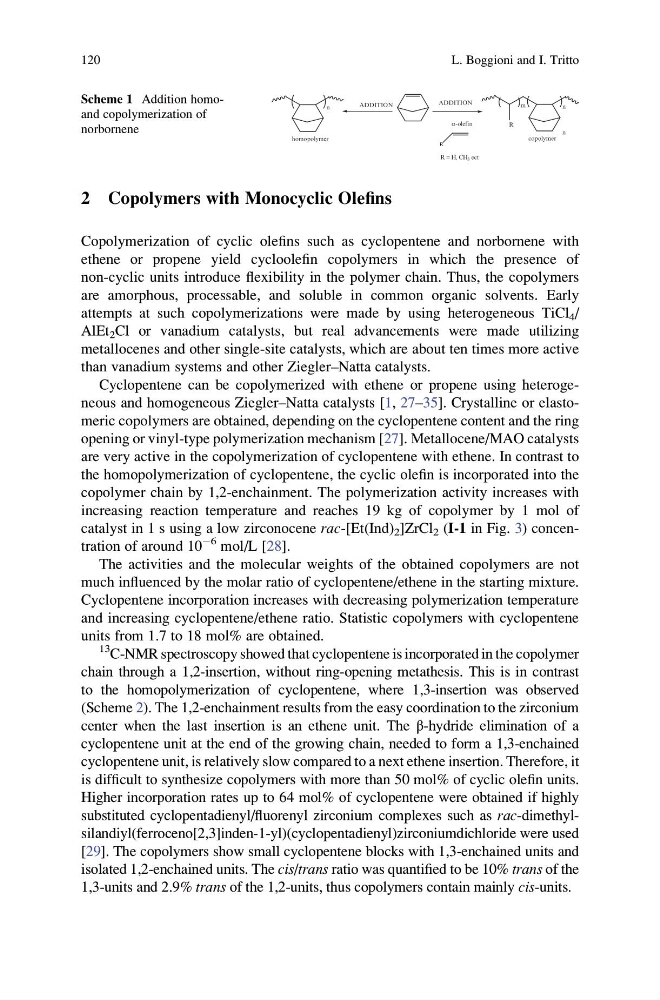
ADDITION
n
homopolymer
α-olefin
n
copolymer
R
R = H, CH3 ect
R
n
m
ADDITION
Scheme 1 Addition homoand copolymerization of
norbornene
120
L. Boggioni and I. Tritto
Copolymerization of cyclic olefins such as cyclopentene and norbornene with
ethene or propene yield cycloolefin copolymers in which the presence of
non-cyclic units introduce flexibility in the polymer chain. Thus, the copolymers
are amorphous, processable, and soluble in common organic solvents. Early
attempts at such copolymerizations were made by using heterogeneous TiCl 4 /
AlEt 2 Cl or vanadium catalysts, but real advancements were made utilizing
metallocenes and other single-site catalysts, which are about ten times more active
than vanadium systems and other Ziegler–Natta catalysts.
Cyclopentene can be copolymerized with ethene or propene using heterogeneous and homogeneous Ziegler–Natta catalysts [1, 27–35]. Crystalline or elastomeric copolymers are obtained, depending on the cyclopentene content and the ring
opening or vinyl-type polymerization mechanism [27]. Metallocene/MAO catalysts
are very active in the copolymerization of cyclopentene with ethene. In contrast to
the homopolymerization of cyclopentene, the cyclic olefin is incorporated into the
copolymer chain by 1,2-enchainment. The polymerization activity increases with
increasing reaction temperature and reaches 19 kg of copolymer by 1 mol of
catalyst in 1 s using a low zirconocene rac-[Et(Ind) 2 ]ZrCl 2 (I-1 in Fig. 3) concentration of around 10
À6 mol/L [28].
The activities and the molecular weights of the obtained copolymers are not
much influenced by the molar ratio of cyclopentene/ethene in the starting mixture.
Cyclopentene incorporation increases with decreasing polymerization temperature
and increasing cyclopentene/ethene ratio. Statistic copolymers with cyclopentene
units from 1.7 to 18 mol% are obtained.
13
C-NMR spectroscopy showed that cyclopentene is incorporated in the copolymer
chain through a 1,2-insertion, without ring-opening metathesis. This is in contrast
to the homopolymerization of cyclopentene, where 1,3-insertion was observed
(Scheme 2). The 1,2-enchainment results from the easy coordination to the zirconium
center when the last insertion is an ethene unit. The β-hydride elimination of a
cyclopentene unit at the end of the growing chain, needed to form a 1,3-enchained
cyclopentene unit, is relatively slow compared to a next ethene insertion. Therefore, it
is difficult to synthesize copolymers with more than 50 mol% of cyclic olefin units.
Higher incorporation rates up to 64 mol% of cyclopentene were obtained if highly
substituted cyclopentadienyl/fluorenyl zirconium complexes such as rac-dimethylsilandiyl(ferroceno[2,3]inden-1-yl)(cyclopentadienyl)zirconiumdichloride were used
[29]. The copolymers show small cyclopentene blocks with 1,3-enchained units and
isolated 1,2-enchained units. The cis/trans ratio was quantified to be 10% trans of the
1,3-units and 2.9% trans of the 1,2-units, thus copolymers contain mainly cis-units.
ADDITION
n
homopolymer
α-olefin
n
copolymer
R
R = H, CH3 ect
R
n
m
ADDITION
Scheme 1 Addition homoand copolymerization of
norbornene
120
L. Boggioni and I. Tritto