

7.5.5 Additive, s-PP/i-PP Blends
Syndiotactic polypropylene can be used as an impact modifier. Indeed, the addition
of s-PP to i-PP can improve impact characteristics over pure i-PP [222–225]. When
s-PP is blended with i-PP, the resulting resin has a processability better than that of
i-PP and impact and transparency properties better than those of pure i-PP. As an
impact modifier to a controlled rheology i-PP copolymer, s-PP does not crosslink or
affect the peroxide efficiency of the copolymer while improving the Izod notched
impact and maintaining the similar processability of the copolymer.
8 Experimental Details [187, 188]
8.1 Synthesis of Bridged, Cyclopentadienyl-Fluorenyl
Zirconocenes.
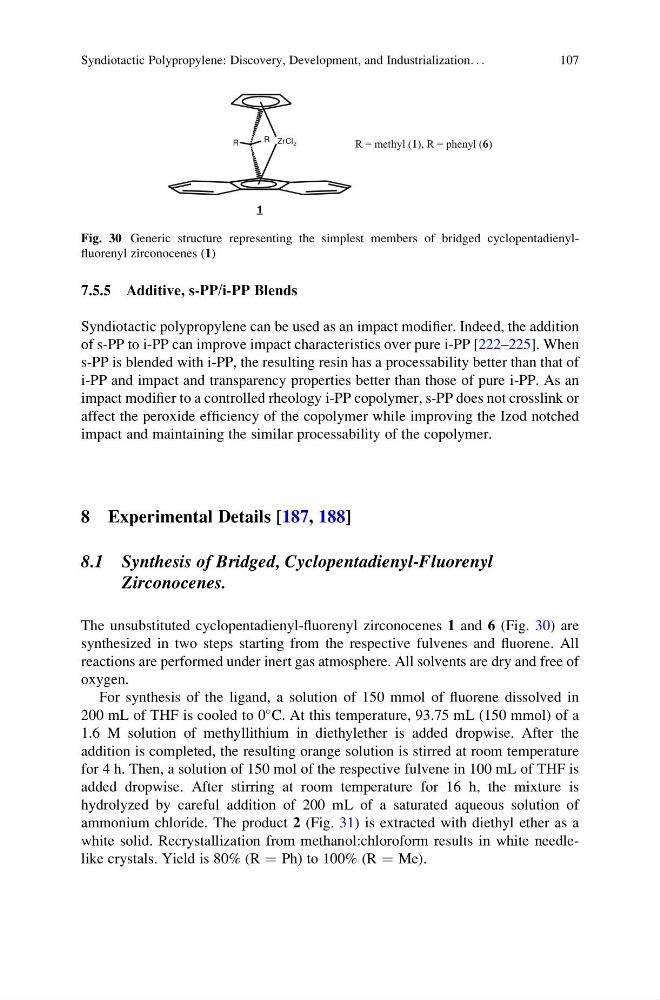
The unsubstituted cyclopentadienyl-fluorenyl zirconocenes 1 and 6 (Fig. 30) are
synthesized in two steps starting from the respective fulvenes and fluorene. All
reactions are performed under inert gas atmosphere. All solvents are dry and free of
oxygen.
For synthesis of the ligand, a solution of 150 mmol of fluorene dissolved in
200 mL of THF is cooled to 0
C. At this temperature, 93.75 mL (150 mmol) of a
1.6 M solution of methyllithium in diethylether is added dropwise. After the
addition is completed, the resulting orange solution is stirred at room temperature
for 4 h. Then, a solution of 150 mol of the respective fulvene in 100 mL of THF is
added dropwise. After stirring at room temperature for 16 h, the mixture is
hydrolyzed by careful addition of 200 mL of a saturated aqueous solution of
ammonium chloride. The product 2 (Fig. 31) is extracted with diethyl ether as a
white solid. Recrystallization from methanol:chloroform results in white needlelike crystals. Yield is 80% (R ¼ Ph) to 100% (R ¼ Me).
R
R ZrCl 2
1
R = methyl (1), R = phenyl (6)
Fig. 30 Generic structure representing the simplest members of bridged cyclopentadienylfluorenyl zirconocenes (1)
Syndiotactic Polypropylene: Discovery, Development, and Industrialization. . .
107
Syndiotactic polypropylene can be used as an impact modifier. Indeed, the addition
of s-PP to i-PP can improve impact characteristics over pure i-PP [222–225]. When
s-PP is blended with i-PP, the resulting resin has a processability better than that of
i-PP and impact and transparency properties better than those of pure i-PP. As an
impact modifier to a controlled rheology i-PP copolymer, s-PP does not crosslink or
affect the peroxide efficiency of the copolymer while improving the Izod notched
impact and maintaining the similar processability of the copolymer.
8 Experimental Details [187, 188]
8.1 Synthesis of Bridged, Cyclopentadienyl-Fluorenyl
Zirconocenes.
The unsubstituted cyclopentadienyl-fluorenyl zirconocenes 1 and 6 (Fig. 30) are
synthesized in two steps starting from the respective fulvenes and fluorene. All
reactions are performed under inert gas atmosphere. All solvents are dry and free of
oxygen.
For synthesis of the ligand, a solution of 150 mmol of fluorene dissolved in
200 mL of THF is cooled to 0
C. At this temperature, 93.75 mL (150 mmol) of a
1.6 M solution of methyllithium in diethylether is added dropwise. After the
addition is completed, the resulting orange solution is stirred at room temperature
for 4 h. Then, a solution of 150 mol of the respective fulvene in 100 mL of THF is
added dropwise. After stirring at room temperature for 16 h, the mixture is
hydrolyzed by careful addition of 200 mL of a saturated aqueous solution of
ammonium chloride. The product 2 (Fig. 31) is extracted with diethyl ether as a
white solid. Recrystallization from methanol:chloroform results in white needlelike crystals. Yield is 80% (R ¼ Ph) to 100% (R ¼ Me).
R
R ZrCl 2
1
R = methyl (1), R = phenyl (6)
Fig. 30 Generic structure representing the simplest members of bridged cyclopentadienylfluorenyl zirconocenes (1)
Syndiotactic Polypropylene: Discovery, Development, and Industrialization. . .
107