

depending on the degree of stereoregularity and the mechanical and thermal
history, different degrees of statistical disorder are present in the crystal packing.
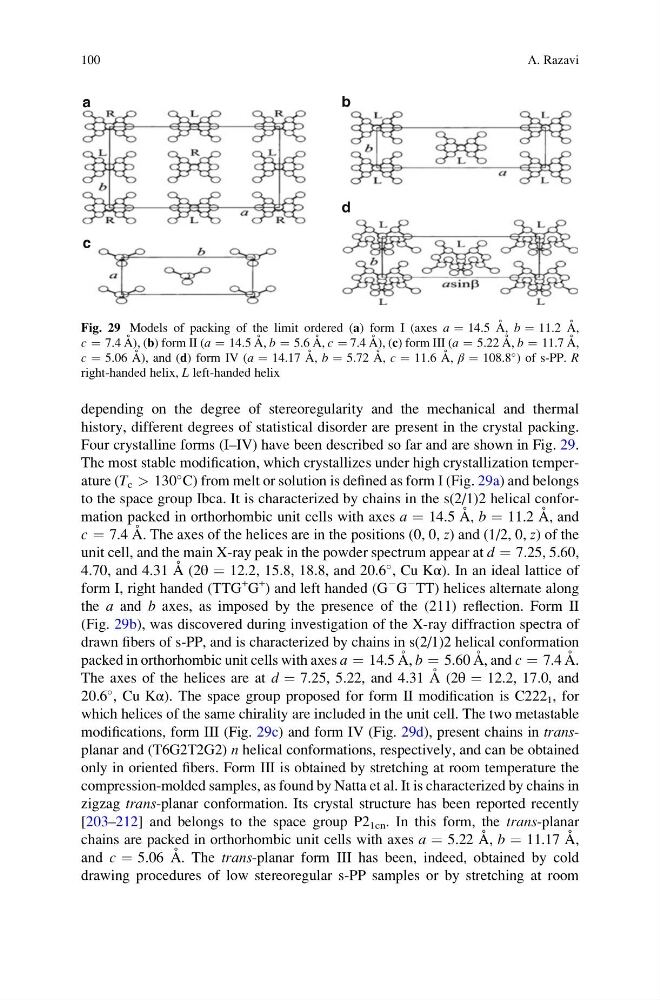
Four crystalline forms (I–IV) have been described so far and are shown in Fig. 29.
The most stable modification, which crystallizes under high crystallization temperature (T c > 130
C) from melt or solution is defined as form I (Fig. 29a) and belongs
to the space group Ibca. It is characterized by chains in the s(2/1)2 helical conformation packed in orthorhombic unit cells with axes a ¼ 14.5 A ˚ , b ¼ 11.2 A ˚ , and
c ¼ 7.4 A ˚ . The axes of the helices are in the positions (0, 0, z) and (1/2, 0, z) of the
unit cell, and the main X-ray peak in the powder spectrum appear at d ¼ 7.25, 5.60,
4.70, and 4.31 A ˚ (2θ ¼ 12.2, 15.8, 18.8, and 20.6
, Cu Kα). In an ideal lattice of
form I, right handed (TTG
+
G
+
) and left handed (G
À G
À TT) helices alternate along
the a and b axes, as imposed by the presence of the (211) reflection. Form II
(Fig. 29b), was discovered during investigation of the X-ray diffraction spectra of
drawn fibers of s-PP, and is characterized by chains in s(2/1)2 helical conformation
packed in orthorhombic unit cells with axes a ¼ 14.5 A ˚ , b ¼ 5.60 A ˚ , and c ¼ 7.4 A ˚ .
The axes of the helices are at d ¼ 7.25, 5.22, and 4.31 A ˚ (2θ ¼ 12.2, 17.0, and
20.6
, Cu Kα). The space group proposed for form II modification is C222 1 , for
which helices of the same chirality are included in the unit cell. The two metastable
modifications, form III (Fig. 29c) and form IV (Fig. 29d), present chains in transplanar and (T6G2T2G2) n helical conformations, respectively, and can be obtained
only in oriented fibers. Form III is obtained by stretching at room temperature the
compression-molded samples, as found by Natta et al. It is characterized by chains in
zigzag trans-planar conformation. Its crystal structure has been reported recently
[203–212] and belongs to the space group P2 1cn . In this form, the trans-planar
chains are packed in orthorhombic unit cells with axes a ¼ 5.22 A ˚ , b ¼ 11.17 A ˚ ,
and c ¼ 5.06 A ˚ . The trans-planar form III has been, indeed, obtained by cold
drawing procedures of low stereoregular s-PP samples or by stretching at room
a
b
c
d
Fig. 29 Models of packing of the limit ordered (a) form I (axes a ¼ 14.5 A ˚ , b ¼ 11.2 A ˚ ,
c ¼ 7.4 A ˚ ), (b) form II (a ¼ 14.5 A ˚ , b ¼ 5.6 A ˚ , c ¼ 7.4 A ˚ ), (c) form III (a ¼ 5.22 A ˚ , b ¼ 11.7 A ˚ ,
c ¼ 5.06 A ˚ ), and (d) form IV (a ¼ 14.17 A ˚ , b ¼ 5.72 A ˚ , c ¼ 11.6 A ˚ , β ¼ 108.8
) of s-PP. R
right-handed helix, L left-handed helix
100
A. Razavi
history, different degrees of statistical disorder are present in the crystal packing.
Four crystalline forms (I–IV) have been described so far and are shown in Fig. 29.
The most stable modification, which crystallizes under high crystallization temperature (T c > 130
C) from melt or solution is defined as form I (Fig. 29a) and belongs
to the space group Ibca. It is characterized by chains in the s(2/1)2 helical conformation packed in orthorhombic unit cells with axes a ¼ 14.5 A ˚ , b ¼ 11.2 A ˚ , and
c ¼ 7.4 A ˚ . The axes of the helices are in the positions (0, 0, z) and (1/2, 0, z) of the
unit cell, and the main X-ray peak in the powder spectrum appear at d ¼ 7.25, 5.60,
4.70, and 4.31 A ˚ (2θ ¼ 12.2, 15.8, 18.8, and 20.6
, Cu Kα). In an ideal lattice of
form I, right handed (TTG
+
G
+
) and left handed (G
À G
À TT) helices alternate along
the a and b axes, as imposed by the presence of the (211) reflection. Form II
(Fig. 29b), was discovered during investigation of the X-ray diffraction spectra of
drawn fibers of s-PP, and is characterized by chains in s(2/1)2 helical conformation
packed in orthorhombic unit cells with axes a ¼ 14.5 A ˚ , b ¼ 5.60 A ˚ , and c ¼ 7.4 A ˚ .
The axes of the helices are at d ¼ 7.25, 5.22, and 4.31 A ˚ (2θ ¼ 12.2, 17.0, and
20.6
, Cu Kα). The space group proposed for form II modification is C222 1 , for
which helices of the same chirality are included in the unit cell. The two metastable
modifications, form III (Fig. 29c) and form IV (Fig. 29d), present chains in transplanar and (T6G2T2G2) n helical conformations, respectively, and can be obtained
only in oriented fibers. Form III is obtained by stretching at room temperature the
compression-molded samples, as found by Natta et al. It is characterized by chains in
zigzag trans-planar conformation. Its crystal structure has been reported recently
[203–212] and belongs to the space group P2 1cn . In this form, the trans-planar
chains are packed in orthorhombic unit cells with axes a ¼ 5.22 A ˚ , b ¼ 11.17 A ˚ ,
and c ¼ 5.06 A ˚ . The trans-planar form III has been, indeed, obtained by cold
drawing procedures of low stereoregular s-PP samples or by stretching at room
a
b
c
d
Fig. 29 Models of packing of the limit ordered (a) form I (axes a ¼ 14.5 A ˚ , b ¼ 11.2 A ˚ ,
c ¼ 7.4 A ˚ ), (b) form II (a ¼ 14.5 A ˚ , b ¼ 5.6 A ˚ , c ¼ 7.4 A ˚ ), (c) form III (a ¼ 5.22 A ˚ , b ¼ 11.7 A ˚ ,
c ¼ 5.06 A ˚ ), and (d) form IV (a ¼ 14.17 A ˚ , b ¼ 5.72 A ˚ , c ¼ 11.6 A ˚ , β ¼ 108.8
) of s-PP. R
right-handed helix, L left-handed helix
100
A. Razavi