

results of association phenomena. The apex of this doctrine was in the early
twentieth century and first among the protagonists were Carl Wilhelm Wolfgang
Ostwald [57] and Wolfgang Josef Pauli [58] (father of the Physics Nobel Laureate).
The quintessence of colloid theory was: “to polymerize” means “to aggregate.”
Finally, the anti-large-molecules camp was assisted by crystallographers who
analyzed crystalline macromolecular substances (e.g., fibers of cellulose and
stretched caoutchouc). There was broad agreement that a molecule could not be
larger than its unit cell. Even though Michael Polanyi pointed out, in a public
discussion in 1921, the possibility that molecules larger than their unit cells could
exist [59],
6 the argument was not taken up again for some time, neither by him nor
by others.
Early in the twentieth century, chemists held, almost exclusively, the belief that
molecules were always small and could not be stable above a critical molecular
weight that appears, from today’s vantage point, amazingly modest. They also held
the view that a pure substance consisted of a single molecular component.
Proponents of this view estimated the limit of molecular weight to be in the few
thousand [60]. By 1920, most chemists were firmly sworn to the canon that largechain molecules could not exist. The 1902 Nobel Laureate in Chemistry, Hermann
Emil Fischer, said in 1913 that very large molecular weights were not possible and
pointed to the highest known molecular weight of 4,021for an artificial sugar
compound [61, 62]. Paul Karrer, who was awarded the Nobel Prize in Chemistry
in 1937, wrote in 1921 [63]: “It is surprising that the idea, dozens or hundreds of
glucose molecules should be connected in long chains in starch, has survived
unimpaired for decades. If this were the case one would certainly have found
well-characterized higher intermediates, given the constant buildup and degradation of starch in plants, with enzymatic, acidic cleavage. It is also quite improbable
that a plant, in converting sugar into the storage material starch, which soon again
might have to be reconverted, would carry out such complicated work as is the
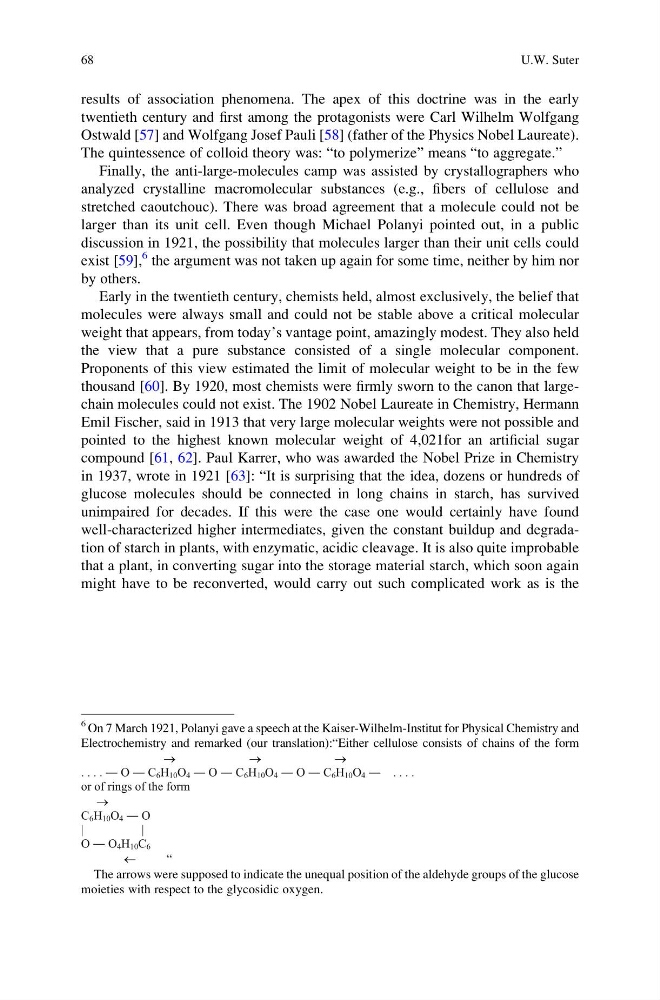
6 On 7 March 1921, Polanyi gave a speech at the Kaiser-Wilhelm-Institut for Physical Chemistry and
Electrochemistry and remarked (our translation):“Either cellulose consists of chains of the form
®
®
®
. . . . ― O ― C 6 H 10 O 4 ― O ― C 6 H 10 O 4 ― O ― C 6 H 10 O 4 ― . . . .
or of rings of the form
®
C 6 H 10 O 4 ― O
|
|
O ― O 4 H 10 C 6
¬
“
The arrows were supposed to indicate the unequal position of the aldehyde groups of the glucose
moieties with respect to the glycosidic oxygen.
68
U.W. Suter
twentieth century and first among the protagonists were Carl Wilhelm Wolfgang
Ostwald [57] and Wolfgang Josef Pauli [58] (father of the Physics Nobel Laureate).
The quintessence of colloid theory was: “to polymerize” means “to aggregate.”
Finally, the anti-large-molecules camp was assisted by crystallographers who
analyzed crystalline macromolecular substances (e.g., fibers of cellulose and
stretched caoutchouc). There was broad agreement that a molecule could not be
larger than its unit cell. Even though Michael Polanyi pointed out, in a public
discussion in 1921, the possibility that molecules larger than their unit cells could
exist [59],
6 the argument was not taken up again for some time, neither by him nor
by others.
Early in the twentieth century, chemists held, almost exclusively, the belief that
molecules were always small and could not be stable above a critical molecular
weight that appears, from today’s vantage point, amazingly modest. They also held
the view that a pure substance consisted of a single molecular component.
Proponents of this view estimated the limit of molecular weight to be in the few
thousand [60]. By 1920, most chemists were firmly sworn to the canon that largechain molecules could not exist. The 1902 Nobel Laureate in Chemistry, Hermann
Emil Fischer, said in 1913 that very large molecular weights were not possible and
pointed to the highest known molecular weight of 4,021for an artificial sugar
compound [61, 62]. Paul Karrer, who was awarded the Nobel Prize in Chemistry
in 1937, wrote in 1921 [63]: “It is surprising that the idea, dozens or hundreds of
glucose molecules should be connected in long chains in starch, has survived
unimpaired for decades. If this were the case one would certainly have found
well-characterized higher intermediates, given the constant buildup and degradation of starch in plants, with enzymatic, acidic cleavage. It is also quite improbable
that a plant, in converting sugar into the storage material starch, which soon again
might have to be reconverted, would carry out such complicated work as is the
6 On 7 March 1921, Polanyi gave a speech at the Kaiser-Wilhelm-Institut for Physical Chemistry and
Electrochemistry and remarked (our translation):“Either cellulose consists of chains of the form
®
®
®
. . . . ― O ― C 6 H 10 O 4 ― O ― C 6 H 10 O 4 ― O ― C 6 H 10 O 4 ― . . . .
or of rings of the form
®
C 6 H 10 O 4 ― O
|
|
O ― O 4 H 10 C 6
¬
“
The arrows were supposed to indicate the unequal position of the aldehyde groups of the glucose
moieties with respect to the glycosidic oxygen.
68
U.W. Suter