

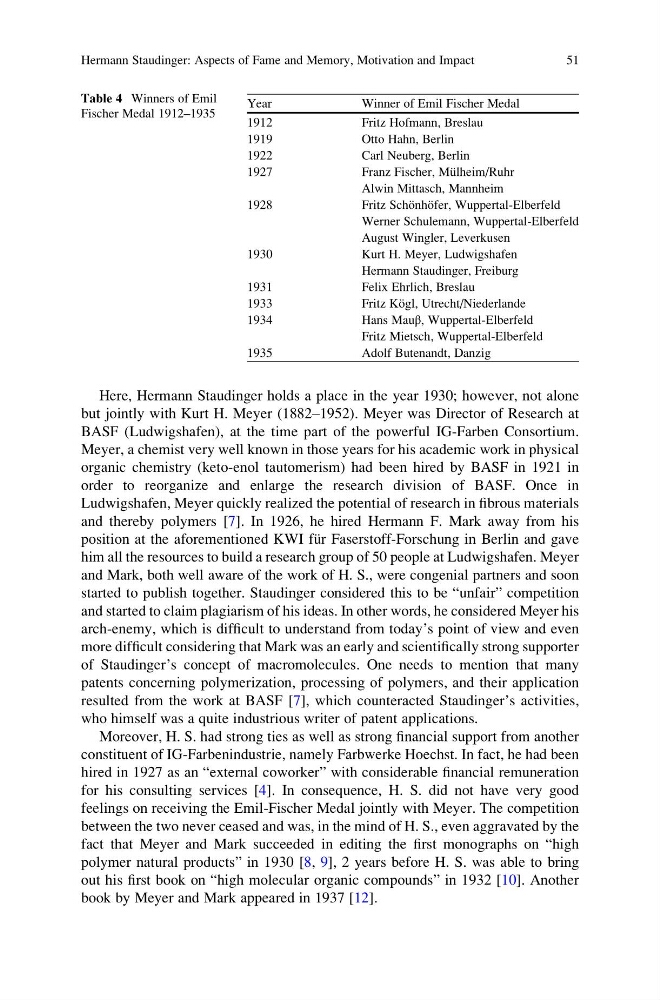
Here, Hermann Staudinger holds a place in the year 1930; however, not alone
but jointly with Kurt H. Meyer (1882–1952). Meyer was Director of Research at
BASF (Ludwigshafen), at the time part of the powerful IG-Farben Consortium.
Meyer, a chemist very well known in those years for his academic work in physical
organic chemistry (keto-enol tautomerism) had been hired by BASF in 1921 in
order to reorganize and enlarge the research division of BASF. Once in
Ludwigshafen, Meyer quickly realized the potential of research in fibrous materials
and thereby polymers [7]. In 1926, he hired Hermann F. Mark away from his
position at the aforementioned KWI fu ¨r Faserstoff-Forschung in Berlin and gave
him all the resources to build a research group of 50 people at Ludwigshafen. Meyer
and Mark, both well aware of the work of H. S., were congenial partners and soon
started to publish together. Staudinger considered this to be “unfair” competition
and started to claim plagiarism of his ideas. In other words, he considered Meyer his
arch-enemy, which is difficult to understand from today’s point of view and even
more difficult considering that Mark was an early and scientifically strong supporter
of Staudinger’s concept of macromolecules. One needs to mention that many
patents concerning polymerization, processing of polymers, and their application
resulted from the work at BASF [7], which counteracted Staudinger’s activities,
who himself was a quite industrious writer of patent applications.
Moreover, H. S. had strong ties as well as strong financial support from another
constituent of IG-Farbenindustrie, namely Farbwerke Hoechst. In fact, he had been
hired in 1927 as an “external coworker” with considerable financial remuneration
for his consulting services [4]. In consequence, H. S. did not have very good
feelings on receiving the Emil-Fischer Medal jointly with Meyer. The competition
between the two never ceased and was, in the mind of H. S., even aggravated by the
fact that Meyer and Mark succeeded in editing the first monographs on “high
polymer natural products” in 1930 [8, 9], 2 years before H. S. was able to bring
out his first book on “high molecular organic compounds” in 1932 [10]. Another
book by Meyer and Mark appeared in 1937 [12].
Table 4 Winners of Emil
Fischer Medal 1912–1935
Year
Winner of Emil Fischer Medal
1912
Fritz Hofmann, Breslau
1919
Otto Hahn, Berlin
1922
Carl Neuberg, Berlin
1927
Franz Fischer, Mu ¨lheim/Ruhr
Alwin Mittasch, Mannheim
1928
Fritz Scho ¨nho ¨fer, Wuppertal-Elberfeld
Werner Schulemann, Wuppertal-Elberfeld
August Wingler, Leverkusen
1930
Kurt H. Meyer, Ludwigshafen
Hermann Staudinger, Freiburg
1931
Felix Ehrlich, Breslau
1933
Fritz Ko ¨gl, Utrecht/Niederlande
1934
Hans Mauβ, Wuppertal-Elberfeld
Fritz Mietsch, Wuppertal-Elberfeld
1935
Adolf Butenandt, Danzig
Hermann Staudinger: Aspects of Fame and Memory, Motivation and Impact
51
but jointly with Kurt H. Meyer (1882–1952). Meyer was Director of Research at
BASF (Ludwigshafen), at the time part of the powerful IG-Farben Consortium.
Meyer, a chemist very well known in those years for his academic work in physical
organic chemistry (keto-enol tautomerism) had been hired by BASF in 1921 in
order to reorganize and enlarge the research division of BASF. Once in
Ludwigshafen, Meyer quickly realized the potential of research in fibrous materials
and thereby polymers [7]. In 1926, he hired Hermann F. Mark away from his
position at the aforementioned KWI fu ¨r Faserstoff-Forschung in Berlin and gave
him all the resources to build a research group of 50 people at Ludwigshafen. Meyer
and Mark, both well aware of the work of H. S., were congenial partners and soon
started to publish together. Staudinger considered this to be “unfair” competition
and started to claim plagiarism of his ideas. In other words, he considered Meyer his
arch-enemy, which is difficult to understand from today’s point of view and even
more difficult considering that Mark was an early and scientifically strong supporter
of Staudinger’s concept of macromolecules. One needs to mention that many
patents concerning polymerization, processing of polymers, and their application
resulted from the work at BASF [7], which counteracted Staudinger’s activities,
who himself was a quite industrious writer of patent applications.
Moreover, H. S. had strong ties as well as strong financial support from another
constituent of IG-Farbenindustrie, namely Farbwerke Hoechst. In fact, he had been
hired in 1927 as an “external coworker” with considerable financial remuneration
for his consulting services [4]. In consequence, H. S. did not have very good
feelings on receiving the Emil-Fischer Medal jointly with Meyer. The competition
between the two never ceased and was, in the mind of H. S., even aggravated by the
fact that Meyer and Mark succeeded in editing the first monographs on “high
polymer natural products” in 1930 [8, 9], 2 years before H. S. was able to bring
out his first book on “high molecular organic compounds” in 1932 [10]. Another
book by Meyer and Mark appeared in 1937 [12].
Table 4 Winners of Emil
Fischer Medal 1912–1935
Year
Winner of Emil Fischer Medal
1912
Fritz Hofmann, Breslau
1919
Otto Hahn, Berlin
1922
Carl Neuberg, Berlin
1927
Franz Fischer, Mu ¨lheim/Ruhr
Alwin Mittasch, Mannheim
1928
Fritz Scho ¨nho ¨fer, Wuppertal-Elberfeld
Werner Schulemann, Wuppertal-Elberfeld
August Wingler, Leverkusen
1930
Kurt H. Meyer, Ludwigshafen
Hermann Staudinger, Freiburg
1931
Felix Ehrlich, Breslau
1933
Fritz Ko ¨gl, Utrecht/Niederlande
1934
Hans Mauβ, Wuppertal-Elberfeld
Fritz Mietsch, Wuppertal-Elberfeld
1935
Adolf Butenandt, Danzig
Hermann Staudinger: Aspects of Fame and Memory, Motivation and Impact
51