

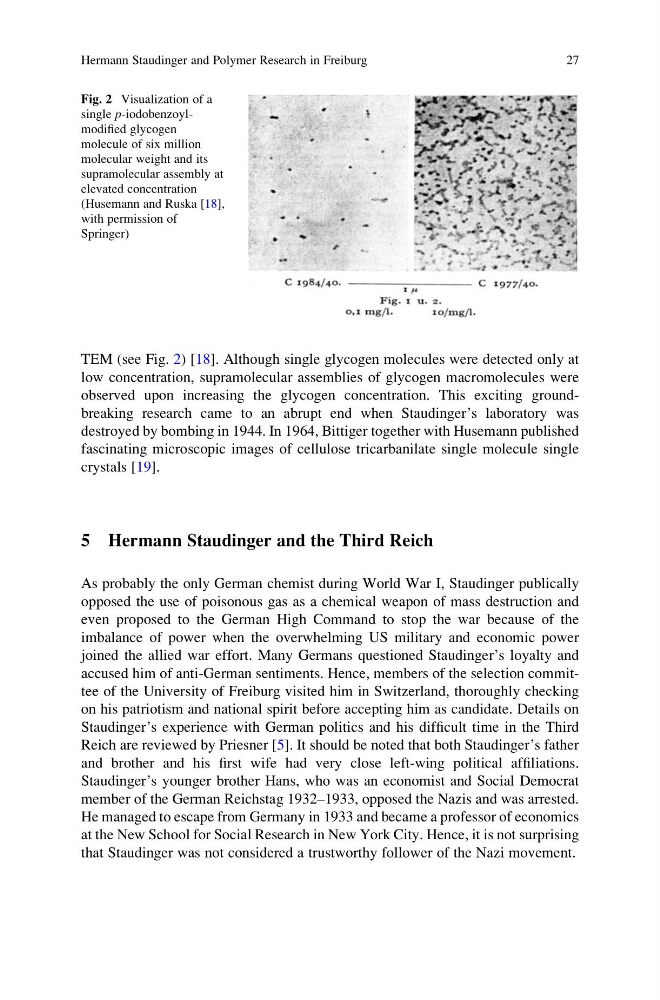
TEM (see Fig. 2) [18]. Although single glycogen molecules were detected only at
low concentration, supramolecular assemblies of glycogen macromolecules were
observed upon increasing the glycogen concentration. This exciting groundbreaking research came to an abrupt end when Staudinger’s laboratory was
destroyed by bombing in 1944. In 1964, Bittiger together with Husemann published
fascinating microscopic images of cellulose tricarbanilate single molecule single
crystals [19].
5 Hermann Staudinger and the Third Reich
As probably the only German chemist during World War I, Staudinger publically
opposed the use of poisonous gas as a chemical weapon of mass destruction and
even proposed to the German High Command to stop the war because of the
imbalance of power when the overwhelming US military and economic power
joined the allied war effort. Many Germans questioned Staudinger’s loyalty and
accused him of anti-German sentiments. Hence, members of the selection committee of the University of Freiburg visited him in Switzerland, thoroughly checking
on his patriotism and national spirit before accepting him as candidate. Details on
Staudinger’s experience with German politics and his difficult time in the Third
Reich are reviewed by Priesner [5]. It should be noted that both Staudinger’s father
and brother and his first wife had very close left-wing political affiliations.
Staudinger’s younger brother Hans, who was an economist and Social Democrat
member of the German Reichstag 1932–1933, opposed the Nazis and was arrested.
He managed to escape from Germany in 1933 and became a professor of economics
at the New School for Social Research in New York City. Hence, it is not surprising
that Staudinger was not considered a trustworthy follower of the Nazi movement.
Fig. 2 Visualization of a
single p-iodobenzoylmodified glycogen
molecule of six million
molecular weight and its
supramolecular assembly at
elevated concentration
(Husemann and Ruska [18],
with permission of
Springer)
Hermann Staudinger and Polymer Research in Freiburg
27
low concentration, supramolecular assemblies of glycogen macromolecules were
observed upon increasing the glycogen concentration. This exciting groundbreaking research came to an abrupt end when Staudinger’s laboratory was
destroyed by bombing in 1944. In 1964, Bittiger together with Husemann published
fascinating microscopic images of cellulose tricarbanilate single molecule single
crystals [19].
5 Hermann Staudinger and the Third Reich
As probably the only German chemist during World War I, Staudinger publically
opposed the use of poisonous gas as a chemical weapon of mass destruction and
even proposed to the German High Command to stop the war because of the
imbalance of power when the overwhelming US military and economic power
joined the allied war effort. Many Germans questioned Staudinger’s loyalty and
accused him of anti-German sentiments. Hence, members of the selection committee of the University of Freiburg visited him in Switzerland, thoroughly checking
on his patriotism and national spirit before accepting him as candidate. Details on
Staudinger’s experience with German politics and his difficult time in the Third
Reich are reviewed by Priesner [5]. It should be noted that both Staudinger’s father
and brother and his first wife had very close left-wing political affiliations.
Staudinger’s younger brother Hans, who was an economist and Social Democrat
member of the German Reichstag 1932–1933, opposed the Nazis and was arrested.
He managed to escape from Germany in 1933 and became a professor of economics
at the New School for Social Research in New York City. Hence, it is not surprising
that Staudinger was not considered a trustworthy follower of the Nazi movement.
Fig. 2 Visualization of a
single p-iodobenzoylmodified glycogen
molecule of six million
molecular weight and its
supramolecular assembly at
elevated concentration
(Husemann and Ruska [18],
with permission of
Springer)
Hermann Staudinger and Polymer Research in Freiburg
27