

strategy based on rational biomimicry as a means for creating a repertoire of
structure-controlled, size- and shape-variable dendrimer assemblies. Successful
demonstrations of such a biomimetic approach has proved it to be a versatile and
powerful synthetic strategy for systematically accessing virtually any desired
combination of size, shape, and surface chemistry in the nanoscale region. Future
extensions will involve combinational variation of dendrimer module parameters
such as families (interior compositions), surfaces, generational levels, or architectural shapes (i.e., spheroids, rods, etc.).
In conclusion, it is hoped that the remarkable features described for the dendritic
state throughout this account will provide fresh new perspectives and positive
expectations for continued growth in the field. There is enormous optimism for
the emergence of entirely new, unprecedented properties and applications based on
the hybridization of these quantized dendrimer nanosized building blocks with
other similar quantized soft and hard nano-building blocks. Quite remarkably,
convergence of the dendritic state with the world of nanoscience has already
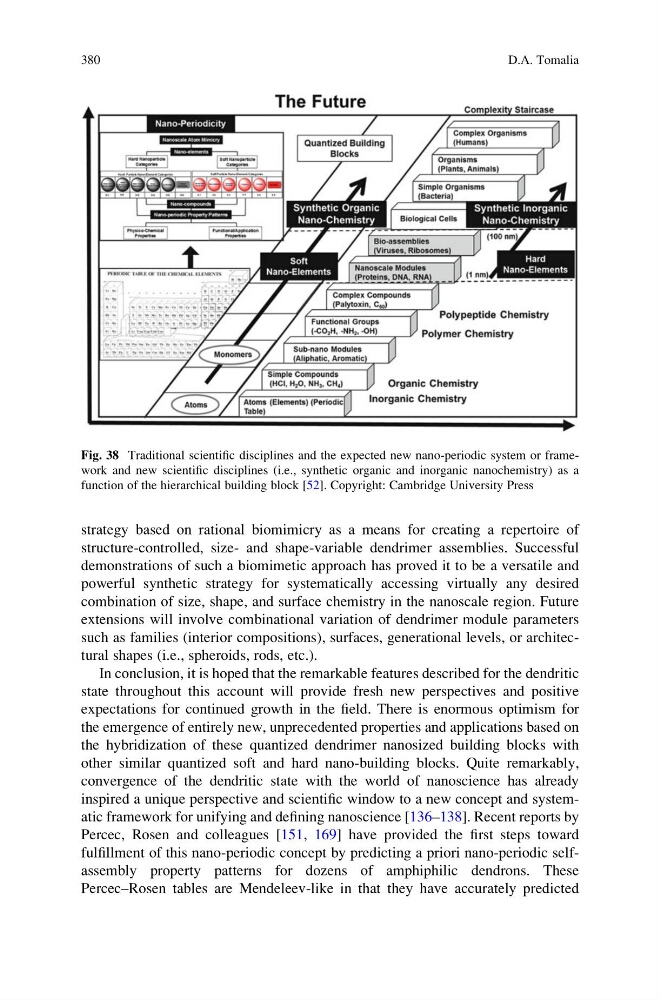
inspired a unique perspective and scientific window to a new concept and systematic framework for unifying and defining nanoscience [136–138]. Recent reports by
Percec, Rosen and colleagues [151, 169] have provided the first steps toward
fulfillment of this nano-periodic concept by predicting a priori nano-periodic selfassembly property patterns for dozens of amphiphilic dendrons. These
Percec–Rosen tables are Mendeleev-like in that they have accurately predicted
Fig. 38 Traditional scientific disciplines and the expected new nano-periodic system or framework and new scientific disciplines (i.e., synthetic organic and inorganic nanochemistry) as a
function of the hierarchical building block [52]. Copyright: Cambridge University Press
380
D.A. Tomalia
structure-controlled, size- and shape-variable dendrimer assemblies. Successful
demonstrations of such a biomimetic approach has proved it to be a versatile and
powerful synthetic strategy for systematically accessing virtually any desired
combination of size, shape, and surface chemistry in the nanoscale region. Future
extensions will involve combinational variation of dendrimer module parameters
such as families (interior compositions), surfaces, generational levels, or architectural shapes (i.e., spheroids, rods, etc.).
In conclusion, it is hoped that the remarkable features described for the dendritic
state throughout this account will provide fresh new perspectives and positive
expectations for continued growth in the field. There is enormous optimism for
the emergence of entirely new, unprecedented properties and applications based on
the hybridization of these quantized dendrimer nanosized building blocks with
other similar quantized soft and hard nano-building blocks. Quite remarkably,
convergence of the dendritic state with the world of nanoscience has already
inspired a unique perspective and scientific window to a new concept and systematic framework for unifying and defining nanoscience [136–138]. Recent reports by
Percec, Rosen and colleagues [151, 169] have provided the first steps toward
fulfillment of this nano-periodic concept by predicting a priori nano-periodic selfassembly property patterns for dozens of amphiphilic dendrons. These
Percec–Rosen tables are Mendeleev-like in that they have accurately predicted
Fig. 38 Traditional scientific disciplines and the expected new nano-periodic system or framework and new scientific disciplines (i.e., synthetic organic and inorganic nanochemistry) as a
function of the hierarchical building block [52]. Copyright: Cambridge University Press
380
D.A. Tomalia