

6.6.5 Aufbau Intermediates Involved in the Dimensional Enhancement
of Soft Nano-element [S-1] Category Complexity
As stated earlier, the “central dogma” for traditional soft and hard matter chemistry
emerged from the first initiatives of Lavoisier, Dalton, and others in the early
nineteenth century. It was initially focused on the simple combinatorial bonding
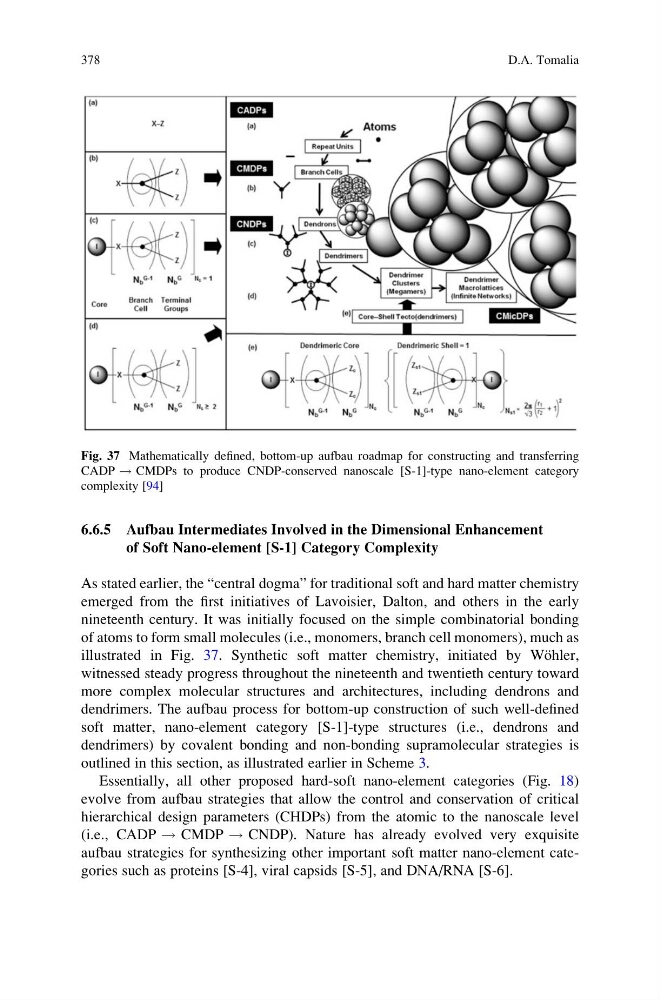
of atoms to form small molecules (i.e., monomers, branch cell monomers), much as
illustrated in Fig. 37. Synthetic soft matter chemistry, initiated by Wo ¨hler,
witnessed steady progress throughout the nineteenth and twentieth century toward
more complex molecular structures and architectures, including dendrons and
dendrimers. The aufbau process for bottom-up construction of such well-defined
soft matter, nano-element category [S-1]-type structures (i.e., dendrons and
dendrimers) by covalent bonding and non-bonding supramolecular strategies is
outlined in this section, as illustrated earlier in Scheme 3.
Essentially, all other proposed hard-soft nano-element categories (Fig. 18)
evolve from aufbau strategies that allow the control and conservation of critical
hierarchical design parameters (CHDPs) from the atomic to the nanoscale level
(i.e., CADP ! CMDP ! CNDP). Nature has already evolved very exquisite
aufbau strategies for synthesizing other important soft matter nano-element categories such as proteins [S-4], viral capsids [S-5], and DNA/RNA [S-6].
Fig. 37 Mathematically defined, bottom-up aufbau roadmap for constructing and transferring
CADP ! CMDPs to produce CNDP-conserved nanoscale [S-1]-type nano-element category
complexity [94]
378
D.A. Tomalia
of Soft Nano-element [S-1] Category Complexity
As stated earlier, the “central dogma” for traditional soft and hard matter chemistry
emerged from the first initiatives of Lavoisier, Dalton, and others in the early
nineteenth century. It was initially focused on the simple combinatorial bonding
of atoms to form small molecules (i.e., monomers, branch cell monomers), much as
illustrated in Fig. 37. Synthetic soft matter chemistry, initiated by Wo ¨hler,
witnessed steady progress throughout the nineteenth and twentieth century toward
more complex molecular structures and architectures, including dendrons and
dendrimers. The aufbau process for bottom-up construction of such well-defined
soft matter, nano-element category [S-1]-type structures (i.e., dendrons and
dendrimers) by covalent bonding and non-bonding supramolecular strategies is
outlined in this section, as illustrated earlier in Scheme 3.
Essentially, all other proposed hard-soft nano-element categories (Fig. 18)
evolve from aufbau strategies that allow the control and conservation of critical
hierarchical design parameters (CHDPs) from the atomic to the nanoscale level
(i.e., CADP ! CMDP ! CNDP). Nature has already evolved very exquisite
aufbau strategies for synthesizing other important soft matter nano-element categories such as proteins [S-4], viral capsids [S-5], and DNA/RNA [S-6].
Fig. 37 Mathematically defined, bottom-up aufbau roadmap for constructing and transferring
CADP ! CMDPs to produce CNDP-conserved nanoscale [S-1]-type nano-element category
complexity [94]
378
D.A. Tomalia