

polymers would never fit into the extremely narrow confinement of the small
crystallographic unit cell.
In 1926, Hermann Staudinger followed Heinrich Wieland and became the
director of the Chemical Laboratory at the Albert-Ludwigs University in Freiburg.
His relocation from Zurich to Freiburg marks a distinct transition in his science and
also in his private life [3–6]. When he moved to Freiburg, Hermann Staudinger
rigorously abandoned his prosperous and highly successful field of small molecule
organic chemistry. Fighting tough battles with his numerous opponents, he boldly
took the risk of embarking on an, at that time, uncertain journey into the stormy and
dangerous seas of the emerging polymer sciences. After his divorce from his wife
Dora in 1925 and his move to Freiburg, he left behind in Switzerland three
daughters and one son. In 1928, he married Magda Woit, a highly cultured
woman born in Latvia, who soon became his fierce and most feared ally in his
never-ending struggle for macromolecules. Holding a PhD in biology and as
experienced botanist, Magda Staudinger shared and encouraged his visions
concerning the prominent role of polymers in biology.
When Hermann Staudinger left the Swiss democracy in 1926, he exposed
himself to the political and economic turbulences of postwar Germany, that was
soon followed by the Nazi tyranny of the Third Reich, which finally led to the
suffering and devastating destructions during World War II. In spite of the manifold
political, economic, and wartime obstacles, Staudinger made significant progress in
macromolecular chemistry. Several books and reviews have addressed Staudinger’s
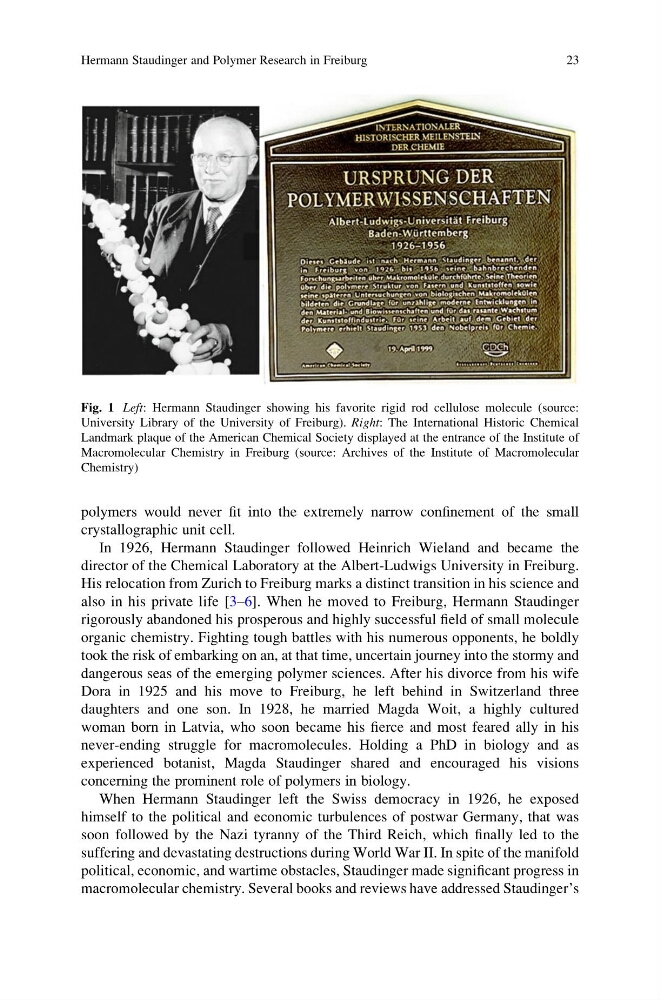
Fig. 1 Left: Hermann Staudinger showing his favorite rigid rod cellulose molecule (source:
University Library of the University of Freiburg). Right: The International Historic Chemical
Landmark plaque of the American Chemical Society displayed at the entrance of the Institute of
Macromolecular Chemistry in Freiburg (source: Archives of the Institute of Macromolecular
Chemistry)
Hermann Staudinger and Polymer Research in Freiburg
23
crystallographic unit cell.
In 1926, Hermann Staudinger followed Heinrich Wieland and became the
director of the Chemical Laboratory at the Albert-Ludwigs University in Freiburg.
His relocation from Zurich to Freiburg marks a distinct transition in his science and
also in his private life [3–6]. When he moved to Freiburg, Hermann Staudinger
rigorously abandoned his prosperous and highly successful field of small molecule
organic chemistry. Fighting tough battles with his numerous opponents, he boldly
took the risk of embarking on an, at that time, uncertain journey into the stormy and
dangerous seas of the emerging polymer sciences. After his divorce from his wife
Dora in 1925 and his move to Freiburg, he left behind in Switzerland three
daughters and one son. In 1928, he married Magda Woit, a highly cultured
woman born in Latvia, who soon became his fierce and most feared ally in his
never-ending struggle for macromolecules. Holding a PhD in biology and as
experienced botanist, Magda Staudinger shared and encouraged his visions
concerning the prominent role of polymers in biology.
When Hermann Staudinger left the Swiss democracy in 1926, he exposed
himself to the political and economic turbulences of postwar Germany, that was
soon followed by the Nazi tyranny of the Third Reich, which finally led to the
suffering and devastating destructions during World War II. In spite of the manifold
political, economic, and wartime obstacles, Staudinger made significant progress in
macromolecular chemistry. Several books and reviews have addressed Staudinger’s
Fig. 1 Left: Hermann Staudinger showing his favorite rigid rod cellulose molecule (source:
University Library of the University of Freiburg). Right: The International Historic Chemical
Landmark plaque of the American Chemical Society displayed at the entrance of the Institute of
Macromolecular Chemistry in Freiburg (source: Archives of the Institute of Macromolecular
Chemistry)
Hermann Staudinger and Polymer Research in Freiburg
23