

charge-neutralized dendriplex. This was followed by covalent amide bond formation between the core and dendrimer shell reagents using a carbodiimide reagent
[165, 174, 175]. The resulting nanocompounds are outer shell saturated, core–shell
tecto(dendrimers). They have also been referred to as “covalent megamers” and are
prime examples of precise polydendrimer cluster structures that are reminiscent of
metal nanoclusters (Fig. 19). These structures may be mathematically predicted by
the Mansfield–Tomalia–Rakesh equation [121, 167] (see Sect. 6.5.3) and have been
unequivocally verified by experimental mass spectrometry, gel electrophoresis, and
atomic force field microscopy (AFM) [121, 174–176].
6.4.4 Dendrimer-(Fullerene) n [S-1:(H-5) n ] Core–Shell-Type
Nanocompounds
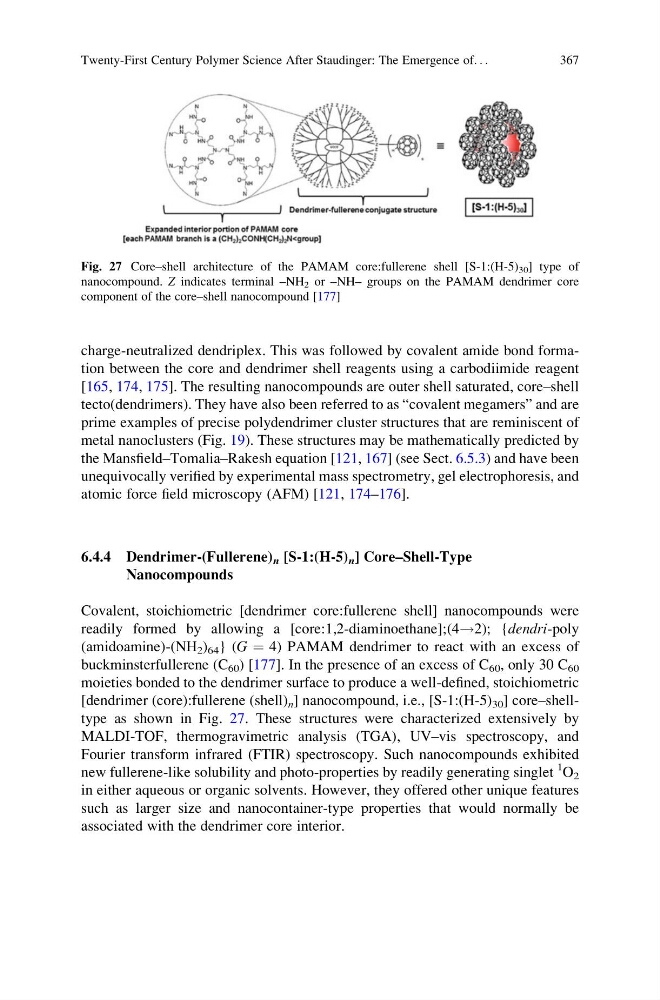
Covalent, stoichiometric [dendrimer core:fullerene shell] nanocompounds were
readily formed by allowing a [core:1,2-diaminoethane];(4!2); {dendri-poly
(amidoamine)-(NH 2 ) 64 } (G ¼ 4) PAMAM dendrimer to react with an excess of
buckminsterfullerene (C 60 ) [177]. In the presence of an excess of C 60 , only 30 C 60
moieties bonded to the dendrimer surface to produce a well-defined, stoichiometric
[dendrimer (core):fullerene (shell) n ] nanocompound, i.e., [S-1:(H-5) 30 ] core–shelltype as shown in Fig. 27. These structures were characterized extensively by
MALDI-TOF, thermogravimetric analysis (TGA), UV–vis spectroscopy, and
Fourier transform infrared (FTIR) spectroscopy. Such nanocompounds exhibited
new fullerene-like solubility and photo-properties by readily generating singlet
1
O 2
in either aqueous or organic solvents. However, they offered other unique features
such as larger size and nanocontainer-type properties that would normally be
associated with the dendrimer core interior.
Fig. 27 Core–shell architecture of the PAMAM core:fullerene shell [S-1:(H-5) 30 ] type of
nanocompound. Z indicates terminal –NH 2 or –NH– groups on the PAMAM dendrimer core
component of the core–shell nanocompound [177]
Twenty-First Century Polymer Science After Staudinger: The Emergence of. . .
367
[165, 174, 175]. The resulting nanocompounds are outer shell saturated, core–shell
tecto(dendrimers). They have also been referred to as “covalent megamers” and are
prime examples of precise polydendrimer cluster structures that are reminiscent of
metal nanoclusters (Fig. 19). These structures may be mathematically predicted by
the Mansfield–Tomalia–Rakesh equation [121, 167] (see Sect. 6.5.3) and have been
unequivocally verified by experimental mass spectrometry, gel electrophoresis, and
atomic force field microscopy (AFM) [121, 174–176].
6.4.4 Dendrimer-(Fullerene) n [S-1:(H-5) n ] Core–Shell-Type
Nanocompounds
Covalent, stoichiometric [dendrimer core:fullerene shell] nanocompounds were
readily formed by allowing a [core:1,2-diaminoethane];(4!2); {dendri-poly
(amidoamine)-(NH 2 ) 64 } (G ¼ 4) PAMAM dendrimer to react with an excess of
buckminsterfullerene (C 60 ) [177]. In the presence of an excess of C 60 , only 30 C 60
moieties bonded to the dendrimer surface to produce a well-defined, stoichiometric
[dendrimer (core):fullerene (shell) n ] nanocompound, i.e., [S-1:(H-5) 30 ] core–shelltype as shown in Fig. 27. These structures were characterized extensively by
MALDI-TOF, thermogravimetric analysis (TGA), UV–vis spectroscopy, and
Fourier transform infrared (FTIR) spectroscopy. Such nanocompounds exhibited
new fullerene-like solubility and photo-properties by readily generating singlet
1
O 2
in either aqueous or organic solvents. However, they offered other unique features
such as larger size and nanocontainer-type properties that would normally be
associated with the dendrimer core interior.
Fig. 27 Core–shell architecture of the PAMAM core:fullerene shell [S-1:(H-5) 30 ] type of
nanocompound. Z indicates terminal –NH 2 or –NH– groups on the PAMAM dendrimer core
component of the core–shell nanocompound [177]
Twenty-First Century Polymer Science After Staudinger: The Emergence of. . .
367