

building blocks as “atom equivalents” (i.e., Mirkin and coworkers [146]) or “nanoscale atoms” (i.e., Roy, Brus and coworkers [168]). In the first case, Mirkin and
coworkers [146] have reported the assembly of metal nanoclusters [H-1], metal
chalcogenide nanocrystals (quantum dots) [H-2], and metal oxide nanocrystals
[H-3] using complementary DNA [S-6] to give [H-1:(S-6)n], [H-2:(S-6)n], or
[H-3:(S-6)n] type 3D nanoscale unit cell lattices. Quite remarkably, these nanoscale
unit cell lattices mimic inorganic salt lattices formed from atomic elements. In the
second case, Roy et al. [168] have shown that by combining fullerene (C 60 ) [H-5]
(i.e., 0.71 nm) with various metal chalcogenide nanocrystals [H-2] (i.e.,
0.85–0.92 nm), a solid-state material is formed that they described as a “super
atomic relative" of the cadmium iodide (CdI 2 ) structure type. Furthermore, they
stated that the constituent clusters (i.e., [H-5] and [H-2]) interacted electronically
to produce a magnetically ordered phase at low temperature, akin to atoms in a
solid-state compound.
Both soft matter (organic) and hard matter (inorganic) categories of these
quantized nanomodules have been proposed and referred to as soft and hard
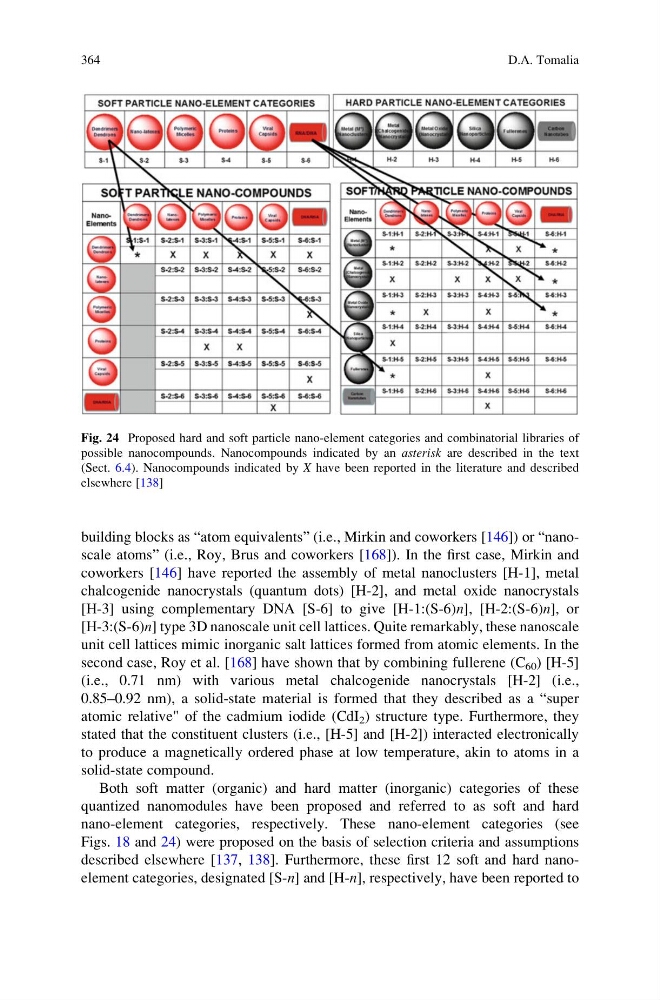
nano-element categories, respectively. These nano-element categories (see
Figs. 18 and 24) were proposed on the basis of selection criteria and assumptions
described elsewhere [137, 138]. Furthermore, these first 12 soft and hard nanoelement categories, designated [S-n] and [H-n], respectively, have been reported to
Fig. 24 Proposed hard and soft particle nano-element categories and combinatorial libraries of
possible nanocompounds. Nanocompounds indicated by an asterisk are described in the text
(Sect. 6.4). Nanocompounds indicated by X have been reported in the literature and described
elsewhere [138]
364
D.A. Tomalia
coworkers [146] have reported the assembly of metal nanoclusters [H-1], metal
chalcogenide nanocrystals (quantum dots) [H-2], and metal oxide nanocrystals
[H-3] using complementary DNA [S-6] to give [H-1:(S-6)n], [H-2:(S-6)n], or
[H-3:(S-6)n] type 3D nanoscale unit cell lattices. Quite remarkably, these nanoscale
unit cell lattices mimic inorganic salt lattices formed from atomic elements. In the
second case, Roy et al. [168] have shown that by combining fullerene (C 60 ) [H-5]
(i.e., 0.71 nm) with various metal chalcogenide nanocrystals [H-2] (i.e.,
0.85–0.92 nm), a solid-state material is formed that they described as a “super
atomic relative" of the cadmium iodide (CdI 2 ) structure type. Furthermore, they
stated that the constituent clusters (i.e., [H-5] and [H-2]) interacted electronically
to produce a magnetically ordered phase at low temperature, akin to atoms in a
solid-state compound.
Both soft matter (organic) and hard matter (inorganic) categories of these
quantized nanomodules have been proposed and referred to as soft and hard
nano-element categories, respectively. These nano-element categories (see
Figs. 18 and 24) were proposed on the basis of selection criteria and assumptions
described elsewhere [137, 138]. Furthermore, these first 12 soft and hard nanoelement categories, designated [S-n] and [H-n], respectively, have been reported to
Fig. 24 Proposed hard and soft particle nano-element categories and combinatorial libraries of
possible nanocompounds. Nanocompounds indicated by an asterisk are described in the text
(Sect. 6.4). Nanocompounds indicated by X have been reported in the literature and described
elsewhere [138]
364
D.A. Tomalia