

observe totally new emerging nanomaterial properties and patterns that are unprecedented and uncharacteristic compared to the less complex hierarchical precursors
and building blocks involved in their construction.
6.1 Elemental Picoscale Periodicity Derived from CADPs
It is generally accepted that very specific amounts and arrangements of quantized
subatomic building block constituents (i.e., particles such as electrons, protons, and
neutrons) are involved in the production of all known atomic elements. The unique
quantities and ratios of these self-assembling subatomic building blocks, by definition, determine the discrete and unique physico-chemical properties of each
atomic element. As a consequence, each atomic element possesses a unique list
of CADPs that allows them to be reproducibly defined and structure-controlled as a
function of CADPs such as size, shape, surface chemistry, flexibility (i.e., polarizability), elemental composition (i.e., number of protons, neutrons, and electrons),
and architecture. As such, these CADP-derived picoscale building blocks are
observed to manifest discrete and unique intrinsic properties individually, as well
as very familiar periodic property relationships when compared to each other.
These elemental periodic property trends or patterns based on CADPs provide the
invaluable predictive value and are the very essence of Mendeleev’s Periodic
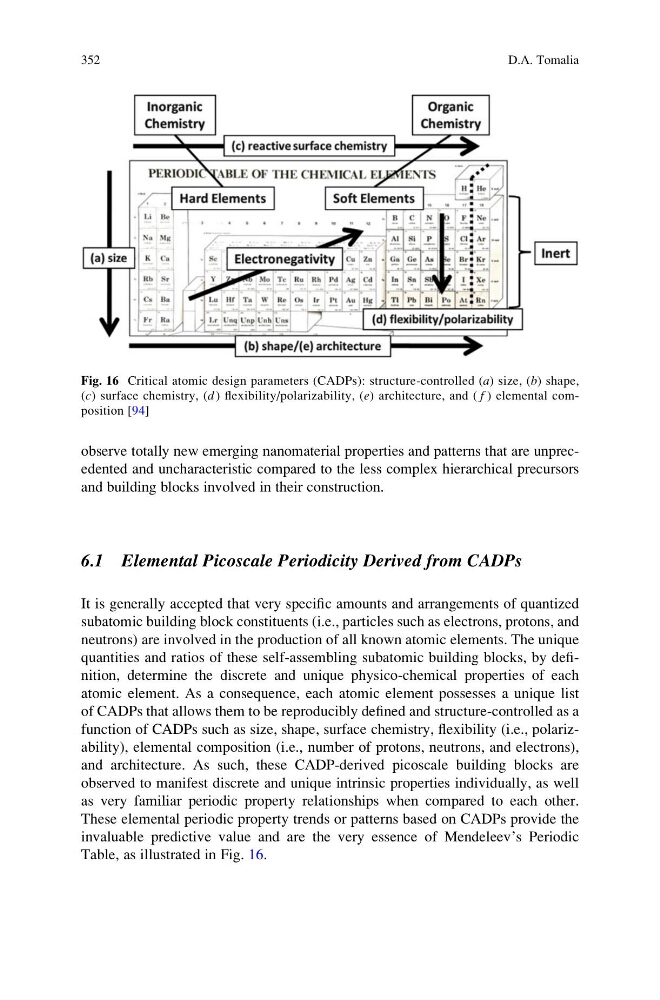
Table, as illustrated in Fig. 16.
Fig. 16 Critical atomic design parameters (CADPs): structure-controlled (a) size, (b) shape,
(c) surface chemistry, (d ) flexibility/polarizability, (e) architecture, and ( f ) elemental composition [94]
352
D.A. Tomalia
and building blocks involved in their construction.
6.1 Elemental Picoscale Periodicity Derived from CADPs
It is generally accepted that very specific amounts and arrangements of quantized
subatomic building block constituents (i.e., particles such as electrons, protons, and
neutrons) are involved in the production of all known atomic elements. The unique
quantities and ratios of these self-assembling subatomic building blocks, by definition, determine the discrete and unique physico-chemical properties of each
atomic element. As a consequence, each atomic element possesses a unique list
of CADPs that allows them to be reproducibly defined and structure-controlled as a
function of CADPs such as size, shape, surface chemistry, flexibility (i.e., polarizability), elemental composition (i.e., number of protons, neutrons, and electrons),
and architecture. As such, these CADP-derived picoscale building blocks are
observed to manifest discrete and unique intrinsic properties individually, as well
as very familiar periodic property relationships when compared to each other.
These elemental periodic property trends or patterns based on CADPs provide the
invaluable predictive value and are the very essence of Mendeleev’s Periodic
Table, as illustrated in Fig. 16.
Fig. 16 Critical atomic design parameters (CADPs): structure-controlled (a) size, (b) shape,
(c) surface chemistry, (d ) flexibility/polarizability, (e) architecture, and ( f ) elemental composition [94]
352
D.A. Tomalia