

3. Nucleophilic ring opening of strained heterocyclic electrophiles (i.e., aziridines,
epoxides, etc.)
4. Huisgen-type 1,3-dipolar cycloaddition of azides to alkynes
It should be noted that the first three reaction categories of click chemistry, as
described above, were used by Tomalia [9, 46] and Vo ¨gtle [97] as preferred
iterative synthetic routes to the first reported examples of dendrimers and low
molecular weight cascade molecules, respectively.
In 1968, Huisgen [98] reported the facile, high yield, chemoselective cycloaddition of organic azides with alkynes to form covalent 1,4-disubstituted 1,2,3triazole linkages. More recently, Sharples and colleagues [96, 99] have shown
that terminal alkynes may be catalyzed by Cu
1+ salts in an orthogonal fashion to
form the corresponding triazoles in very high yields. Because of the high
chemoselectivity of these reactions, they may be selectively performed in the
presence of a wide variety of competing or parallel reactions and/or functionalities
without interference. These features make this approach very attractive for
dendrimer syntheses. Click chemistry based on these copper-catalyzed Huisgen
reactions has been used recently to synthesize dendrimers [99–101], dendronized
linear polymers [102], and other dendritic architectures [103].
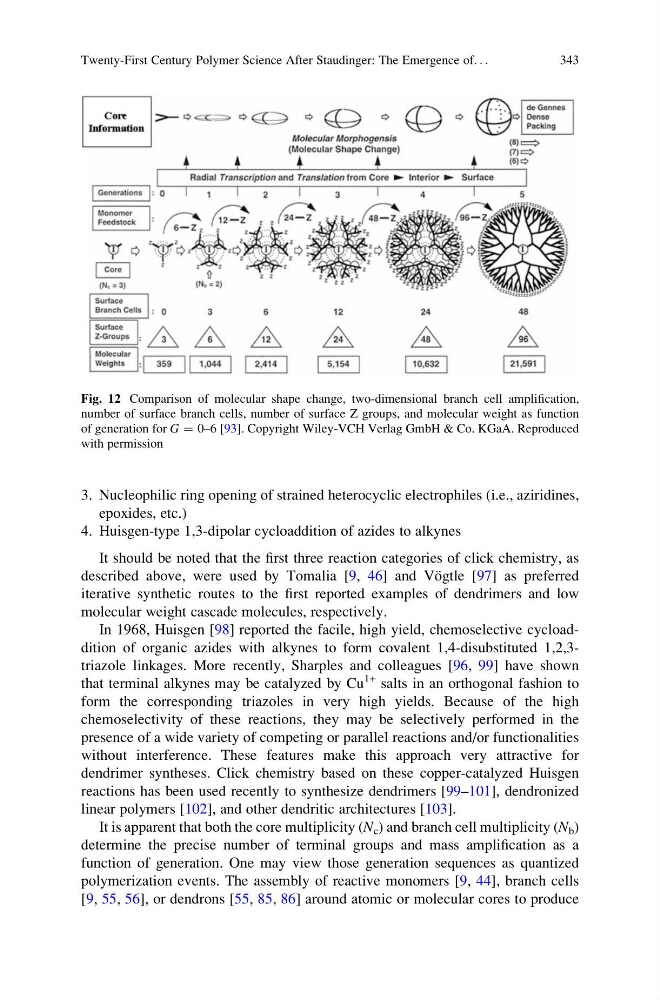
It is apparent that both the core multiplicity (N c ) and branch cell multiplicity (N b )
determine the precise number of terminal groups and mass amplification as a
function of generation. One may view those generation sequences as quantized
polymerization events. The assembly of reactive monomers [9, 44], branch cells
[9, 55, 56], or dendrons [55, 85, 86] around atomic or molecular cores to produce
Fig. 12 Comparison of molecular shape change, two-dimensional branch cell amplification,
number of surface branch cells, number of surface Z groups, and molecular weight as function
of generation for G ¼ 0–6 [93]. Copyright Wiley-VCH Verlag GmbH & Co. KGaA. Reproduced
with permission
Twenty-First Century Polymer Science After Staudinger: The Emergence of. . .
343
epoxides, etc.)
4. Huisgen-type 1,3-dipolar cycloaddition of azides to alkynes
It should be noted that the first three reaction categories of click chemistry, as
described above, were used by Tomalia [9, 46] and Vo ¨gtle [97] as preferred
iterative synthetic routes to the first reported examples of dendrimers and low
molecular weight cascade molecules, respectively.
In 1968, Huisgen [98] reported the facile, high yield, chemoselective cycloaddition of organic azides with alkynes to form covalent 1,4-disubstituted 1,2,3triazole linkages. More recently, Sharples and colleagues [96, 99] have shown
that terminal alkynes may be catalyzed by Cu
1+ salts in an orthogonal fashion to
form the corresponding triazoles in very high yields. Because of the high
chemoselectivity of these reactions, they may be selectively performed in the
presence of a wide variety of competing or parallel reactions and/or functionalities
without interference. These features make this approach very attractive for
dendrimer syntheses. Click chemistry based on these copper-catalyzed Huisgen
reactions has been used recently to synthesize dendrimers [99–101], dendronized
linear polymers [102], and other dendritic architectures [103].
It is apparent that both the core multiplicity (N c ) and branch cell multiplicity (N b )
determine the precise number of terminal groups and mass amplification as a
function of generation. One may view those generation sequences as quantized
polymerization events. The assembly of reactive monomers [9, 44], branch cells
[9, 55, 56], or dendrons [55, 85, 86] around atomic or molecular cores to produce
Fig. 12 Comparison of molecular shape change, two-dimensional branch cell amplification,
number of surface branch cells, number of surface Z groups, and molecular weight as function
of generation for G ¼ 0–6 [93]. Copyright Wiley-VCH Verlag GmbH & Co. KGaA. Reproduced
with permission
Twenty-First Century Polymer Science After Staudinger: The Emergence of. . .
343