

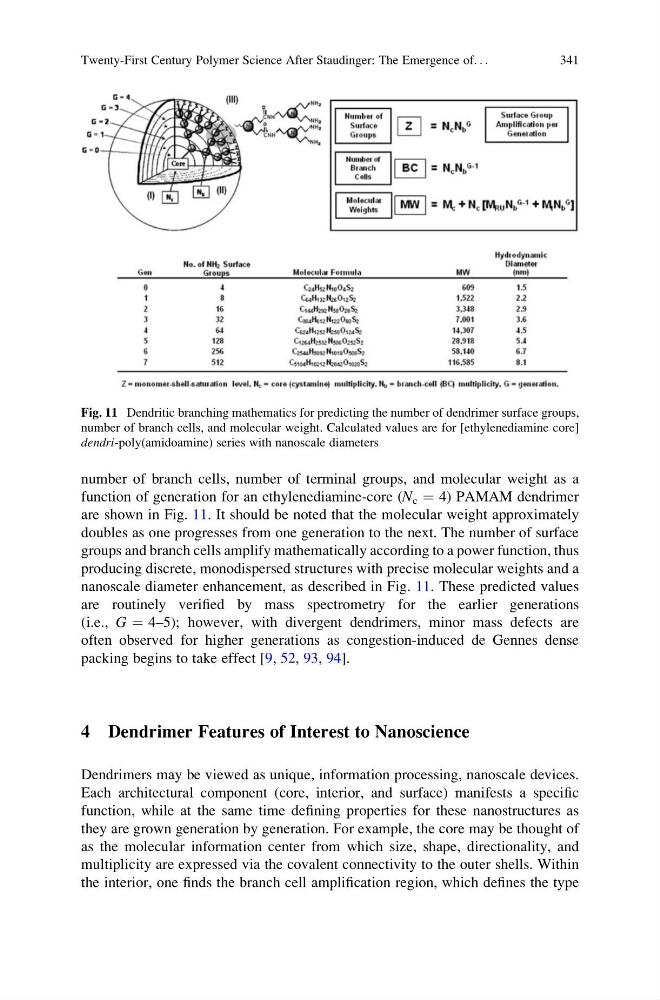
number of branch cells, number of terminal groups, and molecular weight as a
function of generation for an ethylenediamine-core (N c ¼ 4) PAMAM dendrimer
are shown in Fig. 11. It should be noted that the molecular weight approximately
doubles as one progresses from one generation to the next. The number of surface
groups and branch cells amplify mathematically according to a power function, thus
producing discrete, monodispersed structures with precise molecular weights and a
nanoscale diameter enhancement, as described in Fig. 11. These predicted values
are routinely verified by mass spectrometry for the earlier generations
(i.e., G ¼ 4–5); however, with divergent dendrimers, minor mass defects are
often observed for higher generations as congestion-induced de Gennes dense
packing begins to take effect [9, 52, 93, 94].
4 Dendrimer Features of Interest to Nanoscience
Dendrimers may be viewed as unique, information processing, nanoscale devices.
Each architectural component (core, interior, and surface) manifests a specific
function, while at the same time defining properties for these nanostructures as
they are grown generation by generation. For example, the core may be thought of
as the molecular information center from which size, shape, directionality, and
multiplicity are expressed via the covalent connectivity to the outer shells. Within
the interior, one finds the branch cell amplification region, which defines the type
Fig. 11 Dendritic branching mathematics for predicting the number of dendrimer surface groups,
number of branch cells, and molecular weight. Calculated values are for [ethylenediamine core]
dendri-poly(amidoamine) series with nanoscale diameters
Twenty-First Century Polymer Science After Staudinger: The Emergence of. . .
341
function of generation for an ethylenediamine-core (N c ¼ 4) PAMAM dendrimer
are shown in Fig. 11. It should be noted that the molecular weight approximately
doubles as one progresses from one generation to the next. The number of surface
groups and branch cells amplify mathematically according to a power function, thus
producing discrete, monodispersed structures with precise molecular weights and a
nanoscale diameter enhancement, as described in Fig. 11. These predicted values
are routinely verified by mass spectrometry for the earlier generations
(i.e., G ¼ 4–5); however, with divergent dendrimers, minor mass defects are
often observed for higher generations as congestion-induced de Gennes dense
packing begins to take effect [9, 52, 93, 94].
4 Dendrimer Features of Interest to Nanoscience
Dendrimers may be viewed as unique, information processing, nanoscale devices.
Each architectural component (core, interior, and surface) manifests a specific
function, while at the same time defining properties for these nanostructures as
they are grown generation by generation. For example, the core may be thought of
as the molecular information center from which size, shape, directionality, and
multiplicity are expressed via the covalent connectivity to the outer shells. Within
the interior, one finds the branch cell amplification region, which defines the type
Fig. 11 Dendritic branching mathematics for predicting the number of dendrimer surface groups,
number of branch cells, and molecular weight. Calculated values are for [ethylenediamine core]
dendri-poly(amidoamine) series with nanoscale diameters
Twenty-First Century Polymer Science After Staudinger: The Emergence of. . .
341