

functional groups (the outer shell or periphery). In general, dendrimer synthesis
involves divergent or convergent hierarchical assembly strategies that require the
construction components shown in Scheme 3. Within each of these major
approaches there may be variations in methodology for branch-cell construction
or dendron construction. Many of these issues, together with experimental laboratory procedures, have been reviewed elsewhere [81–83].
PAMAM dendrimers are synthesized by the divergent approach. This methodology involves in situ branch-cell construction in stepwise, iterative stages around a
desired core to produce mathematically defined core–shell structures. Typically,
ethylenediamine (core multiplicity N c ¼ 4), ammonia (N c ¼ 3), or cystamine
(N c ¼ 4) may be used as cores and allowed to undergo reiterative, two-step reaction
sequences. These sequences consist of: (1) an exhaustive alkylation of primary
amines (Michael addition) with methyl acrylate, and (2) amidation of amplified
ester groups with a large excess of ethylenediamine to produce primary amine
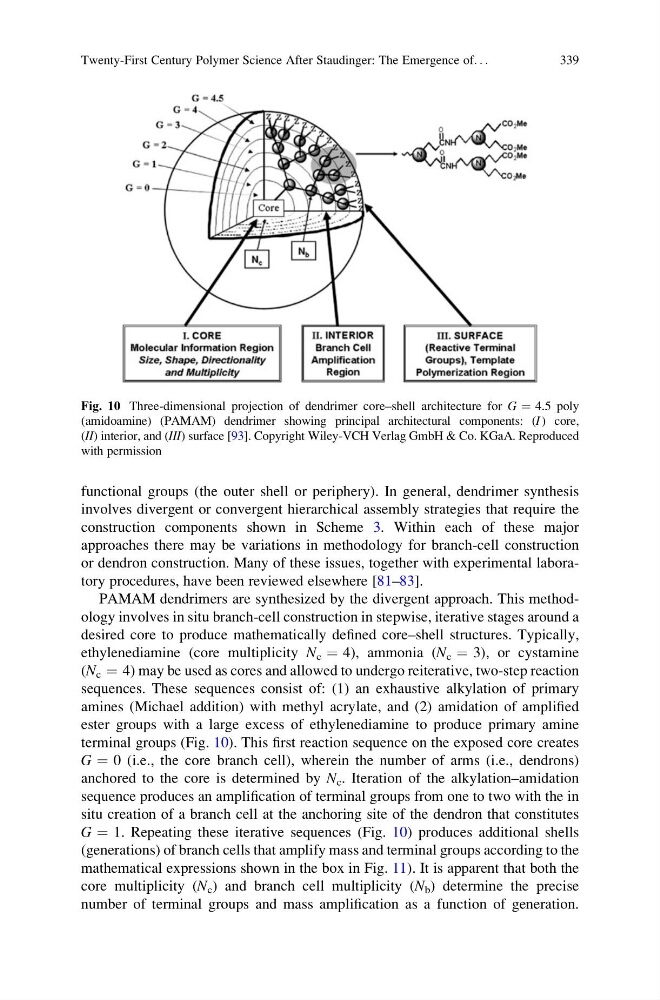
terminal groups (Fig. 10). This first reaction sequence on the exposed core creates
G ¼ 0 (i.e., the core branch cell), wherein the number of arms (i.e., dendrons)
anchored to the core is determined by N c . Iteration of the alkylation–amidation
sequence produces an amplification of terminal groups from one to two with the in
situ creation of a branch cell at the anchoring site of the dendron that constitutes
G ¼ 1. Repeating these iterative sequences (Fig. 10) produces additional shells
(generations) of branch cells that amplify mass and terminal groups according to the
mathematical expressions shown in the box in Fig. 11). It is apparent that both the
core multiplicity (N c ) and branch cell multiplicity (N b ) determine the precise
number of terminal groups and mass amplification as a function of generation.
Fig. 10 Three-dimensional projection of dendrimer core–shell architecture for G ¼ 4.5 poly
(amidoamine) (PAMAM) dendrimer showing principal architectural components: (I ) core,
(II) interior, and (III) surface [93]. Copyright Wiley-VCH Verlag GmbH & Co. KGaA. Reproduced
with permission
Twenty-First Century Polymer Science After Staudinger: The Emergence of. . .
339
involves divergent or convergent hierarchical assembly strategies that require the
construction components shown in Scheme 3. Within each of these major
approaches there may be variations in methodology for branch-cell construction
or dendron construction. Many of these issues, together with experimental laboratory procedures, have been reviewed elsewhere [81–83].
PAMAM dendrimers are synthesized by the divergent approach. This methodology involves in situ branch-cell construction in stepwise, iterative stages around a
desired core to produce mathematically defined core–shell structures. Typically,
ethylenediamine (core multiplicity N c ¼ 4), ammonia (N c ¼ 3), or cystamine
(N c ¼ 4) may be used as cores and allowed to undergo reiterative, two-step reaction
sequences. These sequences consist of: (1) an exhaustive alkylation of primary
amines (Michael addition) with methyl acrylate, and (2) amidation of amplified
ester groups with a large excess of ethylenediamine to produce primary amine
terminal groups (Fig. 10). This first reaction sequence on the exposed core creates
G ¼ 0 (i.e., the core branch cell), wherein the number of arms (i.e., dendrons)
anchored to the core is determined by N c . Iteration of the alkylation–amidation
sequence produces an amplification of terminal groups from one to two with the in
situ creation of a branch cell at the anchoring site of the dendron that constitutes
G ¼ 1. Repeating these iterative sequences (Fig. 10) produces additional shells
(generations) of branch cells that amplify mass and terminal groups according to the
mathematical expressions shown in the box in Fig. 11). It is apparent that both the
core multiplicity (N c ) and branch cell multiplicity (N b ) determine the precise
number of terminal groups and mass amplification as a function of generation.
Fig. 10 Three-dimensional projection of dendrimer core–shell architecture for G ¼ 4.5 poly
(amidoamine) (PAMAM) dendrimer showing principal architectural components: (I ) core,
(II) interior, and (III) surface [93]. Copyright Wiley-VCH Verlag GmbH & Co. KGaA. Reproduced
with permission
Twenty-First Century Polymer Science After Staudinger: The Emergence of. . .
339