

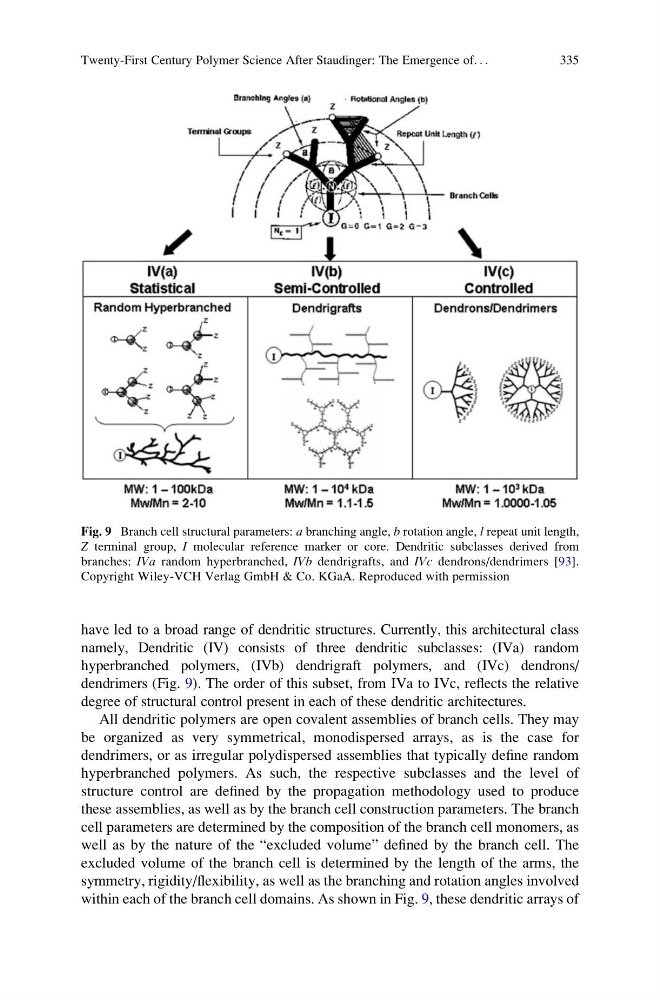
have led to a broad range of dendritic structures. Currently, this architectural class
namely, Dendritic (IV) consists of three dendritic subclasses: (IVa) random
hyperbranched polymers, (IVb) dendrigraft polymers, and (IVc) dendrons/
dendrimers (Fig. 9). The order of this subset, from IVa to IVc, reflects the relative
degree of structural control present in each of these dendritic architectures.
All dendritic polymers are open covalent assemblies of branch cells. They may
be organized as very symmetrical, monodispersed arrays, as is the case for
dendrimers, or as irregular polydispersed assemblies that typically define random
hyperbranched polymers. As such, the respective subclasses and the level of
structure control are defined by the propagation methodology used to produce
these assemblies, as well as by the branch cell construction parameters. The branch
cell parameters are determined by the composition of the branch cell monomers, as
well as by the nature of the “excluded volume” defined by the branch cell. The
excluded volume of the branch cell is determined by the length of the arms, the
symmetry, rigidity/flexibility, as well as the branching and rotation angles involved
within each of the branch cell domains. As shown in Fig. 9, these dendritic arrays of
Fig. 9 Branch cell structural parameters: a branching angle, b rotation angle, l repeat unit length,
Z terminal group, I molecular reference marker or core. Dendritic subclasses derived from
branches: IVa random hyperbranched, IVb dendrigrafts, and IVc dendrons/dendrimers [93].
Copyright Wiley-VCH Verlag GmbH & Co. KGaA. Reproduced with permission
Twenty-First Century Polymer Science After Staudinger: The Emergence of. . .
335
namely, Dendritic (IV) consists of three dendritic subclasses: (IVa) random
hyperbranched polymers, (IVb) dendrigraft polymers, and (IVc) dendrons/
dendrimers (Fig. 9). The order of this subset, from IVa to IVc, reflects the relative
degree of structural control present in each of these dendritic architectures.
All dendritic polymers are open covalent assemblies of branch cells. They may
be organized as very symmetrical, monodispersed arrays, as is the case for
dendrimers, or as irregular polydispersed assemblies that typically define random
hyperbranched polymers. As such, the respective subclasses and the level of
structure control are defined by the propagation methodology used to produce
these assemblies, as well as by the branch cell construction parameters. The branch
cell parameters are determined by the composition of the branch cell monomers, as
well as by the nature of the “excluded volume” defined by the branch cell. The
excluded volume of the branch cell is determined by the length of the arms, the
symmetry, rigidity/flexibility, as well as the branching and rotation angles involved
within each of the branch cell domains. As shown in Fig. 9, these dendritic arrays of
Fig. 9 Branch cell structural parameters: a branching angle, b rotation angle, l repeat unit length,
Z terminal group, I molecular reference marker or core. Dendritic subclasses derived from
branches: IVa random hyperbranched, IVb dendrigrafts, and IVc dendrons/dendrimers [93].
Copyright Wiley-VCH Verlag GmbH & Co. KGaA. Reproduced with permission
Twenty-First Century Polymer Science After Staudinger: The Emergence of. . .
335