

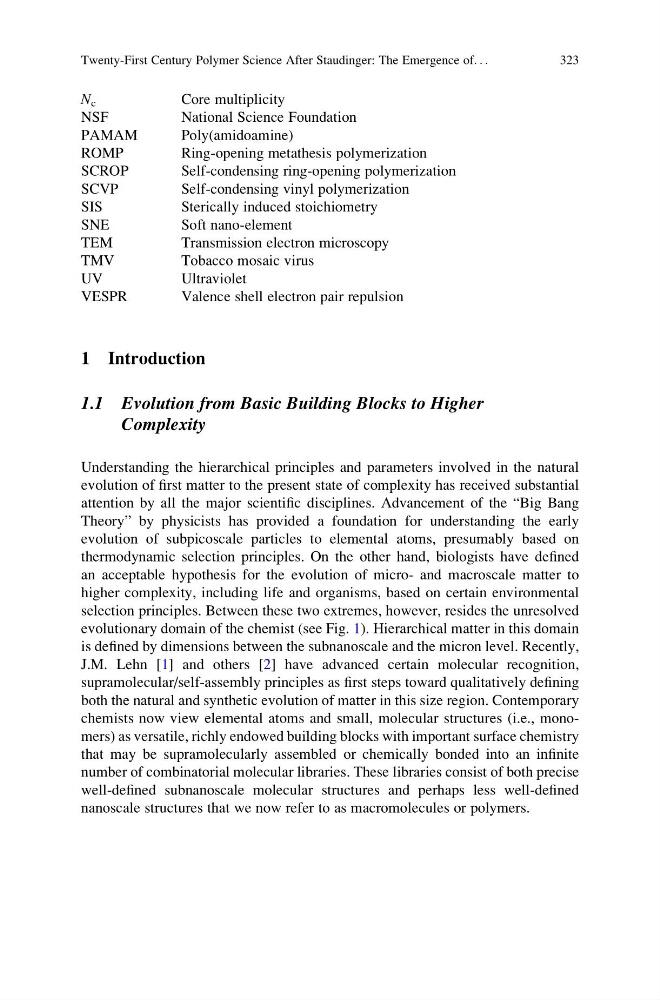
N c
Core multiplicity
NSF
National Science Foundation
PAMAM
Poly(amidoamine)
ROMP
Ring-opening metathesis polymerization
SCROP
Self-condensing ring-opening polymerization
SCVP
Self-condensing vinyl polymerization
SIS
Sterically induced stoichiometry
SNE
Soft nano-element
TEM
Transmission electron microscopy
TMV
Tobacco mosaic virus
UV
Ultraviolet
VESPR
Valence shell electron pair repulsion
1 Introduction
1.1 Evolution from Basic Building Blocks to Higher
Complexity
Understanding the hierarchical principles and parameters involved in the natural
evolution of first matter to the present state of complexity has received substantial
attention by all the major scientific disciplines. Advancement of the “Big Bang
Theory” by physicists has provided a foundation for understanding the early
evolution of subpicoscale particles to elemental atoms, presumably based on
thermodynamic selection principles. On the other hand, biologists have defined
an acceptable hypothesis for the evolution of micro- and macroscale matter to
higher complexity, including life and organisms, based on certain environmental
selection principles. Between these two extremes, however, resides the unresolved
evolutionary domain of the chemist (see Fig. 1). Hierarchical matter in this domain
is defined by dimensions between the subnanoscale and the micron level. Recently,
J.M. Lehn [1] and others [2] have advanced certain molecular recognition,
supramolecular/self-assembly principles as first steps toward qualitatively defining
both the natural and synthetic evolution of matter in this size region. Contemporary
chemists now view elemental atoms and small, molecular structures (i.e., monomers) as versatile, richly endowed building blocks with important surface chemistry
that may be supramolecularly assembled or chemically bonded into an infinite
number of combinatorial molecular libraries. These libraries consist of both precise
well-defined subnanoscale molecular structures and perhaps less well-defined
nanoscale structures that we now refer to as macromolecules or polymers.
Twenty-First Century Polymer Science After Staudinger: The Emergence of. . .
323
Core multiplicity
NSF
National Science Foundation
PAMAM
Poly(amidoamine)
ROMP
Ring-opening metathesis polymerization
SCROP
Self-condensing ring-opening polymerization
SCVP
Self-condensing vinyl polymerization
SIS
Sterically induced stoichiometry
SNE
Soft nano-element
TEM
Transmission electron microscopy
TMV
Tobacco mosaic virus
UV
Ultraviolet
VESPR
Valence shell electron pair repulsion
1 Introduction
1.1 Evolution from Basic Building Blocks to Higher
Complexity
Understanding the hierarchical principles and parameters involved in the natural
evolution of first matter to the present state of complexity has received substantial
attention by all the major scientific disciplines. Advancement of the “Big Bang
Theory” by physicists has provided a foundation for understanding the early
evolution of subpicoscale particles to elemental atoms, presumably based on
thermodynamic selection principles. On the other hand, biologists have defined
an acceptable hypothesis for the evolution of micro- and macroscale matter to
higher complexity, including life and organisms, based on certain environmental
selection principles. Between these two extremes, however, resides the unresolved
evolutionary domain of the chemist (see Fig. 1). Hierarchical matter in this domain
is defined by dimensions between the subnanoscale and the micron level. Recently,
J.M. Lehn [1] and others [2] have advanced certain molecular recognition,
supramolecular/self-assembly principles as first steps toward qualitatively defining
both the natural and synthetic evolution of matter in this size region. Contemporary
chemists now view elemental atoms and small, molecular structures (i.e., monomers) as versatile, richly endowed building blocks with important surface chemistry
that may be supramolecularly assembled or chemically bonded into an infinite
number of combinatorial molecular libraries. These libraries consist of both precise
well-defined subnanoscale molecular structures and perhaps less well-defined
nanoscale structures that we now refer to as macromolecules or polymers.
Twenty-First Century Polymer Science After Staudinger: The Emergence of. . .
323