

motif found in tropoelastin (X being the so-called guest residue, which can be any
amino acid except proline). Their LCST phase behavior at the molecular level can
be fine-tuned by the choice of the guest residue, their chain length, and by the
cosolutes [108]. This makes them excellent candidates for studying fundamental
aspects of intrinsically disordered polypeptides on the one hand and thermoresponsive polymers, on the other hand.
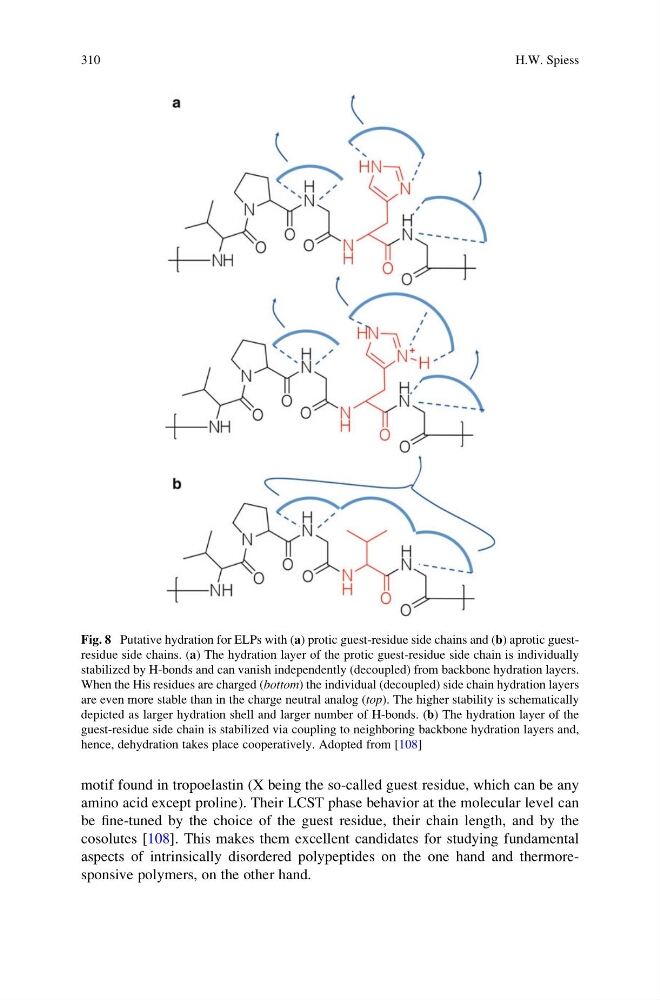
Fig. 8 Putative hydration for ELPs with (a) protic guest-residue side chains and (b) aprotic guestresidue side chains. (a) The hydration layer of the protic guest-residue side chain is individually
stabilized by H-bonds and can vanish independently (decoupled) from backbone hydration layers.
When the His residues are charged (bottom) the individual (decoupled) side chain hydration layers
are even more stable than in the charge neutral analog (top). The higher stability is schematically
depicted as larger hydration shell and larger number of H-bonds. (b) The hydration layer of the
guest-residue side chain is stabilized via coupling to neighboring backbone hydration layers and,
hence, dehydration takes place cooperatively. Adopted from [108]
310
H.W. Spiess
amino acid except proline). Their LCST phase behavior at the molecular level can
be fine-tuned by the choice of the guest residue, their chain length, and by the
cosolutes [108]. This makes them excellent candidates for studying fundamental
aspects of intrinsically disordered polypeptides on the one hand and thermoresponsive polymers, on the other hand.
Fig. 8 Putative hydration for ELPs with (a) protic guest-residue side chains and (b) aprotic guestresidue side chains. (a) The hydration layer of the protic guest-residue side chain is individually
stabilized by H-bonds and can vanish independently (decoupled) from backbone hydration layers.
When the His residues are charged (bottom) the individual (decoupled) side chain hydration layers
are even more stable than in the charge neutral analog (top). The higher stability is schematically
depicted as larger hydration shell and larger number of H-bonds. (b) The hydration layer of the
guest-residue side chain is stabilized via coupling to neighboring backbone hydration layers and,
hence, dehydration takes place cooperatively. Adopted from [108]
310
H.W. Spiess