

binding versatility towards various molecules. As early as the 1950s, Karush developed a concept that accounted for conformational adaptability of the binding sites [72]
and later a model was proposed that took into account the conformational entropy
arising from the flexibility of the fatty acid alkyl chains [73]. As noted in Sect. 2,
distances and distance distribution between spin labels on the nanometer scale can
now be determined with pulsed electron–electron double resonance, DEER
[20, 24]. By using spin-labeled fatty acids, it is possible to unravel the functional
structure of HSA with respect to its binding of fatty acids directly from the fatty acids’
point of view [74]. In this way, the distribution of the fatty acid binding sites is
detected without any contribution from the complex protein itself, which is an
enormous simplification. Structural information of the binding sites is obtained by
determining the distance distributions between the fatty acids in frozen solution. In
order to sample distances between different binding sites, fatty acids with different
labeling positions can be applied. In 5-doxylstearic acid (5-DSA), the unpaired
electron resides near the anchoring carboxylic acid group, in 16-DSA it is located
near the end of the methylene chain. Thus, information can be retrieved separately
from the anchor positions in the protein and from the entry points into the fatty acid
channel formed by the protein.
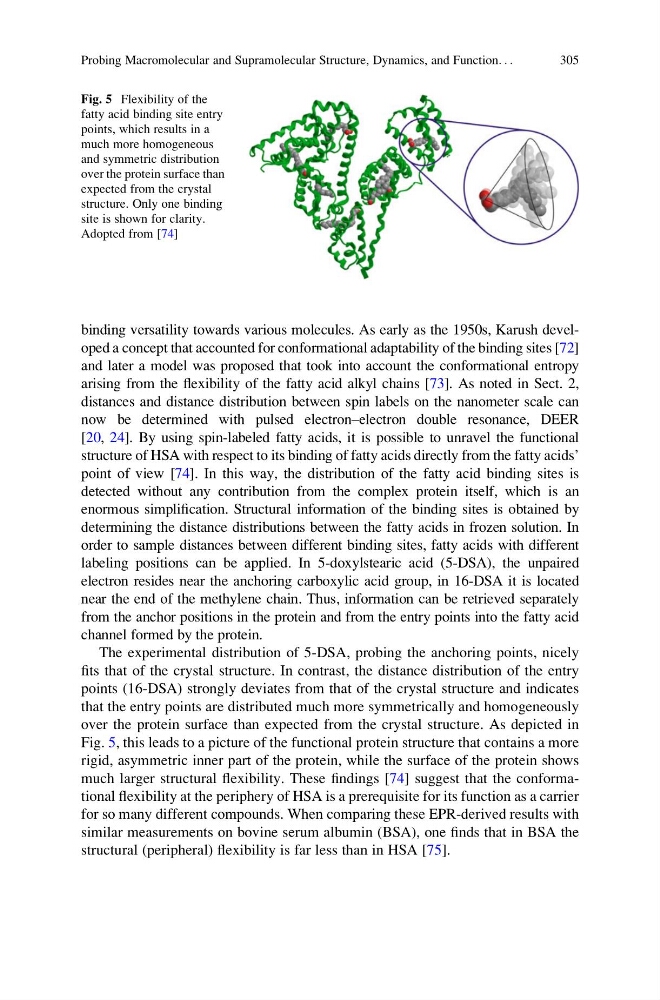
The experimental distribution of 5-DSA, probing the anchoring points, nicely
fits that of the crystal structure. In contrast, the distance distribution of the entry
points (16-DSA) strongly deviates from that of the crystal structure and indicates
that the entry points are distributed much more symmetrically and homogeneously
over the protein surface than expected from the crystal structure. As depicted in
Fig. 5, this leads to a picture of the functional protein structure that contains a more
rigid, asymmetric inner part of the protein, while the surface of the protein shows
much larger structural flexibility. These findings [74] suggest that the conformational flexibility at the periphery of HSA is a prerequisite for its function as a carrier
for so many different compounds. When comparing these EPR-derived results with
similar measurements on bovine serum albumin (BSA), one finds that in BSA the
structural (peripheral) flexibility is far less than in HSA [75].
Fig. 5 Flexibility of the
fatty acid binding site entry
points, which results in a
much more homogeneous
and symmetric distribution
over the protein surface than
expected from the crystal
structure. Only one binding
site is shown for clarity.
Adopted from [74]
Probing Macromolecular and Supramolecular Structure, Dynamics, and Function. . .
305
and later a model was proposed that took into account the conformational entropy
arising from the flexibility of the fatty acid alkyl chains [73]. As noted in Sect. 2,
distances and distance distribution between spin labels on the nanometer scale can
now be determined with pulsed electron–electron double resonance, DEER
[20, 24]. By using spin-labeled fatty acids, it is possible to unravel the functional
structure of HSA with respect to its binding of fatty acids directly from the fatty acids’
point of view [74]. In this way, the distribution of the fatty acid binding sites is
detected without any contribution from the complex protein itself, which is an
enormous simplification. Structural information of the binding sites is obtained by
determining the distance distributions between the fatty acids in frozen solution. In
order to sample distances between different binding sites, fatty acids with different
labeling positions can be applied. In 5-doxylstearic acid (5-DSA), the unpaired
electron resides near the anchoring carboxylic acid group, in 16-DSA it is located
near the end of the methylene chain. Thus, information can be retrieved separately
from the anchor positions in the protein and from the entry points into the fatty acid
channel formed by the protein.
The experimental distribution of 5-DSA, probing the anchoring points, nicely
fits that of the crystal structure. In contrast, the distance distribution of the entry
points (16-DSA) strongly deviates from that of the crystal structure and indicates
that the entry points are distributed much more symmetrically and homogeneously
over the protein surface than expected from the crystal structure. As depicted in
Fig. 5, this leads to a picture of the functional protein structure that contains a more
rigid, asymmetric inner part of the protein, while the surface of the protein shows
much larger structural flexibility. These findings [74] suggest that the conformational flexibility at the periphery of HSA is a prerequisite for its function as a carrier
for so many different compounds. When comparing these EPR-derived results with
similar measurements on bovine serum albumin (BSA), one finds that in BSA the
structural (peripheral) flexibility is far less than in HSA [75].
Fig. 5 Flexibility of the
fatty acid binding site entry
points, which results in a
much more homogeneous
and symmetric distribution
over the protein surface than
expected from the crystal
structure. Only one binding
site is shown for clarity.
Adopted from [74]
Probing Macromolecular and Supramolecular Structure, Dynamics, and Function. . .
305