

which leads to formation of layered structures even in the melt and highly anisotropic motion [39]. The question then arises whether in more conventional polymers
extended conformations involving several repeat units can exhibit conformational
memory manifesting itself in collective anisotropic motions. Randomization of
conformation leading to locally isotropic reorientation could then occur as a separated process on a longer time scale. Structurally heterogeneous poly(n-alkylmethacrylates), which consist of a polar backbone and flexible nonpolar side groups
R n = C n H 2n+1 , are candidates for polymers with conformational memory, and
indeed exhibit unusual relaxation behavior [40]. The backbone of these polymers
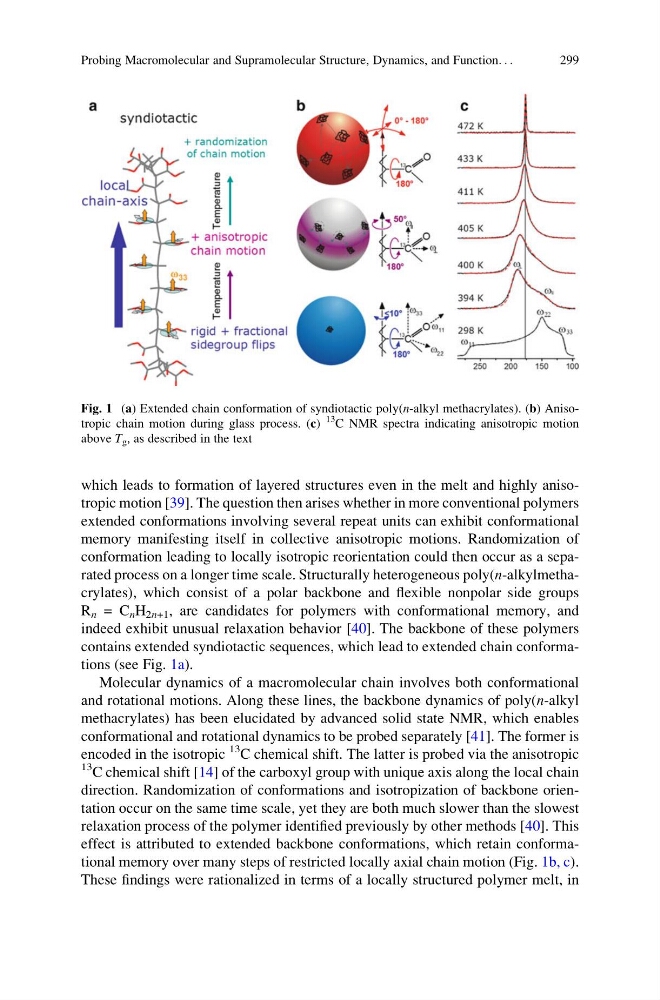
contains extended syndiotactic sequences, which lead to extended chain conformations (see Fig. 1a).
Molecular dynamics of a macromolecular chain involves both conformational
and rotational motions. Along these lines, the backbone dynamics of poly(n-alkyl
methacrylates) has been elucidated by advanced solid state NMR, which enables
conformational and rotational dynamics to be probed separately [41]. The former is
encoded in the isotropic
13 C chemical shift. The latter is probed via the anisotropic
13 C chemical shift [14] of the carboxyl group with unique axis along the local chain
direction. Randomization of conformations and isotropization of backbone orientation occur on the same time scale, yet they are both much slower than the slowest
relaxation process of the polymer identified previously by other methods [40]. This
effect is attributed to extended backbone conformations, which retain conformational memory over many steps of restricted locally axial chain motion (Fig. 1b, c).
These findings were rationalized in terms of a locally structured polymer melt, in
Fig. 1 (a) Extended chain conformation of syndiotactic poly(n-alkyl methacrylates). (b) Anisotropic chain motion during glass process. (c)
13
C NMR spectra indicating anisotropic motion
above T g , as described in the text
Probing Macromolecular and Supramolecular Structure, Dynamics, and Function. . .
299
extended conformations involving several repeat units can exhibit conformational
memory manifesting itself in collective anisotropic motions. Randomization of
conformation leading to locally isotropic reorientation could then occur as a separated process on a longer time scale. Structurally heterogeneous poly(n-alkylmethacrylates), which consist of a polar backbone and flexible nonpolar side groups
R n = C n H 2n+1 , are candidates for polymers with conformational memory, and
indeed exhibit unusual relaxation behavior [40]. The backbone of these polymers
contains extended syndiotactic sequences, which lead to extended chain conformations (see Fig. 1a).
Molecular dynamics of a macromolecular chain involves both conformational
and rotational motions. Along these lines, the backbone dynamics of poly(n-alkyl
methacrylates) has been elucidated by advanced solid state NMR, which enables
conformational and rotational dynamics to be probed separately [41]. The former is
encoded in the isotropic
13 C chemical shift. The latter is probed via the anisotropic
13 C chemical shift [14] of the carboxyl group with unique axis along the local chain
direction. Randomization of conformations and isotropization of backbone orientation occur on the same time scale, yet they are both much slower than the slowest
relaxation process of the polymer identified previously by other methods [40]. This
effect is attributed to extended backbone conformations, which retain conformational memory over many steps of restricted locally axial chain motion (Fig. 1b, c).
These findings were rationalized in terms of a locally structured polymer melt, in
Fig. 1 (a) Extended chain conformation of syndiotactic poly(n-alkyl methacrylates). (b) Anisotropic chain motion during glass process. (c)
13
C NMR spectra indicating anisotropic motion
above T g , as described in the text
Probing Macromolecular and Supramolecular Structure, Dynamics, and Function. . .
299