

indispensible for the sake of progress on both sides of the enterprise. Our group has
collaborated extensively with the Goddard group on the theory behind π-associated
D–A systems. Goddard’s group concluded [118] that, among the popular B3LYP,
PDB, X3LYP, and M06 density functional theory (DFT) functionals, only the M06
class of DFT methods predicts the stability of complexes like DNP & CBPQT
4+ .
The alternative functionals incorrectly identify a net repulsive interaction between
host and guest, which is attributed to their poor descriptions of the attractive
medium-range interactions (e.g., London dispersion forces, π–π stacking) that
play an integral role in the stabilization of these D–A complexes. These results
raise the important point that computational predictions are extremely sensitive to
the level of theory that is chosen to explore these π-associated D–A systems
because of the importance of their weaker medium-range interactions. Thus, theory
and experiment must be extensively cross-checked in a rigorous feedback loop until
a robust theoretical framework for these compounds is developed.
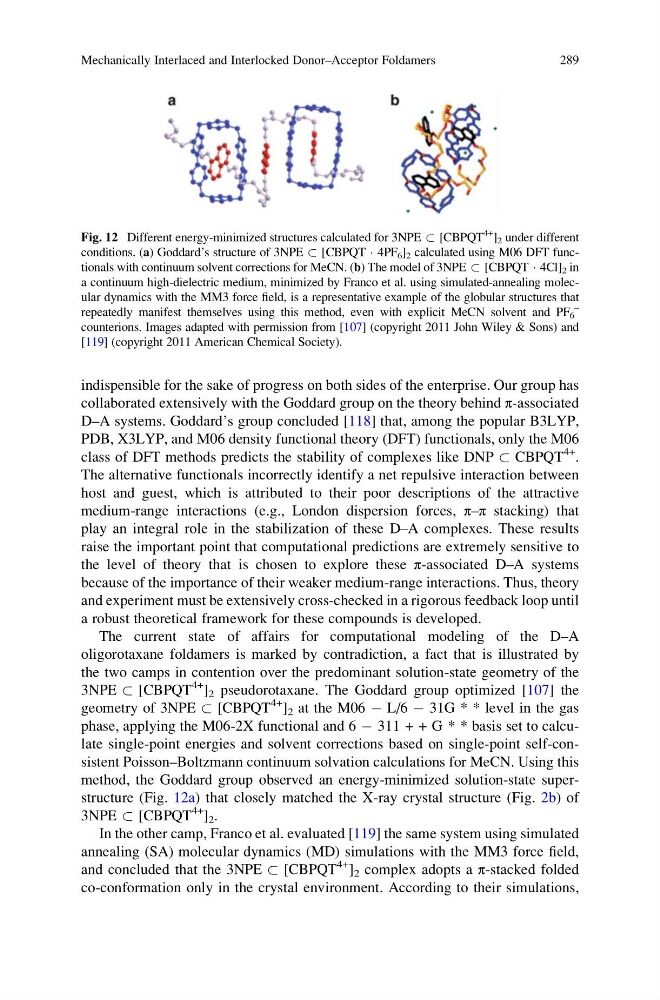
The current state of affairs for computational modeling of the D–A
oligorotaxane foldamers is marked by contradiction, a fact that is illustrated by
the two camps in contention over the predominant solution-state geometry of the
3NPE & [CBPQT
4+ ] 2 pseudorotaxane. The Goddard group optimized [107] the
geometry of 3NPE & [CBPQT
4+ ] 2 at the M06 À L/6 À 31G * * level in the gas
phase, applying the M06-2X functional and 6 À 311 + + G * * basis set to calculate single-point energies and solvent corrections based on single-point self-consistent Poisson–Boltzmann continuum solvation calculations for MeCN. Using this
method, the Goddard group observed an energy-minimized solution-state superstructure (Fig. 12a) that closely matched the X-ray crystal structure (Fig. 2b) of
3NPE & [CBPQT
4+ ] 2 .
In the other camp, Franco et al. evaluated [119] the same system using simulated
annealing (SA) molecular dynamics (MD) simulations with the MM3 force field,
and concluded that the 3NPE & [CBPQT
4+ ] 2 complex adopts a π-stacked folded
co-conformation only in the crystal environment. According to their simulations,
Fig. 12 Different energy-minimized structures calculated for 3NPE & [CBPQT
4+
] 2 under different
conditions. (a) Goddard’s structure of 3NPE & [CBPQT Á 4PF 6 ] 2 calculated using M06 DFT functionals with continuum solvent corrections for MeCN. (b) The model of 3NPE & [CBPQT · 4Cl] 2 in
a continuum high-dielectric medium, minimized by Franco et al. using simulated-annealing molecular dynamics with the MM3 force field, is a representative example of the globular structures that
repeatedly manifest themselves using this method, even with explicit MeCN solvent and PF 6
–
counterions. Images adapted with permission from [107] (copyright 2011 John Wiley & Sons) and
[119] (copyright 2011 American Chemical Society).
Mechanically Interlaced and Interlocked Donor–Acceptor Foldamers
289
collaborated extensively with the Goddard group on the theory behind π-associated
D–A systems. Goddard’s group concluded [118] that, among the popular B3LYP,
PDB, X3LYP, and M06 density functional theory (DFT) functionals, only the M06
class of DFT methods predicts the stability of complexes like DNP & CBPQT
4+ .
The alternative functionals incorrectly identify a net repulsive interaction between
host and guest, which is attributed to their poor descriptions of the attractive
medium-range interactions (e.g., London dispersion forces, π–π stacking) that
play an integral role in the stabilization of these D–A complexes. These results
raise the important point that computational predictions are extremely sensitive to
the level of theory that is chosen to explore these π-associated D–A systems
because of the importance of their weaker medium-range interactions. Thus, theory
and experiment must be extensively cross-checked in a rigorous feedback loop until
a robust theoretical framework for these compounds is developed.
The current state of affairs for computational modeling of the D–A
oligorotaxane foldamers is marked by contradiction, a fact that is illustrated by
the two camps in contention over the predominant solution-state geometry of the
3NPE & [CBPQT
4+ ] 2 pseudorotaxane. The Goddard group optimized [107] the
geometry of 3NPE & [CBPQT
4+ ] 2 at the M06 À L/6 À 31G * * level in the gas
phase, applying the M06-2X functional and 6 À 311 + + G * * basis set to calculate single-point energies and solvent corrections based on single-point self-consistent Poisson–Boltzmann continuum solvation calculations for MeCN. Using this
method, the Goddard group observed an energy-minimized solution-state superstructure (Fig. 12a) that closely matched the X-ray crystal structure (Fig. 2b) of
3NPE & [CBPQT
4+ ] 2 .
In the other camp, Franco et al. evaluated [119] the same system using simulated
annealing (SA) molecular dynamics (MD) simulations with the MM3 force field,
and concluded that the 3NPE & [CBPQT
4+ ] 2 complex adopts a π-stacked folded
co-conformation only in the crystal environment. According to their simulations,
Fig. 12 Different energy-minimized structures calculated for 3NPE & [CBPQT
4+
] 2 under different
conditions. (a) Goddard’s structure of 3NPE & [CBPQT Á 4PF 6 ] 2 calculated using M06 DFT functionals with continuum solvent corrections for MeCN. (b) The model of 3NPE & [CBPQT · 4Cl] 2 in
a continuum high-dielectric medium, minimized by Franco et al. using simulated-annealing molecular dynamics with the MM3 force field, is a representative example of the globular structures that
repeatedly manifest themselves using this method, even with explicit MeCN solvent and PF 6
–
counterions. Images adapted with permission from [107] (copyright 2011 John Wiley & Sons) and
[119] (copyright 2011 American Chemical Society).
Mechanically Interlaced and Interlocked Donor–Acceptor Foldamers
289