

crystallizes primarily as a four-component complex (three rings, one thread) with
alongside vacancies, 5NP & [CBPQT
4+ ] n can preserve a continuous D–A stack
with no DNP vacancies by crystallizing as an equal mixture of three-component
(5:2 DNP : CBPQT
4+ ratio) and four-component (5:3 DNP : CBPQT
4+ ratio) complexes (Fig. 4c). In this latter case, the tetraethylene glycol chains sum to a 1/5
vacancy in the lattice.
Crystals grown from 7-, 9-, and 11-mers of the DNP threads have identical unit
cell dimensions to the pentamers, suggesting that all of the oligomers with five or
more DNP units adopt the same superstructure. Because the DNP trimers described
in Sect. 2.1 do not co-assemble with CBPQT
4+ into an infinite D–A stack, it would
seem that the critical chain length to obtain a polymeric lattice lies between three
and five DNP units.
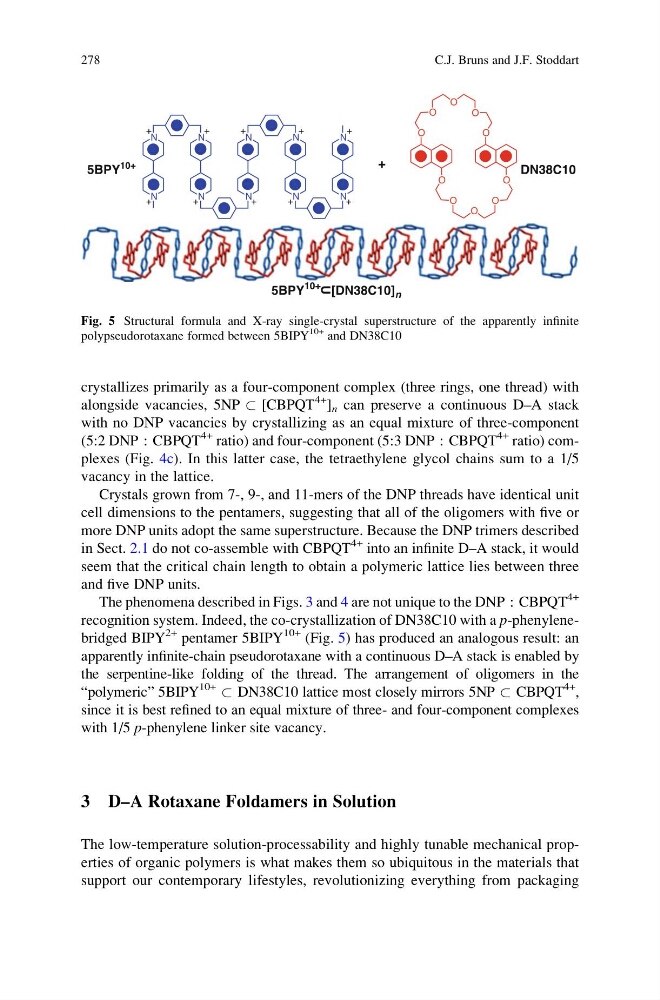
The phenomena described in Figs. 3 and 4 are not unique to the DNP : CBPQT
4+
recognition system. Indeed, the co-crystallization of DN38C10 with a p-phenylenebridged BIPY
2+ pentamer 5BIPY
10+ (Fig. 5) has produced an analogous result: an
apparently infinite-chain pseudorotaxane with a continuous D–A stack is enabled by
the serpentine-like folding of the thread. The arrangement of oligomers in the
“polymeric” 5BIPY
10+
& DN38C10 lattice most closely mirrors 5NP & CBPQT
4+
,
since it is best refined to an equal mixture of three- and four-component complexes
with 1/5 p-phenylene linker site vacancy.
3 D–A Rotaxane Foldamers in Solution
The low-temperature solution-processability and highly tunable mechanical properties of organic polymers is what makes them so ubiquitous in the materials that
support our contemporary lifestyles, revolutionizing everything from packaging
Fig. 5 Structural formula and X-ray single-crystal superstructure of the apparently infinite
polypseudorotaxane formed between 5BIPY
10+ and DN38C10
278
C.J. Bruns and J.F. Stoddart
alongside vacancies, 5NP & [CBPQT
4+ ] n can preserve a continuous D–A stack
with no DNP vacancies by crystallizing as an equal mixture of three-component
(5:2 DNP : CBPQT
4+ ratio) and four-component (5:3 DNP : CBPQT
4+ ratio) complexes (Fig. 4c). In this latter case, the tetraethylene glycol chains sum to a 1/5
vacancy in the lattice.
Crystals grown from 7-, 9-, and 11-mers of the DNP threads have identical unit
cell dimensions to the pentamers, suggesting that all of the oligomers with five or
more DNP units adopt the same superstructure. Because the DNP trimers described
in Sect. 2.1 do not co-assemble with CBPQT
4+ into an infinite D–A stack, it would
seem that the critical chain length to obtain a polymeric lattice lies between three
and five DNP units.
The phenomena described in Figs. 3 and 4 are not unique to the DNP : CBPQT
4+
recognition system. Indeed, the co-crystallization of DN38C10 with a p-phenylenebridged BIPY
2+ pentamer 5BIPY
10+ (Fig. 5) has produced an analogous result: an
apparently infinite-chain pseudorotaxane with a continuous D–A stack is enabled by
the serpentine-like folding of the thread. The arrangement of oligomers in the
“polymeric” 5BIPY
10+
& DN38C10 lattice most closely mirrors 5NP & CBPQT
4+
,
since it is best refined to an equal mixture of three- and four-component complexes
with 1/5 p-phenylene linker site vacancy.
3 D–A Rotaxane Foldamers in Solution
The low-temperature solution-processability and highly tunable mechanical properties of organic polymers is what makes them so ubiquitous in the materials that
support our contemporary lifestyles, revolutionizing everything from packaging
Fig. 5 Structural formula and X-ray single-crystal superstructure of the apparently infinite
polypseudorotaxane formed between 5BIPY
10+ and DN38C10
278
C.J. Bruns and J.F. Stoddart