

The unique chemistry of transition metals has more recently provided inroads
to developing multicomponent assembly that exploits various means to favor
heteroligated coordination environments, thereby allowing the use of multiple
ligands in a given self-assembly mixture without resulting in a statistical mixture
of products. As these methods are developed, they unlock new strategies for
supramolecular transformations, whereby discrete SCCs are themselves subjected
to structural modifications. Likewise, multicomponent assemblies have provided
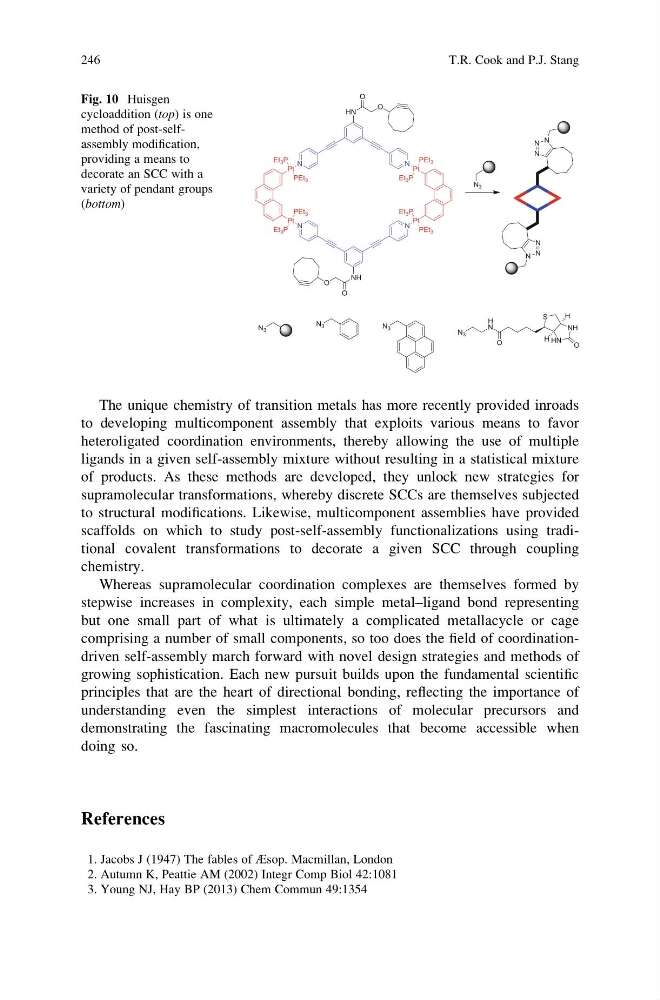
scaffolds on which to study post-self-assembly functionalizations using traditional covalent transformations to decorate a given SCC through coupling
chemistry.
Whereas supramolecular coordination complexes are themselves formed by
stepwise increases in complexity, each simple metal–ligand bond representing
but one small part of what is ultimately a complicated metallacycle or cage
comprising a number of small components, so too does the field of coordinationdriven self-assembly march forward with novel design strategies and methods of
growing sophistication. Each new pursuit builds upon the fundamental scientific
principles that are the heart of directional bonding, reflecting the importance of
understanding even the simplest interactions of molecular precursors and
demonstrating the fascinating macromolecules that become accessible when
doing so.
References
1. Jacobs J (1947) The fables of Æsop. Macmillan, London
2. Autumn K, Peattie AM (2002) Integr Comp Biol 42:1081
3. Young NJ, Hay BP (2013) Chem Commun 49:1354
Fig. 10 Huisgen
cycloaddition (top) is one
method of post-selfassembly modification,
providing a means to
decorate an SCC with a
variety of pendant groups
(bottom)
246
T.R. Cook and P.J. Stang
to developing multicomponent assembly that exploits various means to favor
heteroligated coordination environments, thereby allowing the use of multiple
ligands in a given self-assembly mixture without resulting in a statistical mixture
of products. As these methods are developed, they unlock new strategies for
supramolecular transformations, whereby discrete SCCs are themselves subjected
to structural modifications. Likewise, multicomponent assemblies have provided
scaffolds on which to study post-self-assembly functionalizations using traditional covalent transformations to decorate a given SCC through coupling
chemistry.
Whereas supramolecular coordination complexes are themselves formed by
stepwise increases in complexity, each simple metal–ligand bond representing
but one small part of what is ultimately a complicated metallacycle or cage
comprising a number of small components, so too does the field of coordinationdriven self-assembly march forward with novel design strategies and methods of
growing sophistication. Each new pursuit builds upon the fundamental scientific
principles that are the heart of directional bonding, reflecting the importance of
understanding even the simplest interactions of molecular precursors and
demonstrating the fascinating macromolecules that become accessible when
doing so.
References
1. Jacobs J (1947) The fables of Æsop. Macmillan, London
2. Autumn K, Peattie AM (2002) Integr Comp Biol 42:1081
3. Young NJ, Hay BP (2013) Chem Commun 49:1354
Fig. 10 Huisgen
cycloaddition (top) is one
method of post-selfassembly modification,
providing a means to
decorate an SCC with a
variety of pendant groups
(bottom)
246
T.R. Cook and P.J. Stang