

form an SCC [87]. Since ethynyl groups are found as linear spacers in the organic
backbones of many donor precursors, chemistry altering the angularity of this
inherently 180
moiety will completely change the structure of the SCC. This
was specifically demonstrated using Co 2 (CO) 6 and SCCs containing linear donors
with ethynyl groups. Upon treatment with the metal carbonyl, the triple bonds
participate in the formation of M 2 C 2 cores, which reorient the ligands to contain
120
rather than 180
angularities. Thus, a [6+6] hexagon no longer finds itself
containing six linear ligands, but rather six 120
donors, effecting a transformation
to [3+3] hexagons. Likewise, in a square/triangle equilibria comprising linear
donors and 90
acceptors, the linear donors will become bent, thus favoring
rhomboidal SCCs [87].
The addition of exogenous species need not enforce a change in directionality.
The driving force for heteroligation can also be used to bring out post-self-assembly
structural modifications. For instance, beginning with a homoligated [6+4]
truncated tetrahedron containing a tritopic pyridyl donor and 90
acceptor,
equivalents of carboxylate donors can be added, which will become incorporated
into the initial SCC [52]. If a tritopic carboxylate donor is used, a single pyridyl
panel of the truncated tetrahedron will be substituted in order to give more favorable Pt-N,O coordination. Likewise, ditopic carboxylate donors can instead be
used, which spring open the truncated tetrahedron, ejecting a single pyridyl panel
to afford partial prisms. Given enough equivalents of linear carboxylate donor, such
assemblies can be transformed entirely to host/guest-capable trigonal prisms. One
possibility that such transformations realize is the incorporation of functionalized
precursors, thereby decorating an initially unfunctionalized SCC with a chemically
active moiety. This was demonstrated using a ferrocene-functionalized carboxylate
donor, which ultimately produced a new SCC with two redox-active groups
attached [52].
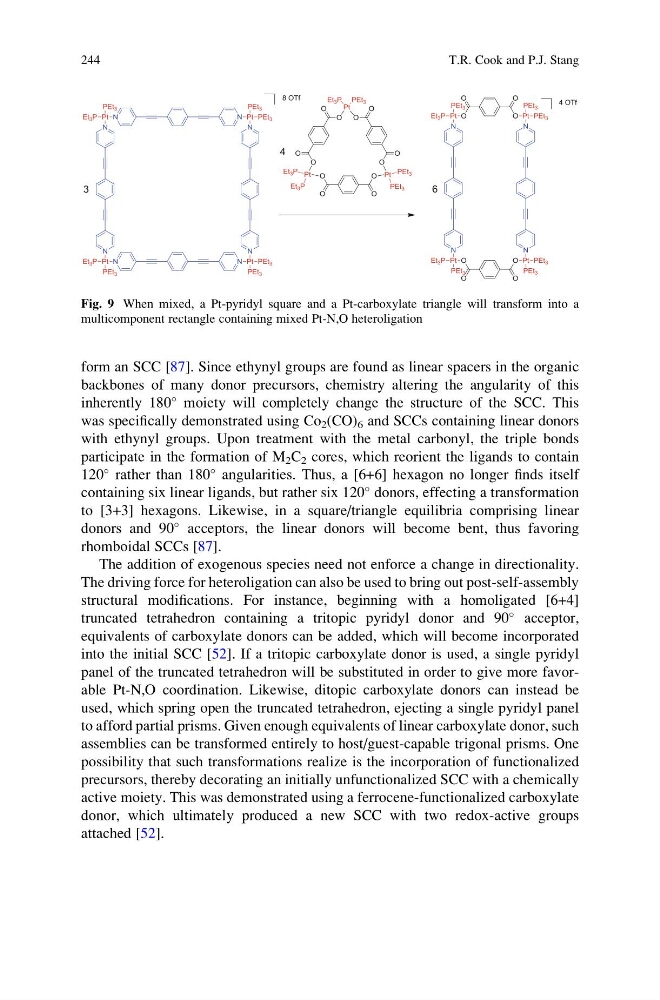
Fig. 9 When mixed, a Pt-pyridyl square and a Pt-carboxylate triangle will transform into a
multicomponent rectangle containing mixed Pt-N,O heteroligation
244
T.R. Cook and P.J. Stang
backbones of many donor precursors, chemistry altering the angularity of this
inherently 180
moiety will completely change the structure of the SCC. This
was specifically demonstrated using Co 2 (CO) 6 and SCCs containing linear donors
with ethynyl groups. Upon treatment with the metal carbonyl, the triple bonds
participate in the formation of M 2 C 2 cores, which reorient the ligands to contain
120
rather than 180
angularities. Thus, a [6+6] hexagon no longer finds itself
containing six linear ligands, but rather six 120
donors, effecting a transformation
to [3+3] hexagons. Likewise, in a square/triangle equilibria comprising linear
donors and 90
acceptors, the linear donors will become bent, thus favoring
rhomboidal SCCs [87].
The addition of exogenous species need not enforce a change in directionality.
The driving force for heteroligation can also be used to bring out post-self-assembly
structural modifications. For instance, beginning with a homoligated [6+4]
truncated tetrahedron containing a tritopic pyridyl donor and 90
acceptor,
equivalents of carboxylate donors can be added, which will become incorporated
into the initial SCC [52]. If a tritopic carboxylate donor is used, a single pyridyl
panel of the truncated tetrahedron will be substituted in order to give more favorable Pt-N,O coordination. Likewise, ditopic carboxylate donors can instead be
used, which spring open the truncated tetrahedron, ejecting a single pyridyl panel
to afford partial prisms. Given enough equivalents of linear carboxylate donor, such
assemblies can be transformed entirely to host/guest-capable trigonal prisms. One
possibility that such transformations realize is the incorporation of functionalized
precursors, thereby decorating an initially unfunctionalized SCC with a chemically
active moiety. This was demonstrated using a ferrocene-functionalized carboxylate
donor, which ultimately produced a new SCC with two redox-active groups
attached [52].
Fig. 9 When mixed, a Pt-pyridyl square and a Pt-carboxylate triangle will transform into a
multicomponent rectangle containing mixed Pt-N,O heteroligation
244
T.R. Cook and P.J. Stang