

90
acceptors that are themselves linked by a separate linear donor. This
approach has been demonstrated using both platinum [78] and palladium prisms
[82]. In such instances, the [n+2] self-assembly is modified to an [2n+n+2]
assembly. For each Lewis-basic site of the n-sided panel ligand, there will be
a metal acceptor. Since there are two such n-sided polygons per prism, found at
each end, 2n metal acceptors are required. For each pair of metal acceptors, a
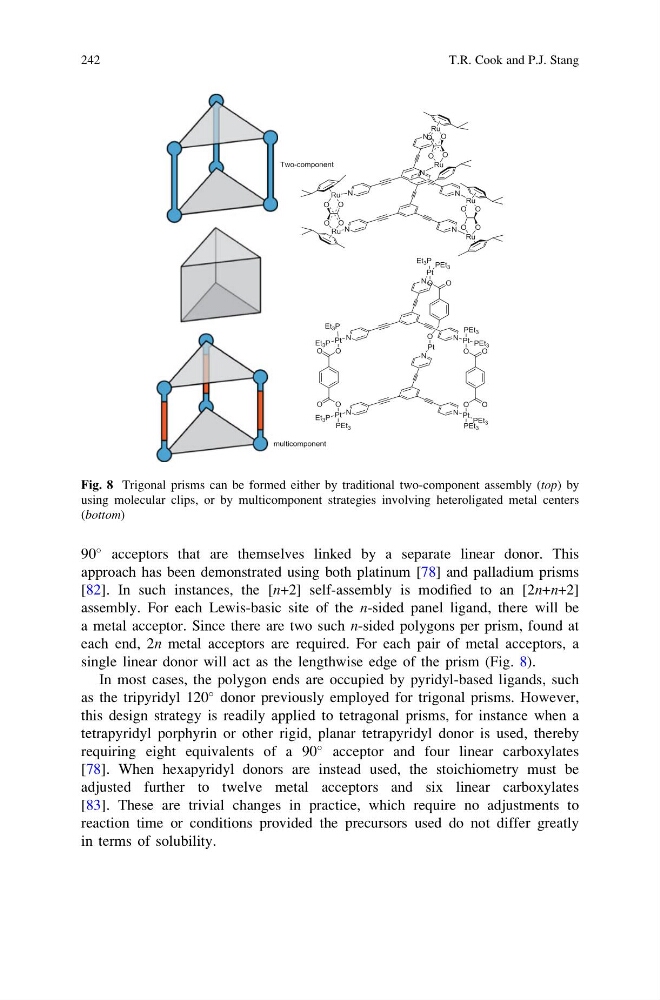
single linear donor will act as the lengthwise edge of the prism (Fig. 8).
In most cases, the polygon ends are occupied by pyridyl-based ligands, such
as the tripyridyl 120
donor previously employed for trigonal prisms. However,
this design strategy is readily applied to tetragonal prisms, for instance when a
tetrapyridyl porphyrin or other rigid, planar tetrapyridyl donor is used, thereby
requiring eight equivalents of a 90
acceptor and four linear carboxylates
[78]. When hexapyridyl donors are instead used, the stoichiometry must be
adjusted further to twelve metal acceptors and six linear carboxylates
[83]. These are trivial changes in practice, which require no adjustments to
reaction time or conditions provided the precursors used do not differ greatly
in terms of solubility.
Fig. 8 Trigonal prisms can be formed either by traditional two-component assembly (top) by
using molecular clips, or by multicomponent strategies involving heteroligated metal centers
(bottom)
242
T.R. Cook and P.J. Stang
acceptors that are themselves linked by a separate linear donor. This
approach has been demonstrated using both platinum [78] and palladium prisms
[82]. In such instances, the [n+2] self-assembly is modified to an [2n+n+2]
assembly. For each Lewis-basic site of the n-sided panel ligand, there will be
a metal acceptor. Since there are two such n-sided polygons per prism, found at
each end, 2n metal acceptors are required. For each pair of metal acceptors, a
single linear donor will act as the lengthwise edge of the prism (Fig. 8).
In most cases, the polygon ends are occupied by pyridyl-based ligands, such
as the tripyridyl 120
donor previously employed for trigonal prisms. However,
this design strategy is readily applied to tetragonal prisms, for instance when a
tetrapyridyl porphyrin or other rigid, planar tetrapyridyl donor is used, thereby
requiring eight equivalents of a 90
acceptor and four linear carboxylates
[78]. When hexapyridyl donors are instead used, the stoichiometry must be
adjusted further to twelve metal acceptors and six linear carboxylates
[83]. These are trivial changes in practice, which require no adjustments to
reaction time or conditions provided the precursors used do not differ greatly
in terms of solubility.
Fig. 8 Trigonal prisms can be formed either by traditional two-component assembly (top) by
using molecular clips, or by multicomponent strategies involving heteroligated metal centers
(bottom)
242
T.R. Cook and P.J. Stang