

of those dimensions allows the formation of a smectic phase of predetermined layer
spacing. Thus, genetic information can be used to program not only the molecular
architecture, but also the supramolecular organization of the system.
2.3 Programming the Viscoelastic Behavior
of Macromolecular Solutions and Gels
We next turned our attention to the prospect of programming the dynamic behavior
of macromolecular systems [19]. Here, the initial target was a reversible hydrogel
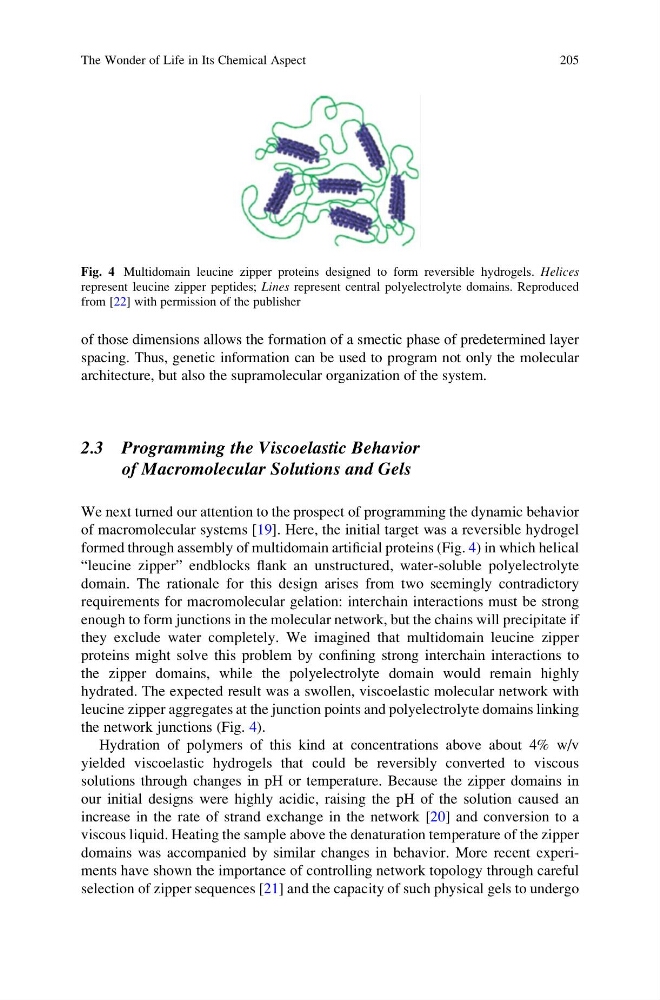
formed through assembly of multidomain artificial proteins (Fig. 4) in which helical
“leucine zipper” endblocks flank an unstructured, water-soluble polyelectrolyte
domain. The rationale for this design arises from two seemingly contradictory
requirements for macromolecular gelation: interchain interactions must be strong
enough to form junctions in the molecular network, but the chains will precipitate if
they exclude water completely. We imagined that multidomain leucine zipper
proteins might solve this problem by confining strong interchain interactions to
the zipper domains, while the polyelectrolyte domain would remain highly
hydrated. The expected result was a swollen, viscoelastic molecular network with
leucine zipper aggregates at the junction points and polyelectrolyte domains linking
the network junctions (Fig. 4).
Hydration of polymers of this kind at concentrations above about 4% w/v
yielded viscoelastic hydrogels that could be reversibly converted to viscous
solutions through changes in pH or temperature. Because the zipper domains in
our initial designs were highly acidic, raising the pH of the solution caused an
increase in the rate of strand exchange in the network [20] and conversion to a
viscous liquid. Heating the sample above the denaturation temperature of the zipper
domains was accompanied by similar changes in behavior. More recent experiments have shown the importance of controlling network topology through careful
selection of zipper sequences [21] and the capacity of such physical gels to undergo
Fig. 4 Multidomain leucine zipper proteins designed to form reversible hydrogels. Helices
represent leucine zipper peptides; Lines represent central polyelectrolyte domains. Reproduced
from [22] with permission of the publisher
The Wonder of Life in Its Chemical Aspect
205
spacing. Thus, genetic information can be used to program not only the molecular
architecture, but also the supramolecular organization of the system.
2.3 Programming the Viscoelastic Behavior
of Macromolecular Solutions and Gels
We next turned our attention to the prospect of programming the dynamic behavior
of macromolecular systems [19]. Here, the initial target was a reversible hydrogel
formed through assembly of multidomain artificial proteins (Fig. 4) in which helical
“leucine zipper” endblocks flank an unstructured, water-soluble polyelectrolyte
domain. The rationale for this design arises from two seemingly contradictory
requirements for macromolecular gelation: interchain interactions must be strong
enough to form junctions in the molecular network, but the chains will precipitate if
they exclude water completely. We imagined that multidomain leucine zipper
proteins might solve this problem by confining strong interchain interactions to
the zipper domains, while the polyelectrolyte domain would remain highly
hydrated. The expected result was a swollen, viscoelastic molecular network with
leucine zipper aggregates at the junction points and polyelectrolyte domains linking
the network junctions (Fig. 4).
Hydration of polymers of this kind at concentrations above about 4% w/v
yielded viscoelastic hydrogels that could be reversibly converted to viscous
solutions through changes in pH or temperature. Because the zipper domains in
our initial designs were highly acidic, raising the pH of the solution caused an
increase in the rate of strand exchange in the network [20] and conversion to a
viscous liquid. Heating the sample above the denaturation temperature of the zipper
domains was accompanied by similar changes in behavior. More recent experiments have shown the importance of controlling network topology through careful
selection of zipper sequences [21] and the capacity of such physical gels to undergo
Fig. 4 Multidomain leucine zipper proteins designed to form reversible hydrogels. Helices
represent leucine zipper peptides; Lines represent central polyelectrolyte domains. Reproduced
from [22] with permission of the publisher
The Wonder of Life in Its Chemical Aspect
205